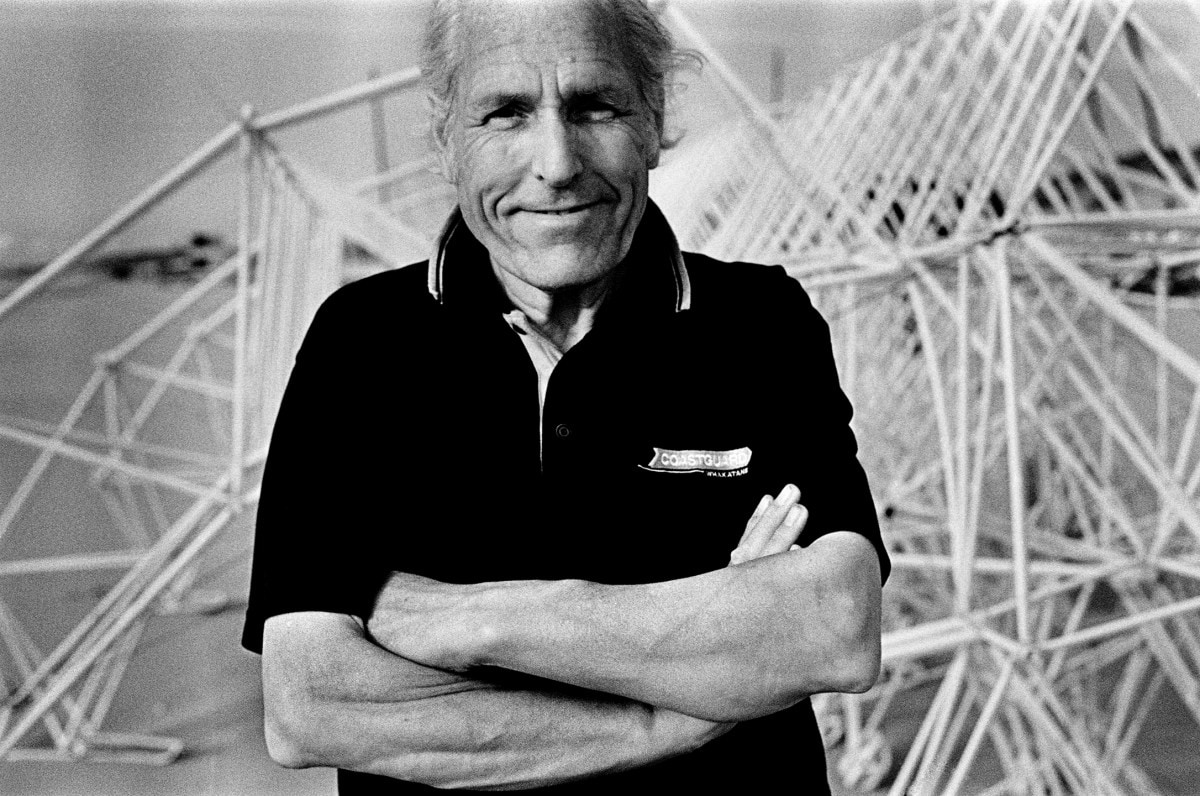
Theo Jansen
 Netherlands
Member of Mbungo Express
sculptor•kinetic artist•visual artist
Birthday
March 17, 1948
Birth Sign
Pisces
Birthplace
Scheveningen, Netherlands
Age
78 years old
About
Theo Jansen is a Dutch artist and kinetic sculptor best known for his Strandbeesten, massive wind-powered sculptures that walk along beaches. Born on March 17, 1948 in Scheveningen, he studied physics at Delft University of Technology before pivoting to art. In 1990, he began creating these intricate PVC creatures, which move autonomously using only the wind. Some even incorporate primitive logic gates to detect and avoid obstacles like the sea. Jansen views his work as a fusion of art and engineering, once saying, "The walls between art and engineering exist only in our minds." His creations have been exhibited worldwide, from museums in Tokyo to the beaches of the Netherlands. He has appeared in documentaries like 60 Minutes and Nova, and was the subject of the 2017 film Theo Jansen: The Beach Beast Maker. Over the decades, he has built dozens of Strandbeesten, each generation more complex. Now in his late 70s, Jansen continues to refine his beach beasts, aiming to create a species that can survive entirely on their own.
Early Life & Background
Theo Jansen grew up in Scheveningen, a coastal town in the Netherlands, where the North Sea winds would later inspire his life's work. He studied physics at the Delft University of Technology, but never completed a degree, he found the academic environment too restrictive. Instead, he pursued art, initially painting and building small kinetic experiments. In the 1980s, he created a flying saucer-like object that caused a local panic, leading to a brief stint as a media curiosity. The pivotal moment came in 1990, when he began working on the first Strandbeest, using cheap PVC electrical tubing. His early prototypes were simple, but they walked, a sight that captivated him and set him on a path he has followed ever since.
Career Growth
Jansen's breakthrough came in 1990 with the first Strandbeest, Animaris Currens Vulgaris. Over the next decade, he built dozens of generations, each adding new capabilities. By the 2000s, his beach beasts could detect water and reverse direction. He exhibited them on Dutch beaches and later in museums worldwide, including the Museum of Modern Art in New York and the Centre Pompidou in Paris. In 2017, the documentary Theo Jansen: The Beach Beast Maker premiered, bringing his work to a global audience. He has also appeared on 60 Minutes and Nova, and his TED Talk has millions of views. As of 2026, Jansen continues to evolve the Strandbeesten, now incorporating artificial intelligence concepts to make them more autonomous. He also lectures internationally, sharing his philosophy of creating artificial life.
Career Timeline
Public Image & Style
Jansen is widely celebrated as a pioneer of kinetic art, often called a "modern-day Leonardo da Vinci" by media. His public persona is that of a gentle, eccentric inventor, think white hair, glasses, and a perpetual look of curiosity. He speaks in a soft, deliberate manner, often using metaphors about evolution and artificial life. His fans, many of whom are engineers and artists, follow his work online and attend his beach demonstrations. There's no official fandom name, but enthusiasts call themselves "Beast Watchers." Jansen's social media presence is minimal but authentic: he posts updates on new creations and behind-the-scenes glimpses of his process. Audiences connect with his blend of childlike wonder and serious engineering, seeing him as proof that art and science can coexist beautifully.
Fame & Fandom (iFAMOUS Rankings)
Theo Jansen stands as a singular figure where art and engineering dissolve into one another, creating a legacy that transcends the gallery wall. In August 2026, his global cultural footprint is quantified by the iFANN Global Fame Rankings, which place him the 64th most famous person from Netherlands. This recognition tracks how his work resonates across media coverage, search trends, and consumption signals worldwide, cementing his status not just as an inventor but as a modern mythmaker. His creations have turned beaches into stages, drawing crowds of engineers, artists, and curious onlookers who gather to witness the wind-powered beasts in motion. Yet, despite this global attention, there is no official fandom name for his audience. Fans do not rally under a specific banner or chant slogans; instead, they are a dispersed community of enthusiasts who follow his progress through professional channels like his official website and social media updates. They attend demonstrations to see the evolution of mechanisms firsthand, engaging with the work rather than the personality. The lack of a formal collective noun underscores the unique nature of his appeal: it is a fascination with the mechanics of life itself rather than traditional celebrity worship. While some obscure databases might list him in unrelated musical contexts, the overwhelming cultural narrative remains focused on his kinetic sculptures. These stories of artificial life surviving on the shore form the core of his legend, retold by those who witnessed the skeletal animals walking against the tide.
Interesting Facts and Legends
Before achieving global acclaim, Jansen left Delft University without graduating to dedicate himself fully to art. His first Strandbeest was a humble construction built from cheap PVC tubing costing around $10. He has consistently stated a desire for his creatures to eventually live autonomously on the beach without human intervention. A flying saucer stunt he performed in the 1980s once made local headlines, hinting at his early penchant for spectacle. Today, he works out of a dedicated workshop in Ypenburg where he builds and tests new generations of these complex machines. The Strandbeesten carry distinct names such as Animaris Ordis and Animaris Rhinoceros.
The enduring legend surrounding Jansen centers on the inception of the Strandbeests, where he began crafting large mechanisms capable of moving solely via wind power. This vision of creating artificial life forms that could survive on beaches became a staple in discussions of bio-mimicry. Another recurring theme in his mythology is the visual spectacle of dozens of these multi-legged creatures walking in unison, a phenomenon observed at various locations including Delft. While some data points suggest a minor affiliation with a group called Mbungo Express, no legendary musical moments or viral concert footage exist to support a musical persona; the true iconography remains the skeletal beasts striding along the sand.
Notable Quotes
“The walls between art and engineering exist only in our minds.”
“I want to create a new species that will live on the beaches.”
Family & Personal Life
Jansen was born to a Catholic family in Scheveningen. His father was a draftsman, and his mother was a homemaker. He has a younger sister, but she prefers to stay out of the public eye. Jansen never married and has no children. He lives alone in Ypenburg, Netherlands, in a house filled with tools and half-finished sculptures. He has no pets, but his workshop is often visited by stray cats from the neighborhood.
Notable Connections
Jansen has collaborated with engineers and scientists, but his work is largely solitary. He has been featured in documentaries by NOVA and 60 Minutes. His Strandbeesten have been purchased by collectors like the Museum of Modern Art.
Relationships & Dating History
Jansen has never been publicly linked to any romantic partner. He has stated in interviews that his work is his life's companion. As of 2026, he is reportedly single and has no known dating history.
Salary, Net Worth In 2026
$5 Million
iFANN Editorial Team estimate
Per iFANN's editorial analysis, Theo Jansen's net worth is estimated at $5 Million as of 2026. His income streams are diverse yet deeply rooted in his artistic practice, primarily generated by selling his Strandbeesten sculptures to private collectors and museums, where each piece can fetch tens of thousands of dollars. Additional revenue flows from public exhibitions, lecture fees, and royalties associated with the film Theo Jansen: The Beach Beast Maker. Jansen lives modestly in Ypenburg, consistently reinvesting much of his earnings back into materials for new creations. He avoids major brand endorsements or external business ventures, keeping his art as his sole focus. Over the years, his net worth has grown steadily as his reputation has expanded globally.
Awards Won (2)
Jansen has not won major competitive awards, though his work has been recognized with several honors. He received the Golden Nica at Ars Electronica in 1996 for his Strandbeesten, and was awarded the Witteveen+Bos Art+Technology Prize in 2016. These accolades celebrate his unique fusion of art and engineering.
1996 · Interactive Art
Strandbeesten
2016 · Art and Technology
Strandbeesten
Known For
Strandbeesten (Beach Beasts)
1990 · Creator
Keywords
Quick Facts
- Profession
- sculptor, kinetic artist, visual artist
- Born
- +1948-03-17
- Birthplace
- Scheveningen
- Gender
- Male
- Birth Sign
- Pisces
Personal Details
- Full Name
- Theodorus Gerardus Jozef Jansen
- Education
- Delft University of Technology (physics)
Filmography
1
Total
1
Film
0
TV
Frequently Asked Questions
How old is Theo Jansen?
What is Theo Jansen's net worth in 2026?
Is Theo Jansen still making Strandbeesten?
Where can I see Theo Jansen's Strandbeesten?
What inspired Theo Jansen to create Strandbeesten?
Join the community
fans discussing