“John Wayne gives a surprisingly restrained and effective performance as the crippled aviator, but the film itself never quite takes flight, bogged down in episodic storytelling.”
Bosley Crowther
The New York Times
 United States
"From cockpit to script: one man's wild ride."
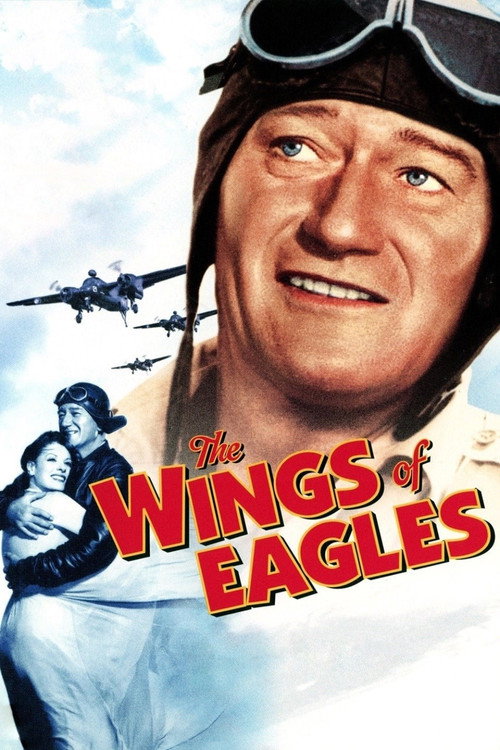
John Ford's The Wings of Eagles (1957) tells the true story of Frank W. "Spig" Wead, a U.S. Navy aviator who reinvented himself as a Hollywood screenwriter after a paralyzing accident. John Wayne plays Wead with a gruff determination that fits the real man's restless energy. The supporting cast includes Maureen O'Hara as Wead's long-suffering wife Min, Dan Dailey as his loyal friend Jughead Carson, and Ward Bond as Navy chief John Dodge. Shot in color by cinematographer Paul Vogel, the film moves from the early days of naval aviation through World War II.
Produced by MGM on a moderate budget of around $2.5 million, the film blends domestic drama with war sequences but avoids the bombast of Ford's cavalry epics. Critics at the time found it uneven, and its 6.3 rating on IMDb reflects a mixed reception. Still, it offers a rare look at how one man navigated two demanding careers: flight and film. The film's title draws from Isaiah 40:31, a biblical reference to renewing strength and soaring on wings like eagles.
Ford initially hesitated to direct, feeling it echoed his earlier They Were Expendable (1945), but agreed after MGM promised creative freedom. Authentic naval aviation footage, including scenes shot at Naval Air Station Pensacola where Wead trained, adds historical texture. The score by Jeff Alexander blends orchestral themes with military brass, though it remains understated compared to other Ford works.
Availability and pricing can change. Confirm on the provider's site before purchasing.
Frank W. "Spig" Wead is a restless Navy pilot in the 1920s, pushing the boundaries of early naval aviation. He marries Min, a devoted wife who struggles with his frequent absences and obsessive commitment to flying. Wead's daring earns him respect but strains his marriage, as he pursues records and clashes with superiors.
The central crisis comes when Wead falls down a staircase at home, breaking his neck and leaving him paralyzed from the neck down. The accident occurs just as he nears his greatest ambitions. The film follows his agonizing rehabilitation, his battle with depression, and his determination to rebuild his life despite being confined to a wheelchair. His wife Min and close friend Jughead Carson support him through this dark period.
As Wead struggles to find purpose, he discovers a talent for writing. He begins crafting stories and screenplays about naval aviation, eventually becoming a successful Hollywood screenwriter. The film shows his transition from pilot to writer, his work on films like They Were Expendable and The Fleet That Came to Stay, and his efforts to contribute to the war effort during World War II. Wead's friendship with Navy chief John Dodge and his interactions with other naval officers provide a backdrop of camaraderie and shared sacrifice.
The story builds toward his return to active duty during World War II, where he uses his influence and expertise to support the Navy's aviation programs, all while grappling with his physical limitations and the toll his choices have taken on his family.
1951 - The Wings Of Eagles - L'Aigle Vole au Soleil
Critical Consensus
An uneven but sincere biopic that benefits from John Wayne's committed performance and John Ford's directorial touch, though it struggles with pacing and tonal shifts between domestic drama and war spectacle, ultimately feeling like a minor entry in both men's filmographies.
“John Wayne gives a surprisingly restrained and effective performance as the crippled aviator, but the film itself never quite takes flight, bogged down in episodic storytelling.”
Bosley Crowther
The New York Times
“Ford's direction is assured, but the script fails to fully capture the dramatic potential of Wead's remarkable life, leaving the film feeling more like a series of vignettes than a cohesive narrative.”
Variety Staff
Variety
“The picture has its moments of genuine emotion and excitement, particularly in the aviation sequences, but it lacks the dramatic weight of Ford's best work.”
Edwin Schallert
Los Angeles Times
“A moderately entertaining biographical drama that will appeal to John Wayne fans, though it fails to achieve the emotional impact of the real-life story it portrays.”
Harrison's Reports
Harrison's Reports
John Wayne
Frank W. 'Spig' Wead
Dan Dailey
'Jughead' Carson
Maureen O'Hara
Min Wead
Ward Bond
John Dodge
Ken Curtis
John Dale Price
Edmund Lowe
Adm. Moffett
Kenneth Tobey
Capt. Herbert Allen Hazard
James Todd
Jack Travis
Barry Kelley
Capt. Jock Clark
Sig Ruman
Manager
Henry O'Neill
Capt. Spear
Willis Bouchey
Barton
Director
John Ford
Writers
Frank Wead, Frank Fenton, William Wister Haines
Composer
Jeff Alexander
Cinematographer
Paul Vogel
Producer
Charles Schnee
Writers Guild of America Award (1957)
Best Written American Drama: Nominated
Join the community
fans discussing