“Sorkin has written a script that is both a tribute to the spirit of the times and a warning about the dangers of ignoring the past.”
Manohla Dargis
The New York Times
 United States
"In 1968, democracy refused to back down."
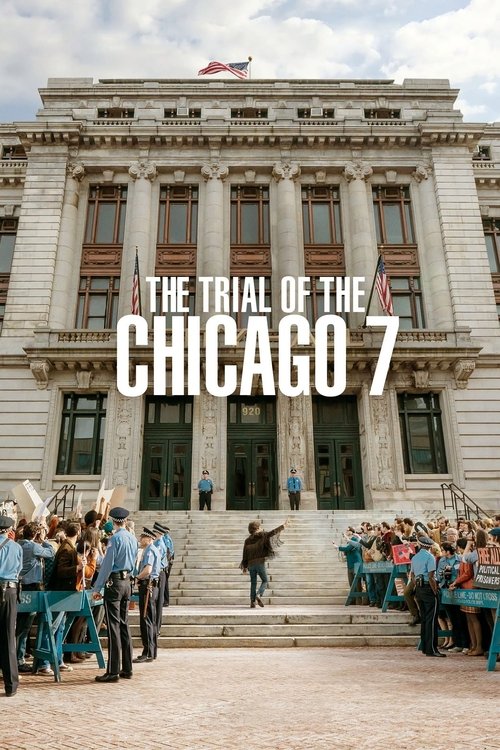
The chaotic atmosphere of the 1968 Democratic National Convention in Chicago serves as the backdrop for a legal battle that would define an era. Anti-war protesters gather to demonstrate against the Vietnam War, only to face a violent crackdown by local police under Mayor Richard Daley. The incident draws seven men into federal court where they face charges of conspiracy to incite a riot. Aaron Sorkin directs this adaptation, focusing on the clash between the defendants and a judicial system perceived as hostile to dissent.
William Kunstler leads the defense team alongside Leonard Weinglass, challenging the government's narrative while navigating the personal dynamics within the group. Abbie Hoffman brings theatrical flair to the proceedings, often mocking the judge, while Tom Hayden attempts to maintain a more serious intellectual tone. The courtroom becomes a stage for ideological warfare as the trial exposes deep racial and generational divides in American society.
Stream
Availability and pricing can change. Confirm on the provider's site before purchasing.
The story begins in August 1968 when thousands of anti-war activists descend upon Chicago for the Democratic National Convention. Tom Hayden, Rennie Davis, Jerry Rubin, Abbie Hoffman, David Dellinger, Lee Weiner, and John Froines organize a peaceful march through Grant Park. Bobby Seale arrives representing the Black Panther Party to support their cause. Local police respond with overwhelming force, using batons and tear gas to disperse the crowd. The violence spreads to the convention hall itself, drawing national media attention and setting the stage for federal intervention.
Federal prosecutors charge the eight men with crossing state lines to conspire to incite a riot. The trial opens in Chicago before Judge Julius Hoffman, a conservative figure known for his intolerance of counterculture movements. William Kunstler and Leonard Weinglass form the defense team, arguing that the defendants were exercising their First Amendment rights. The prosecution, represented by Richard Schultz, portrays the group as dangerous radicals threatening national security. The courtroom quickly becomes a battleground where legal arguments intertwine with political posturing.
Tensions rise as the trial progresses. Abbie Hoffman frequently disrupts proceedings by wearing robes and making theatrical gestures to mock the judge. Jerry Rubin uses humor and satire to undermine the prosecution, while Tom Hayden tries to steer the conversation toward substantive policy issues. Judge Hoffman holds multiple defendants in contempt of court for interrupting or refusing to follow protocol. The racial dynamic intensifies when Bobby Seale demands the right to represent himself and insists on a separate trial due to prejudice.
The prosecution relentlessly pushes for convictions, presenting testimony that paints the defendants as instigators of violence. Flashbacks reveal the personal motivations of each man and the political climate that led to their arrest. The film meticulously reconstructs the procedural absurdities of the trial, showing how the court system appears rigged against those who challenge the status quo. As the weeks drag on, the line between the courtroom drama and historical reality blurs, leaving viewers questioning the true nature of justice.
Internal conflicts emerge among the defendants regarding strategy and ideology. Some advocate for radical confrontation while others prefer a more measured approach. The defense struggles to present a unified front while dealing with the constant interruptions from the bench. The atmosphere grows increasingly hostile as Judge Hoffman exercises his authority to control the proceedings, often silencing the defendants when they attempt to speak. The narrative builds tension through the escalating confrontations without revealing the final outcome, focusing instead on the resilience of the accused.
The trial reaches a critical point when the judge orders the removal of Bobby Seale from the proceedings after he repeatedly attempts to defend himself. This decision isolates him from the other defendants and changes the composition of the case from eight to seven. The remaining men continue to face the full weight of the prosecution's case as the jury deliberates. The film maintains its focus on the process and the characters' reactions to the injustice they face rather than rushing toward a conclusion.
Throughout the proceedings, the film highlights the broader social context of 1968 America. The Vietnam War dominates the news cycle while civil rights movements struggle for recognition. The defendants use the courtroom as a platform to broadcast their message to a wider audience. The prosecution works to contain the spread of their ideas, viewing them as a threat to established order. The narrative weaves together personal stories with historical events to create a comprehensive picture of the era.
The climax approaches as the jury returns to deliver its verdict. The defendants prepare for the consequences of their actions while maintaining their dignity in the face of potential imprisonment. The film captures the emotional toll of the trial on the men and their families. It ends by emphasizing the importance of the struggle for free speech and the cost of speaking truth to power, leaving the audience to reflect on the legacy of the event.
Official Trailer
Official Teaser
Behind the Scenes
Critical Consensus
Aaron Sorkin delivers a masterfully crafted courtroom drama that balances sharp dialogue with genuine emotional depth. While some critics noted the film simplifies complex historical nuances, the stellar performances and Sorkin's ability to humanize political figures make it a compelling exploration of justice and dissent.
“Sorkin has written a script that is both a tribute to the spirit of the times and a warning about the dangers of ignoring the past.”
Manohla Dargis
The New York Times
“A triumph of storytelling, 'The Trial of the Chicago 7' is a gripping, thought-provoking film that resonates deeply with our current political climate.”
Peter Travers
Rolling Stone
“Sorkin's screenplay is a masterclass in pacing and character development, bringing the chaotic energy of the 1960s to life with precision and passion.”
David Ehrlich
IndieWire
Eddie Redmayne
Tom Hayden
Sacha Baron Cohen
Abbie Hoffman
Mark Rylance
William Kunstler
Joseph Gordon-Levitt
Richard Schultz
Frank Langella
Judge Julius Hoffman
Jeremy Strong
Jerry Rubin
John Carroll Lynch
David Dellinger
Yahya Abdul-Mateen II
Bobby Seale
Alex Sharp
Rennie Davis
Noah Robbins
Lee Weiner
Danny Flaherty
John Froines
Ben Shenkman
Leonard Weinglass
Macy Gray
Mrs. Davis
Director
Aaron Sorkin
Writer
Aaron Sorkin
Composer
Daniel Pemberton
Cinematographer
Phedon Papamichael
Producers
Marc Platt, Matt Jackson, Stuart M. Besser, Tyler Thompson, Scott Rudin
Academy Awards (2021)
Best Picture: Nominated
Academy Awards (2021)
Best Original Screenplay: Nominated
Academy Awards (2021)
Best Supporting Actor: Nominated
Golden Globe Awards (2021)
Best Motion Picture – Drama: Nominated
Screen Actors Guild Awards (2021)
Outstanding Performance by a Cast: Won
Writers Guild of America (2021)
Best Original Screenplay: Won
Join the community
fans discussing