“The Towering Inferno is a movie of enormous technical skill and enormous dramatic foolishness, and the two qualities are so evenly matched that the movie works, after a fashion.”
Roger Ebert
Chicago Sun-Times
 United States
"A night of gala becomes a night of terror."
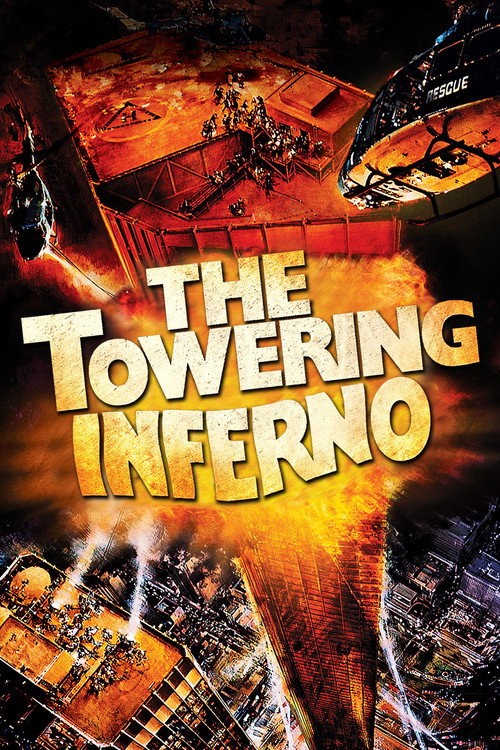
The Towering Inferno, released in 1974, stands as the definitive disaster epic of its era. Directed by John Guillermin and produced by Irwin Allen, the film brought together two rival studios, Warner Bros. and 20th Century Fox, which had each purchased rights to a different novel about a skyscraper fire. Rather than compete, they merged the projects, combining Richard Martin Stern's The Tower with Thomas N. Scortia and Frank M. Robinson's The Glass Inferno. The result was a $14 million production, one of the most expensive of its time, featuring a cast that read like a who's who of Hollywood royalty.
The plot centers on the opening night gala of the Glass Tower, a 138-story skyscraper in San Francisco, where a small electrical fire on the 81st floor quickly escalates into a raging inferno. The building's developer, Jim Duncan, played by William Holden, had secretly authorized substandard wiring to cut costs, a decision that proves catastrophic. As the fire spreads, architect Doug Roberts (Paul Newman) and fire chief O'Hallorhan (Steve McQueen) lead a desperate rescue effort. The film's ensemble includes Faye Dunaway, Fred Astaire, Richard Chamberlain, and a young O. J. Simpson, among others.
The Towering Inferno was a massive commercial success, grossing over $116 million worldwide and becoming the highest-grossing film of 1974. It earned eight Academy Award nominations, winning three for cinematography, film editing, and the original song "We May Never Love Like This Again." Critics were divided, with some praising the spectacle and others dismissing the thin characterizations, but audiences embraced its blend of star power and pyrotechnics. The film's legacy endures as a benchmark for disaster movies, influencing countless imitators and cementing the genre's popularity throughout the decade.
Availability and pricing can change. Confirm on the provider's site before purchasing.
In San Francisco, the Glass Tower, the world's tallest building at 138 stories, is about to be unveiled at a lavish opening night gala. Architect Doug Roberts has designed the tower, but he harbors deep concerns about its safety, knowing that his father-in-law, developer Jim Duncan, authorized cost-cutting measures during construction. Chief O'Hallorhan of the San Francisco Fire Department attends the party reluctantly, pressured by city officials to maintain good relations with the powerful Duncan.
As the champagne flows and the city's elite mingle, a small electrical fire breaks out in a storage room on the 81st floor. The fire, caused by substandard wiring installed by electrical contractor Roger Simmons, quickly spreads through the building's inadequately protected vertical shafts. The modern furnishings and open floor plans accelerate the flames, turning the tower into a vertical chimney. Roberts recognizes the danger immediately, but Duncan downplays the threat, worried about the negative publicity and financial fallout of an evacuation.
O'Hallorhan and his firefighters arrive on the scene, facing an unprecedented challenge. The building's height makes standard firefighting equipment useless above a certain floor, and the fire is moving faster than anything they've encountered. As the inferno races upward, the guests are trapped, and the rescue operation becomes a desperate race against time. Roberts guides a group of survivors, including Senator Parker, the wealthy Bigelow, and con man Harlee Claiborne, through the building's labyrinthine corridors, while O'Hallorhan coordinates helicopters, aerial ladders, and his crew from below.
The fire continues to spread, cutting off escape routes and forcing survivors to retreat higher. The film interweaves the parallel struggles of the firefighters and the trapped partygoers, while exposing the personal conflicts among the characters. Roberts confronts Duncan about the building's fatal flaws, and Simmons' culpability begins to surface. As the flames close in, the survivors must confront their own mortality, and the heroes must make impossible choices to save as many lives as possible.
The Towering Inferno (1974) - Trailer
Critical Consensus
The Towering Inferno is regarded as the crowning achievement of the 1970s disaster film cycle, combining spectacular special effects with a genuinely star-studded cast. While critics have noted its melodramatic excesses and shallow character development, the film's technical craftsmanship, John Williams' score, and the sheer entertainment value of its pyrotechnic spectacle have ensured its enduring status as a genre classic.
“The Towering Inferno is a movie of enormous technical skill and enormous dramatic foolishness, and the two qualities are so evenly matched that the movie works, after a fashion.”
Roger Ebert
Chicago Sun-Times
“The Towering Inferno is the biggest, most expensive, most spectacular disaster movie ever made, and it's also one of the most entertaining.”
Vincent Canby
The New York Times
“The Towering Inferno is a thoroughly professional piece of entertainment that delivers exactly what its audience expects, spectacle, suspense, and stars.”
Variety Staff
Variety
“The Towering Inferno was the crown jewel in the 1970s disaster cycle, disdained by many critics for being trashy (while acknowledging it was entertaining trash).”
The Guardian
The Guardian
Steve McQueen
Chief O'Hallorhan
Paul Newman
Doug Roberts
William Holden
Jim Duncan
Faye Dunaway
Susan
Fred Astaire
Harlee Claiborne
Richard Chamberlain
Simmons
O. J. Simpson
Jernigan
Robert Vaughn
Senator Parker
Robert Wagner
Bigelow
Susan Blakely
Patty
Jennifer Jones
Lisolette
Susan Flannery
Lorrie
Director
John Guillermin
Writers
Stirling Silliphant, Richard Martin Stern, Thomas N. Scortia, Frank M. Robinson
Composer
John Williams
Cinematographer
Fred J. Koenekamp
Producer
Irwin Allen
Academy Awards (1975)
Best Cinematography: Won
Academy Awards (1975)
Best Original Song: Won
Academy Awards (1975)
Best Film Editing: Won
Academy Awards (1975)
Best Picture: Nominated
Academy Awards (1975)
Best Supporting Actor: Nominated
Academy Awards (1975)
Best Art Direction: Nominated
Academy Awards (1975)
Best Sound: Nominated
Golden Globe Awards (1975)
Best Motion Picture - Drama: Nominated
Golden Globe Awards (1975)
Best Actor - Drama: Nominated
Golden Globe Awards (1975)
Best Supporting Actor: Nominated
Golden Globe Awards (1975)
Best New Star of the Year: Nominated
Join the community
fans discussing