 Taiwan
“Yang's film is a masterpiece of urban anxiety, a story of how small deceptions can ripple outward to reshape destinies.”
Roger Ebert
Chicago Sun-Times
Part of a Collection
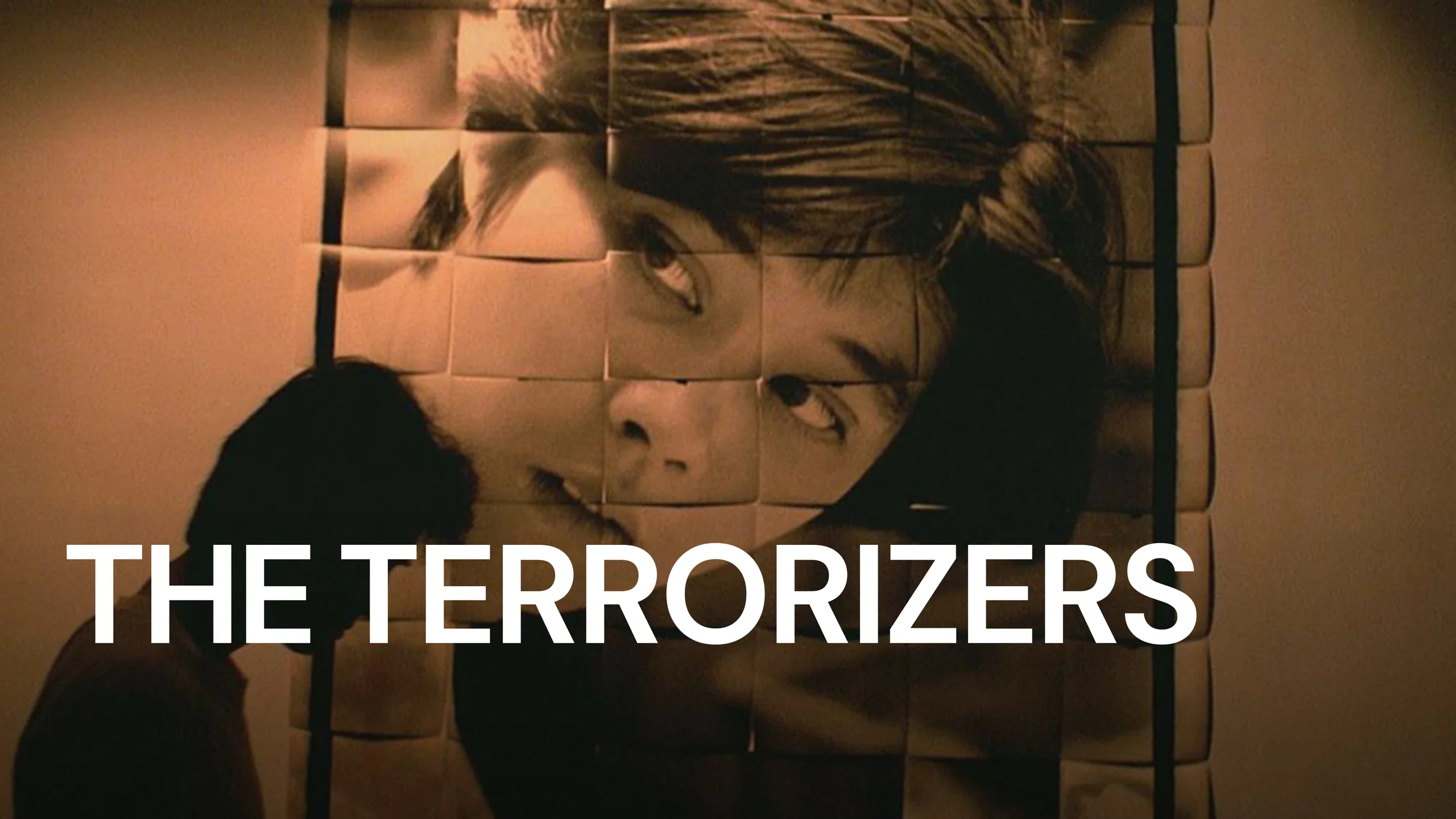
Set against the backdrop of rapidly modernizing Taipei in the mid-1980s, Edward Yang's The Terrorizers fractures the traditional narrative to expose the quiet desperation lurking beneath urban life. The film tracks four distinct individuals whose paths cross through chance encounters and miscommunications, creating a web of unintended consequences. Zhao Sheng-hui, an amateur photographer, discovers a mysterious cassette tape that becomes the catalyst for chaos, while Cheng Wen-ho, a writer suffering from severe creative block, attempts to weave its contents into his own fiction. Their stories intertwine with Kuo Hsiu-fen, a rebellious teenager caught between her family and a dangerous relationship, and the shadowy figure known only as the terrorizer.
Yang constructs a mosaic of alienation where reality blurs with imagination. The movie does not rely on action or clear villains but instead focuses on the psychological unraveling of characters who are physically close yet emotionally distant. By refusing to provide easy answers or a linear resolution, the film forces viewers to confront the ambiguity of truth and the destructive power of isolation in a crowded metropolis.
Availability and pricing can change. Confirm on the provider's site before purchasing.
The story opens in the bustling streets of Taipei, introducing Zhao Sheng-hui, a young man who observes the world through the viewfinder of his camera. He treats people like subjects rather than human beings, capturing images without engaging with their lives. One evening, he finds a discarded cassette tape left behind by someone fleeing a scene. The recording contains a voicemail from a woman named Kuo Hsiu-fen, filled with frantic energy and vague threats about being followed or watched. Zhao keeps the tape, intrigued by the raw emotion it conveys, and eventually plays it for others, unknowingly setting off a chain reaction that will ripple through their separate existences.
Kuo Hsiu-fen is a rebellious artist struggling to find her voice in a society that stifles her expression. She is involved with Chen Yi-hua, a man connected to local street gangs, and their relationship is volatile. Hsiu-fen feels trapped by her family and the expectations placed upon her, leading her to engage in risky behaviors and artistic experiments that blur the lines between what is real and what is imagined. Her discovery that Zhao possesses her private recording adds a layer of paranoia to her already unstable life, driving her to act out in ways that threaten her safety.
Parallel to these events, Cheng Wen-ho, a married writer, faces a crisis of confidence. His marriage to Lin Ching-chi, a pragmatic doctor, is strained by years of emotional distance and a lack of genuine communication. Cheng desperately wants to write a novel but suffers from a crippling inability to produce anything original. When he comes into possession of the same cassette tape, perhaps through a mix-up or a deliberate intervention, he becomes obsessed with its content. He begins to incorporate the details of the recording into his fictional manuscript, using the voices and situations described by Hsiu-fen to fuel his creativity.
As Cheng writes, the boundary between his invented story and actual events starts to dissolve. He begins to see patterns in his own life that mirror the narrative he is constructing, convincing himself that the terrorizer is targeting him specifically. This delusion leads him to make decisions that have devastating consequences for those around him. The film builds tension through the psychological pressure cooker created by these converging narratives, showing how small misunderstandings can escalate into catastrophic failures of communication.
The climax approaches as the characters' lives collide in unexpected ways. Zhao’s photographs may reveal secrets that were meant to stay hidden, while Cheng’s writing inadvertently exposes truths that destroy relationships. Hsiu-fen reaches a breaking point, forced to confront the reality of her choices and the danger she has invited into her life. The narrative structure shifts back and forth, revealing how each character's actions have influenced the others, often without their knowledge. The film culminates in a series of events where the past, present, and future seem to merge, leaving the audience to piece together the final outcome of this intricate dance of fate and free will.
Through its non-linear storytelling, the film explores the nature of truth and the power of storytelling itself. It asks whether one can ever truly escape the consequences of their choices or the stories others tell about them. The characters are left to face the aftermath of their actions, realizing that the terror they feared was not an external force but a manifestation of their own internal struggles and the disconnect that defines modern urban existence.
Official Trailer
Critical Consensus
Edward Yang's masterpiece weaves a complex tapestry of urban anxiety through the intersecting lives of strangers in Taipei. Its non-linear narrative and ambiguous ending challenge viewers to question the nature of reality, making it a timeless classic of the Taiwanese New Wave.
“Yang's film is a masterpiece of urban anxiety, a story of how small deceptions can ripple outward to reshape destinies.”
Roger Ebert
Chicago Sun-Times
“The Terrorizers is a haunting portrait of modern life, where the boundaries between reality and fiction blur.”
A.O. Scott
The New York Times
“A stunning achievement in narrative structure, capturing the essence of Taipei in the 1980s with clarity that is both intimate and universal.”
Peter Bradshaw
The Guardian
Cora Miao
Kuo Hsiu-fen
Lee Li-chun
Zhao Sheng-hui
Chin Shih-Chieh
Cheng Wen-ho
You Anshun
Chen Yi-hua
Huang Ming-yuan
Lin Ching-chi
Director
Edward Yang
Writer
Edward Yang
Cinematographer
Wu Wenguang
Producer
Central Pictures Corporation
Golden Horse Awards (1987)
Best Director: Won
Golden Horse Awards (1987)
Best Original Screenplay: Won
Venice Film Festival (1987)
Golden Lion: Nominated
Berlin International Film Festival (1987)
Silver Bear for Outstanding Artistic Contribution: Nominated
Los Angeles Film Critics Association Awards (1987)
Best Foreign Language Film: Won
Join the community
fans discussing