“The Terminal is a movie that works because of the performance of Tom Hanks, who is able to make Viktor a man of dignity and resourcefulness.”
Roger Ebert
Chicago Sun-Times
 United States
"Life is waiting."
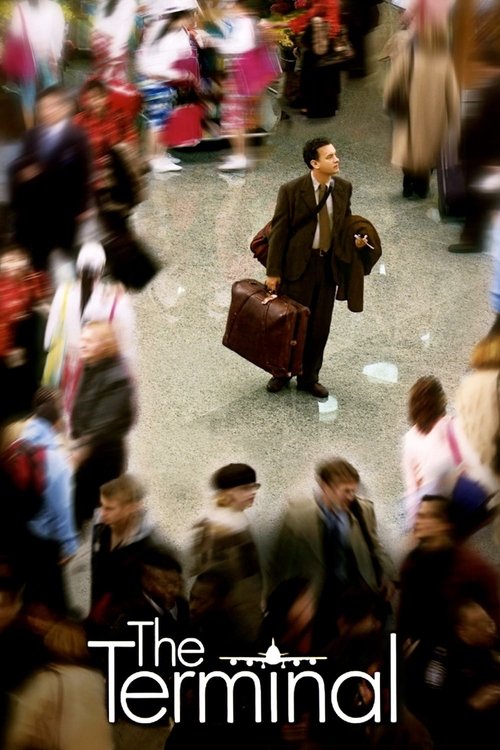
When Viktor Navorski, a traveler from the fictional Eastern European country of Krakozhia, lands at New York's JFK Airport, he expects a short layover. But a sudden coup back home invalidates his passport, leaving him stateless and stranded. Viktor can't enter the United States, and he can't go home. So he does the only thing he can: he moves into the airport's Terminal 1. What follows is a warm, often funny story of resilience and human connection, directed by Steven Spielberg and starring Tom Hanks as the ever-optimistic Viktor. Catherine Zeta-Jones plays Amelia Warren, a flight attendant who becomes his love interest, and Stanley Tucci is Frank Dixon, the airport official determined to oust him. With a budget of $60 million and a worldwide box office of over $219 million, the film blends comedy and drama into a crowd-pleasing tale. John Williams provides the score, and Janusz Kamiński's cinematography turns a sterile terminal into a world of possibility. The movie earned a solid 7.4 rating from audiences, reflecting its enduring charm.
Stream
Availability and pricing can change. Confirm on the provider's site before purchasing.
Viktor Navorski, a man from the fictional Eastern European nation of Krakozhia, arrives at John F. Kennedy International Airport in New York expecting a brief stopover before heading into the city. While he is in the air, a violent coup erupts in Krakozhia. The United States government immediately revokes recognition of the country, invalidating all passports and travel documents. Viktor is suddenly a man without a country: he cannot enter the United States because he has no valid visa, and he cannot return home because the Krakozhian government has collapsed and no flights are operating.
Frank Dixon, the meticulous and by-the-book Director of Customs and Border Protection at JFK, sees Viktor as a bureaucratic anomaly that must be contained. Dixon offers Viktor a simple choice: voluntarily return to the transit area and wait until the situation in Krakozhia is resolved. Dixon believes Viktor will give up within days, but Viktor refuses to leave the terminal. Dixon then devises a strategy to make Viktor's life so uncomfortable that he will abandon his post. He denies Viktor access to the main terminal, restricts his movement to the international transit lounge, and instructs his staff to provide no assistance.
Viktor, however, is not easily defeated. He discovers that the airport's transit lounge is a self-contained ecosystem. He finds abandoned gate areas, learns the layout of the terminal's hidden corridors, and begins to build a new life. He befriends a group of airport employees who become his surrogate family: Mulroy, a kind-hearted baggage handler who dreams of becoming a construction foreman; Enrique Cruz, a young food service worker who uses Viktor to communicate with a female immigration officer named Torres; Thurman, a gruff but ultimately loyal janitor; and Gupta Rajan, an elderly Indian janitor who harbors a secret past.
Viktor's ingenuity is showcased as he constructs a makeshift bed from airport chairs, earns money by returning abandoned luggage carts for deposits, and learns English by reading magazines and watching television. He also develops a romantic connection with Amelia Warren, a beautiful and sophisticated flight attendant who is trapped in a long-term affair with a married man. Amelia is drawn to Viktor's sincerity and kindness, and their relationship becomes a central emotional thread.
The central conflict of the film is Viktor's determination to complete a personal mission that brought him to New York in the first place. He carries a small, seemingly insignificant tin can, a gift for a jazz musician he has long admired. This mission gives him purpose and fuels his refusal to leave the terminal, even as Dixon escalates his efforts to break him. The story unfolds over months, with Viktor transforming the sterile terminal into a home, earning the loyalty of the airport staff, and becoming a folk hero to travelers who hear his story.
Trailer
Critical Consensus
The Terminal is a pleasant, well-acted diversion from Steven Spielberg, but its lightweight plot and predictable sentimentality prevent it from soaring as high as his best work.
“The Terminal is a movie that works because of the performance of Tom Hanks, who is able to make Viktor a man of dignity and resourcefulness.”
Roger Ebert
Chicago Sun-Times
“Mr. Spielberg and his star, Tom Hanks, have turned a preposterous situation into a sweet, engaging fable about the triumph of the human spirit.”
A.O. Scott
The New York Times
“A lightweight but engaging comedy-drama that showcases Tom Hanks' everyman charm and Spielberg's ability to find humanity in the most unlikely settings.”
Todd McCarthy
Variety
“Spielberg and Hanks are a formidable team, but 'The Terminal' feels like a minor work, a pleasant enough diversion that never quite takes off.”
Peter Travers
Rolling Stone
“A film that is more interested in being liked than in being memorable, 'The Terminal' is a pleasant enough ride that evaporates almost as soon as it's over.”
Kenneth Turan
Los Angeles Times
Tom Hanks
Viktor Navorski
Catherine Zeta-Jones
Amelia Warren
Stanley Tucci
Frank Dixon
Chi McBride
Mulroy
Diego Luna
Enrique Cruz
Barry Shabaka Henley
Thurman
Kumar Pallana
Gupta Rajan
Zoe Saldaña
Torres
Eddie Jones
Salchak
Jude Ciccolella
Karl Iverson
Corey Reynolds
Waylin
Guillermo Díaz
Bobby Alima
Director
Steven Spielberg
Writers
Sacha Gervasi, Jeff Nathanson, Andrew Niccol
Composer
John Williams
Cinematographer
Janusz Kamiński
Producers
Walter F. Parkes, Steven Spielberg, Laurie MacDonald
Teen Choice Awards (2005)
Choice Movie: Drama: Nominated
Teen Choice Awards (2005)
Choice Movie Actor: Drama: Nominated
Teen Choice Awards (2005)
Choice Movie: Liplock: Nominated
People's Choice Awards (2005)
Favorite Motion Picture: Nominated
Golden Trailer Awards (2004)
Best Romance: Nominated
BMI Film Music Award (2005)
John Williams: Won
Join the community
fans discussing