“The film is a clever, darkly comic look at the nature of truth and the ease with which lies can be sold to those who want to believe them.”
Roger Ebert
Chicago Sun-Times
 United States
"In a place this treacherous, what a good spy needs is a spy of his own."
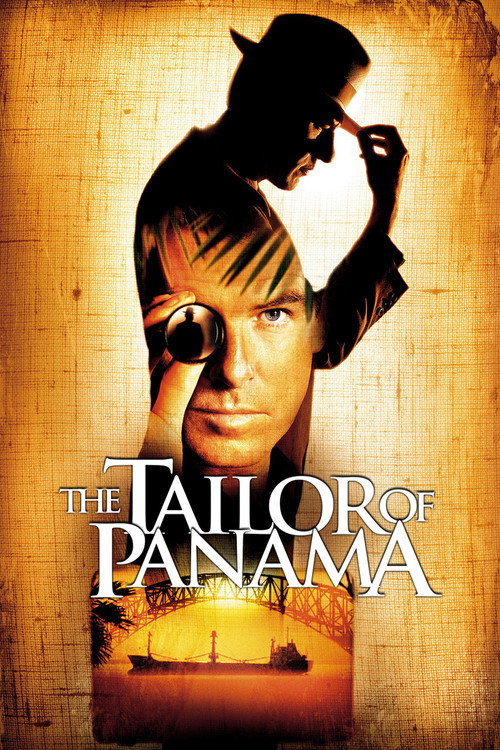
John Boorman directs this tense political thriller set against the backdrop of a Panama teetering on the edge of change. Pierce Brosnan stars as Andy Osnard, a British intelligence officer sent to the country after an affair with an ambassador's mistress forces him into exile. Once there, he strikes up a dangerous partnership with Harry Pendel, played by Geoffrey Rush, a local tailor hiding secrets from his past and connections to everyone from gangsters to government officials. The film explores how easily truth can be manufactured when greed and fear are involved.
Released in early 2001, the production carried a budget of $21 million and grossed roughly $28 million worldwide. Critics gave it a modest reception, with ratings hovering around 6 out of 10. The movie blends drama and suspense while drawing heavily on the spy fiction traditions of John le Carré, whose novel serves as the source material alongside contributions from writers Andrew Davies and director John Boorman himself.
Availability and pricing can change. Confirm on the provider's site before purchasing.
The year is 1999, and Panama City stands on the precipice of a US invasion designed to oust dictator Manuel Noriega. Into this volatile environment steps Andy Osnard, a low-level MI6 operative seeking redemption after a scandal back in London. Osnard arrives with no resources and a desperate need for actionable intelligence, yet he finds the local situation far more opaque than expected. His path crosses with Harry Pendel, a charming British expatriate who runs a high-end tailoring shop catering to the city's elite. Harry appears to be a man of simple means, devoted to his wife Louisa and young son Mark, but his shop serves as a front where he overhears confidential conversations from politicians, military leaders, and criminals alike.
Osnard identifies Harry as a potential asset and begins a campaign of intimidation to turn him into an informant. He threatens to expose Harry's minor criminal history unless the tailor provides details on local drug trafficking and political instability. Harry initially resists, fearing for his family's safety, but the threat eventually compels him to cooperate. The arrangement quickly devolves into a game of fabrication. Osnard feeds Harry completely made-up stories about impending coups, secret American operations, and hidden caches of weapons. Harry, believing these lies to be true or simply eager to please his benefactor, weaves them into his reports to Osnard.
As the months pass, the dynamic between the two men shifts in unsettling ways. Harry becomes increasingly invested in the narrative he has constructed, finding himself in positions of unexpected influence as his fabricated intelligence begins to shape real-world events. The lies spiral outward, creating a self-fulfilling prophecy that destabilizes the region further. Meanwhile, Louisa grows suspicious of her husband's sudden wealth and erratic behavior, digging into his past without realizing the extent of the deception she is uncovering. The tension builds as the line between fact and fiction blurs, leaving Harry trapped in a web of his own making while Osnard watches the chaos unfold with growing unease.
The narrative escalates through moments of dark comedy and mounting dread. As the US invasion approaches, the stakes rise to life-and-death proportions. Harry finds himself at the center of a storm he helped create, forced to navigate a landscape where every word he speaks carries weight beyond his control. The story moves toward a breaking point where the fabrications can no longer be contained, forcing Harry to confront the reality of the consequences he has unleashed. The film maintains a tightrope walk between suspense and satire, questioning whether the truth matters when the lie serves a purpose, and what happens when the liar becomes the victim of their own deception.
The Tailor of Panama (2001) Official Trailer 1
Critical Consensus
While praised for its sharp performances and satirical edge, The Tailor of Panama suffers from a disjointed narrative that fails to fully capitalize on its premise. Critics found the film's pacing uneven and its political commentary somewhat muddled, though the chemistry between Brosnan and Rush kept audiences engaged. It is a flawed but occasionally brilliant exploration of deception in the world of espionage.
“The film is a clever, darkly comic look at the nature of truth and the ease with which lies can be sold to those who want to believe them.”
Roger Ebert
Chicago Sun-Times
“Brosnan and Rush are excellent, bringing a level of charm and wit to their roles that elevates the material beyond its sometimes clunky script.”
A.O. Scott
The New York Times
“A smart, darkly satirical thriller with exuberant performances from Pierce Brosnan and Geoffrey Rush, though the plot occasionally stumbles under its own weight.”
Variety Staff
Variety
Director
John Boorman
Writers
John Boorman, Andrew Davies, John le Carré
Composer
Shaun Davey
Cinematographer
Philippe Rousselot
Producer
John Boorman
Cannes Film Festival (2001)
Palme d'Or: Nominated
Golden Globe Awards (2001)
Best Original Score: Nominated
BAFTA Awards (2001)
Best Cinematography: Nominated
Satellite Awards (2001)
Best Actor – Motion Picture Drama: Nominated
Writers Guild of America (2001)
Best Adapted Screenplay: Nominated
Join the community
fans discussing