“David Fincher's film is a masterfully crafted work that captures the zeitgeist with electrifying speed and intelligence.”
Ann Hornaday
The Washington Post
 United States
"You don't get to 500 million friends without making a few enemies."
Part of a Collection
The Social Network Collection
In the fall of 2003, a Harvard undergraduate named Mark Zuckerberg sat down at his computer and, over the course of a single night, created something that would reshape the way the world communicates. That something was not yet Facebook, but a crude, misogynistic site called Facemash that compared photos of female students. The incident got him on academic probation, but it also planted a seed. Within months, Zuckerberg launched Thefacebook, a social network that spread from Harvard to Yale to Stanford and beyond, eventually becoming a global behemoth with over half a billion users.
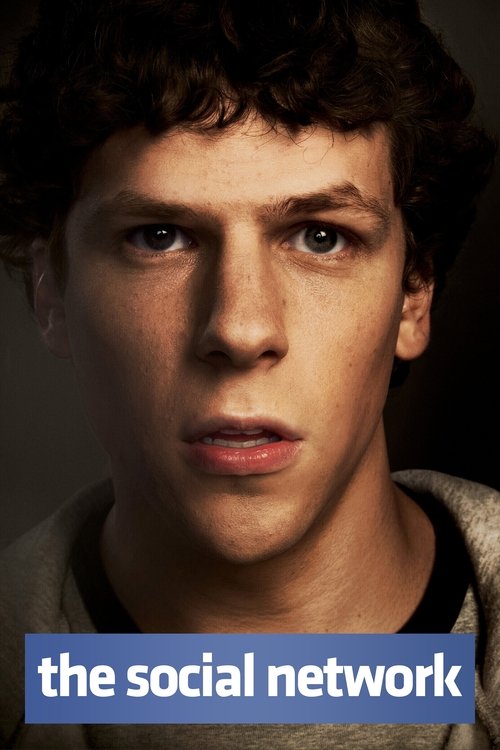
David Fincher's The Social Network is not a straightforward biopic. Instead, it is a legal thriller and a character study wrapped in one, unfolding through two parallel depositions years after the company's founding. The film examines the cost of ambition, the fragility of friendship, and the loneliness of building a machine designed for connection. Aaron Sorkin's screenplay, adapted from Ben Mezrich's book The Accidental Billionaires, crackles with rapid-fire dialogue that turns boardroom negotiations into pulse-pounding drama. The result is a film that feels both immediate and timeless, a portrait of a generation's defining entrepreneur that refuses to paint him as either hero or villain.
Shot largely in Baltimore and Boston, with a haunting electronic score by Trent Reznor and Atticus Ross, the film captured the zeitgeist with surgical precision. It premiered at the New York Film Festival on September 24, 2010, and went on to gross over $224 million worldwide against a $40 million budget. Critics hailed it as one of the best films of the decade, and it won three Academy Awards, including Best Adapted Screenplay. More than a decade later, it remains the definitive cinematic account of the digital revolution's birth pangs.
Stream
Availability and pricing can change. Confirm on the provider's site before purchasing.
The film opens on a brisk October night in 2003. Mark Zuckerberg, a Harvard computer science sophomore, is at a bar with his girlfriend Erica Albright. Their conversation turns sour as Mark's arrogant, dismissive patter grates on her. She breaks up with him, telling him that he will go through life thinking women don't like him because he is a nerd, when in truth it is because he is an asshole. Stung and drunk, Mark returns to his dormitory in Kirkland House and begins blogging bitterly about Erica. In a fit of inspiration, he creates a website called Facemash that pulls photos of female Harvard students from campus house facebooks and lets visitors rate them on attractiveness. The site crashes Harvard's network within hours, generating 22,000 page views and earning Mark a six-month academic probation.
The buzz from Facemash draws the attention of Cameron and Tyler Winklevoss, wealthy, athletic twins who are members of the Porcellian Club, Harvard's most exclusive final club. Along with their business partner Divya Narendra, they pitch Mark an idea for a social networking site called Harvard Connection, a dating site exclusive to Harvard students that would leverage their social connections. Mark agrees to help code the site but stalls them repeatedly, working instead on his own project with his best friend Eduardo Saverin. Eduardo, a Brazilian finance major and president of the Phoenix S.K. final club, provides the initial funding and business acumen. Together, they launch Thefacebook on February 4, 2004.
The site explodes. Within two weeks, more than half of Harvard's undergraduate body has signed up. Thefacebook spreads to Columbia, Stanford, Yale, and other Ivy League schools. Mark and Eduardo become campus celebrities, and the site's growth attracts the attention of Sean Parker, the co-founder of Napster. Sean, a charismatic and reckless tech visionary, sees Thefacebook's potential to be much bigger than a college network. He inserts himself into Mark's life, offering advice on investors and strategy while encouraging Mark to think globally. Eduardo, wary of Sean's influence, finds himself increasingly sidelined as Mark gravitates toward Sean's vision.
The narrative is intercut with two depositions. In one, the Winklevoss twins and Divya Narendra sue Mark for stealing their idea and for breach of contract. In the other, Eduardo sues Mark for financial betrayal, claiming that Mark and Sean deliberately diluted his shares from 34% to 0.03% during a round of financing. The depositions reveal the layers of deception and ambition that drove the company forward. Mark's testimony is sharp, evasive, and occasionally cruel. He insists that he never stole anything, that the Winklevosses' idea was fundamentally different from his own, and that Eduardo's removal was a business decision, not a personal one. But the depositions also expose the emotional toll: the friendships destroyed, the trust shattered, and the loneliness of a man who built a network that connected the world but left him isolated.
As Thefacebook grows, the tension between Mark and Eduardo escalates. Sean Parker's lifestyle becomes increasingly erratic, culminating in his arrest for cocaine possession at a party. Mark is forced to distance himself from Sean, but the damage to his relationship with Eduardo is already done. The film traces the company's relocation to Palo Alto, its first major investment from Peter Thiel, and the legal battles that would define its early years. By the time the depositions conclude, the audience understands that Mark's success came at a steep price: the loss of his closest friend, the enmity of his peers, and a reputation for ruthlessness that would follow him forever.
International Trailer
Official Trailer
Critical Consensus
Intelligent, impeccably crafted, and with a career-defining performance from Jesse Eisenberg, The Social Network is a compelling portrait of ambition and betrayal in the digital age.
“David Fincher's film is a masterfully crafted work that captures the zeitgeist with electrifying speed and intelligence.”
Ann Hornaday
The Washington Post
“Aaron Sorkin's screenplay is a marvel of rapid-fire dialogue and structural ingenuity, weaving together multiple timelines and perspectives.”
Todd McCarthy
The Hollywood Reporter
“Jesse Eisenberg delivers a tour-de-force performance as the brilliant, enigmatic, and often unlikeable Mark Zuckerberg.”
Peter Travers
Rolling Stone
“The film is a surprisingly profound meditation on friendship, class, and the loneliness of genius.”
A.O. Scott
The New York Times
Jesse Eisenberg
Mark Zuckerberg
Andrew Garfield
Eduardo Saverin
Armie Hammer
Cameron Winklevoss / Tyler Winklevoss
Justin Timberlake
Sean Parker
Rooney Mara
Erica Albright
Max Minghella
Divya Narendra
Brenda Song
Christy Ling
Rashida Jones
Marilyn Delpy
Director
David Fincher
Writers
Aaron Sorkin, Ben Mezrich
Composers
Trent Reznor, Atticus Ross
Cinematographer
Jeff Cronenweth
Producers
Dana Brunetti, Ceán Chaffin, Scott Rudin, Michael De Luca
Academy Awards (2011)
Best Adapted Screenplay: Won
Academy Awards (2011)
Best Picture: Nominated
Academy Awards (2011)
Best Director: Nominated
Golden Globe Awards (2011)
Best Motion Picture – Drama: Won
Golden Globe Awards (2011)
Best Director: Won
Golden Globe Awards (2011)
Best Screenplay: Won
BAFTA Awards (2011)
Best Adapted Screenplay: Won
BAFTA Awards (2011)
Best Editing: Won
Join the community
fans discussing