 United States
“A magnificent movie that captures the spirit of the age and the courage of the men who dared to fly. It stands as a testament to the power of cinema to tell the truth about history.”
Roger Ebert
Chicago Sun-Times
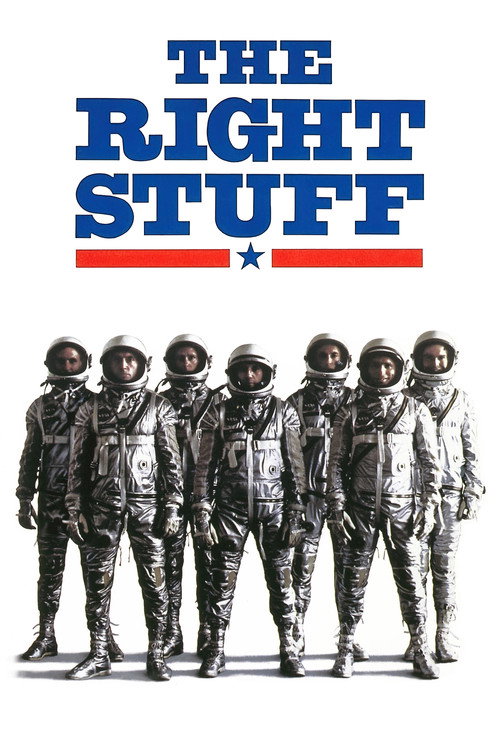
The Space Race defined a generation, but the men who actually pushed humanity toward the stars faced their own private battles. Philip Kaufman's The Right Stuff shifts focus from the politics of Washington to the cockpit and the test range. It follows seven daredevils who volunteered for the Mercury program, trading safety for the chance to fly faster than sound or higher into the void. The film balances the glamour of early spaceflight with the terrifying reality of mechanical failure and human error.
Sam Shepard leads as Chuck Yeager, the test pilot who shattered the sound barrier in 1947 and set the standard for the coolness required in high-stakes aviation. When the Soviets launch Sputnik in 1957, the United States scrambles to catch up, creating NASA and selecting the Mercury Seven. These men are not polished heroes; they are gamblers, drinkers, and skilled flyers who struggle with the transition from independent pilots to government employees under intense media scrutiny.
Availability and pricing can change. Confirm on the provider's site before purchasing.
The narrative begins in 1947 at Muroc Army Air Field, where Chuck Yeager climbs into the Bell X-1 rocket plane. He pushes through the sound barrier, an event that defines the "right stuff", a mix of nerve, skill, and luck. This success establishes the Air Force's dominance until the Soviet Union beats America to orbit with Sputnik in October 1957. The political pressure forces the U.S. to accelerate its space program, leading to the selection of the Mercury Seven astronauts from the ranks of military test pilots.
We meet Alan Shepard, Gus Grissom, John Glenn, Scott Carpenter, Wally Schirra, Gordon Cooper, and Deke Slayton at Edwards Air Force Base and later at Cape Canaveral. They undergo grueling physical tests involving centrifuges that spin them at extreme G-forces, isolation tanks, and rigorous academic study. The film highlights the camaraderie among these men while showing the toll on their families. Their wives deal with the uncertainty of their husbands' lives and the sudden fame that comes with being part of the first American space program.
The story contrasts the rugged individualism of the test pilots with the emerging corporate culture of NASA. As the missions progress, the tension mounts between the astronauts' desire for glory and the cold calculations of the government. Shepard faces a medical setback that delays his flight, while Glenn becomes a national icon before he even leaves Earth. Gordon Cooper, known for his rebellious nature, pushes the boundaries of endurance during his training. The film builds suspense around the upcoming orbital flights, focusing on the personalities and risks involved without revealing the final outcomes of the historical events.
A central conflict emerges when the public perception of the astronauts as invincible heroes clashes with the harsh reality of mechanical failures. The Mercury Redstone 3 mission sees Alan Shepard become the first American in space, followed by Gus Grissom's Liberty Bell 7 flight, which ends with a dramatic water landing and the capsule sinking. The narrative captures the excitement of the Space Race while exploring the intimate, often painful, human stories behind the headlines. The audience anticipates the moment of launch, knowing the historical significance without seeing the tragic events that would follow in real history.
Original Theatrical Trailer
TV Spot
Critical Consensus
This sweeping epic captures the spirit of the Space Age with stunning visuals and powerful performances. It balances historical accuracy with emotional depth, creating a timeless tribute to courage and ambition. The film avoids simplifying the complexities of the astronauts' lives while delivering breathtaking cinematography and a stirring score.
“A magnificent movie that captures the spirit of the age and the courage of the men who dared to fly. It stands as a testament to the power of cinema to tell the truth about history.”
Roger Ebert
Chicago Sun-Times
“Philip Kaufman has made a film that is both a celebration of the American spirit and a meditation on the costs of progress. The performances are outstanding and the direction masterful.”
Vincent Canby
The New York Times
“A visually stunning and emotionally resonant epic that brings the Space Race to life with unprecedented detail and authenticity. The cast delivers career-defining performances.”
Variety Staff
Variety
Sam Shepard
Chuck Yeager
Scott Glenn
Alan Shepard
Ed Harris
John Glenn
Dennis Quaid
Gordon Cooper
Fred Ward
Gus Grissom
Barbara Hershey
Glennis Yeager
Kim Stanley
Pancho Barnes
Veronica Cartwright
Betty Grissom
Pamela Reed
Trudy Cooper
Scott Paulin
Deke Slayton
Charles Frank
Scott Carpenter
Lance Henriksen
Wally Schirra
Director
Philip Kaufman
Writers
Tom Wolfe, Philip Kaufman
Composer
Bill Conti
Cinematographer
Caleb Deschanel
Producers
Irwin Winkler, Robert Chartoff
Academy Awards (1984)
Best Film Editing: Won
Academy Awards (1984)
Best Sound: Nominated
Golden Globe Awards (1984)
Best Motion Picture - Drama: Nominated
BAFTA Awards (1984)
Best Film: Nominated
Join the community
fans discussing