 France
“A charming and imaginative little film that captures the magic of childhood with extraordinary delicacy. The red balloon is one of the most memorable characters in cinema.”
Bosley Crowther
The New York Times
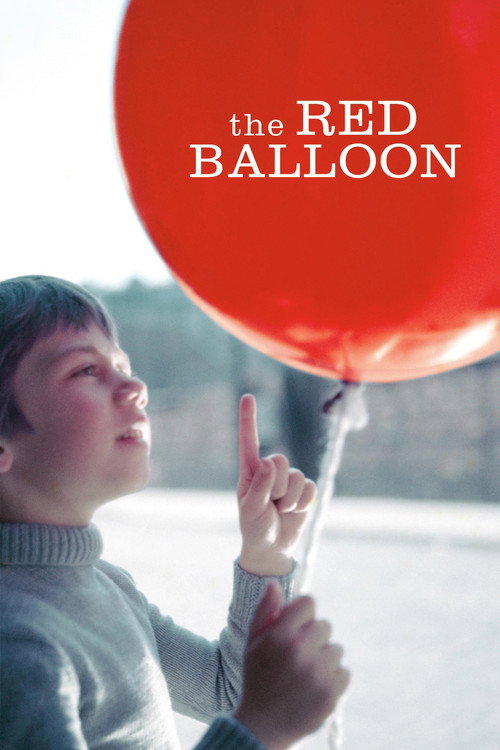
In the working-class streets of postwar Paris, a young schoolboy named Pascal discovers a large red balloon tied to a lamppost. The balloon seems to have a mind of its own, following him like a loyal pet through the narrow cobblestone alleys of Ménilmontant and Belleville. Director Albert Lamorisse cast his own six-year-old son Pascal in the lead, and the boy's real-life sister Sabine appears as a girl with a blue balloon. The film has almost no spoken dialogue, relying instead on ambient street sounds and Maurice Le Roux's melancholic waltz score to tell its story.
Shot on location in the 20th arrondissement of Paris, the film used over twenty hand-painted red balloons controlled by puppeteers with invisible wires. Cinematographer Edmond Séchan developed a special rig to make the balloon appear alive. Produced for an estimated $50,000 by Films Montsouris, the 34-minute short won the Academy Award for Best Original Screenplay, the only Oscar ever given to a short film in that category. It also won the Palme d'Or for Best Short Film at the 1956 Cannes Film Festival and was selected for preservation in the United States National Film Registry in 2011.
Availability and pricing can change. Confirm on the provider's site before purchasing.
Pascal, a small boy of about six, lives with his mother in a modest apartment in the Ménilmontant quarter of Paris. One morning on his way to school, he notices a large red balloon tied to a lamppost. He unties it and carries it with him, but when he tries to board a city bus, the conductor refuses to allow the balloon onboard. Pascal walks to school instead, and the balloon bobs alongside him at eye level, as if keeping pace.
During the school day, the balloon waits outside, floating patiently by the gate. It peeks through the classroom windows, and when Pascal emerges, it is there to greet him. He tries to bring it into his apartment building, but the concierge stops him. Pascal ties the balloon to a railing outside, but it floats up to his third-floor window and taps on the glass. His mother, initially amused, finally lets it out the window, and the balloon hovers just outside, waiting.
A gang of older, rougher boys from the neighborhood notices the balloon and becomes obsessed with capturing it. They chase Pascal through the narrow streets, and the balloon actively evades them, swooping and dodging like a living creature. It seems to protect Pascal, leading him away from danger and hiding in courtyards and alleyways. Pascal also encounters a little girl carrying a blue balloon, suggesting a parallel world of magical companions. The chase sequences build tension, contrasting the innocence of Pascal and his balloon with the cruelty of the other children.
The Red Balloon (1956) Re-Release Trailer #1 - Le Ballon Rouge Movie HD
Critical Consensus
A tender, visually poetic short film that captures childhood wonder with remarkable simplicity, The Red Balloon transcends its modest runtime to become an enduring masterpiece of French cinema. Its wordless storytelling and luminous photography create a bittersweet fantasy that resonates across generations.
“A charming and imaginative little film that captures the magic of childhood with extraordinary delicacy. The red balloon is one of the most memorable characters in cinema.”
Bosley Crowther
The New York Times
“A film of such purity and grace that it seems to have been made outside of time. It is a perfect expression of the loneliness and resilience of childhood.”
Roger Ebert
Chicago Sun-Times
“A dreamlike, almost silent masterpiece that uses its Parisian setting like a character. The red balloon is a symbol of everything pure and vulnerable in childhood.”
Peter Bradshaw
The Guardian
Pascal Lamorisse
Pascal, the Little Boy
Georges Sellier
The Irritated Schoolmaster
Vladimir Popov
A Tenant
Director
Albert Lamorisse
Writer
Albert Lamorisse
Composer
Maurice Le Roux
Cinematographer
Edmond Séchan
Producer
Albert Lamorisse
Academy Awards (1957)
Best Original Screenplay: Won
Cannes Film Festival (1956)
Palme d'Or for Best Short Film: Won
BAFTA Awards (1957)
Best Specialised Film: Won
French Syndicate of Cinema Critics (1956)
Best Short Film: Won
Prix Louis Delluc (1956)
Best Film (short film category): Won
Join the community
fans discussing