“Ruffalo gives a performance of raw, unlovely conviction, and the film's refusal to soften Ned Weeks is exactly what makes it land.”
Alessandra Stanley
The New York Times
 United States
"To win a war, You have to start one"
User Score
938 votes
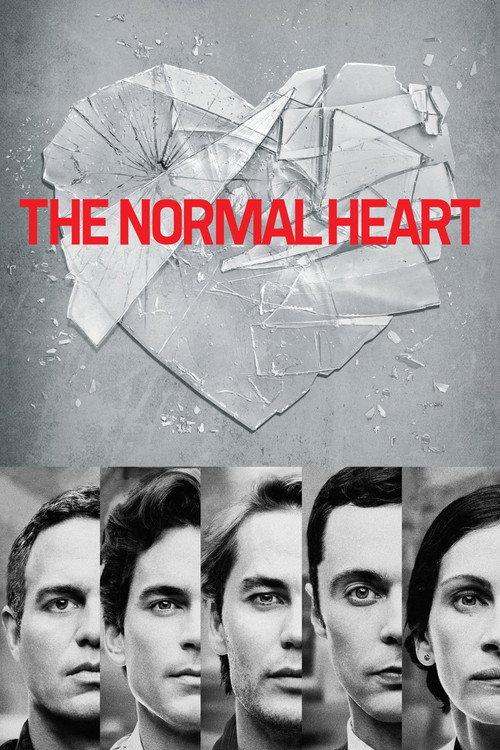
Larry Kramer spent nearly three decades trying to get his 1985 play The Normal Heart onto screens. The version that finally aired, on HBO the night of May 25, 2014, was directed by Ryan Murphy and adapted by Kramer himself, which matters: the fury in the script is the playwright's own, undiluted. Mark Ruffalo plays Ned Weeks, a writer whose refusal to be polite about a plague killing his friends makes him a hard man to organize around. Matt Bomer is Felix Turner, the New York Times fashion writer Ned falls for; Taylor Kitsch is Bruce Niles, the polished activist who thinks survival depends on not making enemies. Julia Roberts, in a role Kramer wrote after meeting real doctors fighting the same silence, plays Dr. Emma Brookner, a physician watching young men die while the government stalls.
The film opens in 1981 and runs through the first years of the crisis, moving between bathhouses and boardrooms, clinic waiting rooms and the cramped apartments where friends nurse each other. Kramer's screenplay keeps Ned abrasive on purpose. The supporting cast includes Jim Parsons as Tommy Boatwright, Joe Mantello as Mickey Marcus, Alfred Molina as Ned's straight brother Ben, and a circle of stage veterans (BD Wong, Stephen Spinella, Denis O'Hare) alongside newcomers like Jonathan Groff and Finn Wittrock.
Shot by Daniel Moder with a score by Cliff Martinez, the film was produced by HBO Films with Plan B Entertainment and Blumhouse, among others. It never played theaters, which turned out to be the right call: roughly 1.4 million viewers watched the premiere, and the movie went on to win the Primetime Emmy for Outstanding Television Movie. For anyone who has followed Kramer's career, the most striking thing is how current the anger still feels. Ned's fights with Bruce, with the mayor's office, with his own brother, are arguments that never really ended.
Availability and pricing can change. Confirm on the provider's site before purchasing.
New York, 1981. Ned Weeks (Mark Ruffalo) is a writer and activist who has never met a room he couldn't alienate. At a birthday party on Fire Island, he watches a friend, a man in his thirties who had been healthy weeks earlier, struggle to breathe. The friend dies soon after, one of the first. Ned starts counting obituaries. He visits Dr. Emma Brookner (Julia Roberts), a physician who has been treating a stream of young gay men with collapsed immune systems, and she tells him plainly that whatever this is, it is spreading and nobody in power wants to say so out loud.
Ned gathers a handful of friends and acquaintances to form an organization, modeled closely on the real Gay Men's Health Crisis. The group includes Bruce Niles (Taylor Kitsch), a banker with a diplomat's instincts; Tommy Boatwright (Jim Parsons), a hospital administrator who sees the death certificates before anyone else; Mickey Marcus (Joe Mantello), a closeted clinic worker; and a rotating cast of volunteers. They meet in living rooms and argue about stationery. Ned wants to shout. Bruce wants a letterhead and a meeting with the health department. The tension between them is not abstract: Bruce believes the community's safety depends on respectability, and Ned believes respectability is a luxury paid for in funerals.
At a press event, Ned meets Felix Turner (Matt Bomer), a fashion journalist for the New York Times. Felix is charming, a little vain, and initially unimpressed. Their courtship is the film's warmest stretch: dinners, a Fire Island weekend, the slow building of a life together. Felix moves into Ned's apartment. For a while the movie holds two stories in balance, the public fight and the private one.
The organization grows, but so does the body count. Ned writes furious op-eds and crashes press conferences. He calls the mayor's office and gets a junior aide, Hiram Keebler (Denis O'Hare), who promises a task force that never materializes. Dr. Brookner, confined to a wheelchair after childhood polio, testifies at a city hearing and is treated with open contempt by officials who suggest the disease is a moral failing rather than a medical emergency. The activists stage a protest at the health department. Bruce gives interviews in a suit. Ned gives interviews in a rage.
The group starts to fracture. Members worry that Ned's confrontational style will cost them access and funding. Mickey, who works at a hospital and sees the dying up close, is torn between his job and his friends. Tommy keeps a list of the dead in a notebook, and the notebook gets longer. Ned's brother Ben (Alfred Molina), a lawyer, refuses to engage with what Ned is living through, and their phone calls turn into the same argument every time: Ben thinks Ned is hysterical, Ned thinks Ben is a coward.
Felix, meanwhile, has been losing weight. A purple lesion appears on his ankle. The film follows the diagnosis without flinching, and Ned, who has spent years demanding that the world look at this disease, now has to look at it in his own bedroom. He becomes a caretaker. The activist who could not stop shouting learns to be quiet in a different way, sitting by a bed, changing sheets, arguing with hospital staff. The organization he helped found votes to push him out, and he goes, still furious, still certain he was right.
The film does not resolve the epidemic. It cannot. What it does is trace the arc from a handful of unexplained deaths to an institutional catastrophe, and it keeps Ned's voice at the center, abrasive and unbroken. The last stretch turns on Felix's illness and on the question of whether Ned's brother will finally show up, which is where the film's public and private stories collide.
The Normal Heart: Trailer (HBO Films)
The Normal Heart | official trailer (2014) HBO Mark Ruffalo Jim Parsons
Critical Consensus
Critics largely embraced the film as a harrowing, necessary dramatization of the early AIDS crisis, powered by Mark Ruffalo's ferocious lead performance and Larry Kramer's unsparing script. Some found the stage origins conspicuous and the tone relentless, but most agreed the anger was the point. Julia Roberts and Matt Bomer drew strong notices in support.
“Ruffalo gives a performance of raw, unlovely conviction, and the film's refusal to soften Ned Weeks is exactly what makes it land.”
Alessandra Stanley
The New York Times
“Kramer's fury has not aged a day. The Normal Heart is less a period piece than a prosecution, and Ryan Murphy directs it like one.”
Tim Goodman
The Hollywood Reporter
“A devastating, occasionally speechifying adaptation that earns its tears. Bomer's transformation is the quiet shock of the piece.”
Brian Lowry
Variety
“It is not subtle, and it is not supposed to be. The film works because Kramer's anger is specific, historical, and still justified.”
Emily Nussbaum
The New Yorker
Mark Ruffalo
Ned Weeks
Matt Bomer
Felix Turner
Taylor Kitsch
Bruce Niles
Jim Parsons
Tommy Boatwright
Alfred Molina
Ben Weeks
Julia Roberts
Dr. Emma Brookner
Joe Mantello
Mickey Marcus
BD Wong
Buzzy
Jonathan Groff
Craig
Stephen Spinella
Sanford
Finn Wittrock
Albert
Denis O'Hare
Hiram Keebler
Director
Ryan Murphy
Writer
Larry Kramer
Composer
Cliff Martinez
Cinematographer
Daniel Moder
Producers
Alexis Martin Woodall, Scott Ferguson
Primetime Emmy Awards (2014)
Outstanding Television Movie: Won
Primetime Emmy Awards (2014)
Outstanding Lead Actor in a Miniseries or a Movie (Mark Ruffalo): Nominated
Primetime Emmy Awards (2014)
Outstanding Supporting Actor in a Miniseries or a Movie (Matt Bomer): Won
Primetime Emmy Awards (2014)
Outstanding Supporting Actress in a Miniseries or a Movie (Julia Roberts): Nominated
Golden Globe Awards (2015)
Best Actor – Miniseries or Television Film (Mark Ruffalo): Nominated
Screen Actors Guild Awards (2015)
Outstanding Performance by a Male Actor in a Television Movie or Miniseries (Mark Ruffalo): Nominated
Critics' Choice Television Awards (2015)
Best Actor in a Movie/Miniseries (Mark Ruffalo): Nominated
Join the community
fans discussing