 United States
“Robert Preston is magnificent as the fast-talking Harold Hill, a role he was born to play.”
Bosley Crowther
The New York Times
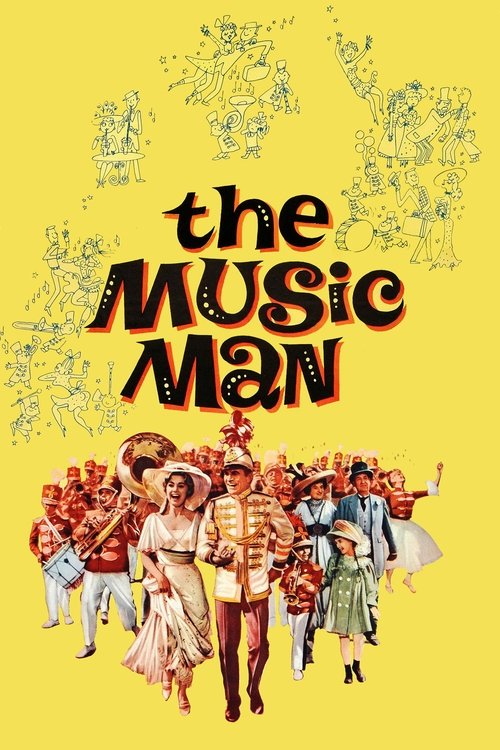
In the summer of 1912, River City, Iowa, is a town that prides itself on its quiet, predictable rhythms. That all changes when Harold Hill steps off the train. A fast-talking, charismatic salesman posing as a professor of music, Hill promises to turn the town's boys into a marching band, complete with shiny instruments and crisp uniforms. His real plan is to pocket the money and skip town before the instruments arrive. But River City has its own stubborn pride, embodied by Mayor Shinn and his wife Eulalie, and a sharp-witted librarian named Marian Paroo who sees right through him.
Robert Preston, who originated Harold Hill on Broadway, brings the role to life with a magnetic energy that feels both slick and surprisingly sincere. Shirley Jones, fresh off her Oscar-winning turn in Elmer Gantry, plays Marian with a blend of intelligence and vulnerability. The film was shot on location in Mason City, Iowa, the real-life hometown of composer Meredith Willson, who based the fictional River City on his own memories. Director Morton DaCosta, who also directed the stage version, captures the warmth and humor of small-town Americana while letting the musical numbers shine.
With a budget of $4.24 million and a box office gross of $15 million, The Music Man was a commercial hit. It earned Academy Award nominations for Best Picture, Best Film Editing, and Best Sound, winning for Best Scoring of a Musical Picture. The soundtrack, featuring songs like "76 Trombones" and "Till There Was You," won a Grammy. The film's G rating and family-friendly tone have made it a perennial favorite, often broadcast on television and cherished across generations.
Stream
Availability and pricing can change. Confirm on the provider's site before purchasing.
Harold Hill arrives in River City, Iowa, on the Rock Island train, a traveling salesman with a well-worn con. He poses as a professor from the Madison Musical Bureau, claiming he can form a boys' marching band and teach them to play in just a few lessons. The town is ripe for his scheme: gossip spreads fast, and the arrival of a new billiard parlor has parents worried about their sons' moral fiber. Hill seizes on that fear, delivering a rousing speech about "trouble" in River City, complete with a warning about pool halls leading to sin. The townsfolk, led by Mayor George Shinn and his wife Eulalie Mackechnie Shinn, are quickly won over.
Not everyone is charmed. Marian Paroo, the town librarian and piano teacher, sees Hill as a fraud. She is a woman of integrity, devoted to her younger brother Winthrop, who has a severe lisp and struggles with shyness. Marian's mother, Mrs. Paroo, is more optimistic, hoping Hill might help Winthrop come out of his shell. Marian's skepticism puts her at odds with the town, but she finds an unlikely ally in Marcellus Washburn, an old associate of Hill's who has settled down in River City and now works at the local hotel. Marcellus is torn between his friendship with Hill and his growing loyalty to the community.
As Hill works his magic, he wins over the town's children and parents. He teaches the boys a simple marching pattern and gets them excited about the band, even though no instruments have arrived. He also charms Eulalie, who wants her daughter Zaneeta to be part of the parade, and wins over the school board with his confident bluster. Meanwhile, Marian begins to soften as she sees Hill's effect on Winthrop: the boy starts to speak more clearly and gains confidence. Hill, for his part, finds himself genuinely drawn to Marian, serenading her with "Marian the Librarian" and later with "Till There Was You."
The town's excitement builds toward the Fourth of July picnic and parade, where the band is scheduled to debut. Hill has collected all the money for instruments and uniforms, but he has not placed any orders. His plan is to leave town before the parade, but his growing feelings for Marian and the town's genuine enthusiasm complicate matters. A rival salesman, Charlie Cowell, arrives with evidence of Hill's past cons, threatening to expose him. Marian, having discovered the truth, must decide whether to turn Hill in or protect the joy he has brought to her brother and the town.
The Music Man Official Trailer (1962)
Critical Consensus
A vibrant and tuneful adaptation of the Broadway hit, The Music Man is a charming musical comedy powered by Robert Preston's indelible performance. Its infectious energy and heartwarming story have made it a timeless classic.
“Robert Preston is magnificent as the fast-talking Harold Hill, a role he was born to play.”
Bosley Crowther
The New York Times
“A joyous and exhilarating musical that captures the spirit of small-town America with infectious enthusiasm.”
Variety Staff
Variety
“Morton DaCosta directs with a sure hand, translating the stage magic to the screen with delightful results.”
James Powers
The Hollywood Reporter
Robert Preston
Harold Hill
Shirley Jones
Marian Paroo
Buddy Hackett
Marcellus Washburn
Ron Howard
Winthrop Paroo
Hermione Gingold
Eulalie Mackechnie Shinn
Paul Ford
Mayor George Shinn
Pert Kelton
Mrs. Paroo
Timmy Everett
Tommy Djilas
Susan Luckey
Zaneeta Shinn
Harry Hickox
Charlie Cowell
Director
Morton DaCosta
Writers
Meredith Willson, Franklin Lacey, Marion Hargrove
Composer
Meredith Willson
Cinematographer
Robert Burks
Producer
Morton DaCosta
Academy Award for Best Scoring of a Musical Picture (1963)
Best Scoring of a Musical Picture: Won
Academy Award for Best Picture (1963)
Best Picture: Nominated
Academy Award for Best Film Editing (1963)
Best Film Editing: Nominated
Academy Award for Best Sound (1963)
Best Sound: Nominated
Golden Globe for Best Motion Picture – Musical or Comedy (1963)
Best Motion Picture – Musical or Comedy: Nominated
Golden Globe for Best Actor – Motion Picture Musical or Comedy (1963)
Best Actor – Motion Picture Musical or Comedy: Nominated
Golden Globe for Best Actress – Motion Picture Musical or Comedy (1963)
Best Actress – Motion Picture Musical or Comedy: Nominated
Grammy Award for Best Score from an Original Cast Show Album (1963)
Best Score from an Original Cast Show Album: Won
Join the community
fans discussing