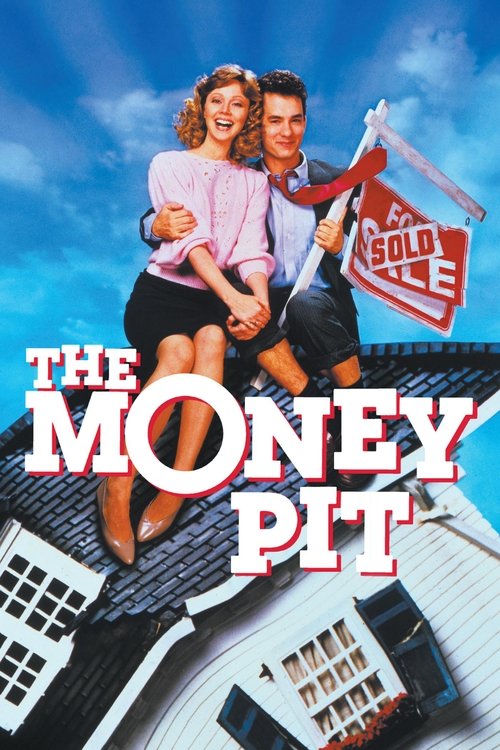
Walter Fielding Jr. (Tom Hanks) and Anna Crowley (Shelley Long) are a Manhattan couple whose cramped apartment life is upended when Anna's ex-husband, a flamboyant conductor, returns home. Forced to find a new place quickly, they stumble upon a grand colonial mansion in the suburbs at a surprisingly low price. The elderly owners, Estelle and Curly, are eager to sell and head to Florida, so the couple jumps at the deal without a proper inspection. It's a decision they'll regret almost instantly.
Directed by Richard Benjamin and produced by Amblin Entertainment, this 1986 comedy turns the American dream of homeownership into a cascade of slapstick disasters. From a kitchen that literally falls apart to a bathtub crashing through the floor, the house reveals itself as a decrepit shell held together by hope. The film's title has since become a permanent part of the language, a shorthand for any project that consumes money without end. With a budget of $10 million, it grossed over $54 million worldwide, a testament to its enduring appeal.
Hanks and Long bring genuine chemistry to their roles, balancing the farce with moments of real tenderness. The supporting cast, including Joe Mantegna as a shady contractor and Maureen Stapleton as the oblivious seller, adds layers of comic chaos. The film is a time capsule of 1980s comedy, but its themes of financial strain and relationship stress remain remarkably relevant today.
Availability and pricing can change. Confirm on the provider's site before purchasing.
PlotSpoiler-free
Walter Fielding Jr. is a lawyer with a promising career, and Anna Crowley works in the music industry. They live in a stylish Manhattan apartment that belongs to Anna's ex-husband, Max Beissart, a charismatic European conductor who is frequently away on tour. When Max unexpectedly returns, the couple is evicted and must find a new home quickly. Their search leads them to a beautiful colonial-style house in the suburbs, listed at a surprisingly low price. The sellers, Estelle and her husband Curly, are an eccentric elderly couple eager to move to Florida. Estelle calls everyone 'darling' and Curly communicates mostly through grunts, but they are charming enough to convince Walter and Anna to sign the papers without a professional inspection.
The moment they move in, the house begins to fall apart. The kitchen faucet handle comes off in Anna's hand, triggering a chain reaction that destroys the entire kitchen. The sink collapses, cabinets crash to the floor, and water sprays everywhere. The staircase soon follows, collapsing under Walter's feet. A bathtub falls through the floor into the living room, and the chimney crumbles. The roof leaks in a dozen places. The couple quickly realizes they have bought a money pit.
They hire a series of contractors, most notably Art Shirk and his team, who are either incompetent, dishonest, or simply overextended. Art's father Brad and brother work alongside him, but their efforts often make things worse. Walter's legal career suffers as he becomes consumed by the house's endless problems, and Anna's professional life also strains under the pressure. The renovation costs balloon far beyond their budget, threatening their financial stability.
Throughout the ordeal, the couple's relationship is tested. They argue about money, about the house, and about the strain it places on their lives. Anna's ex-husband Max occasionally reappears, adding a layer of romantic tension. The film also introduces a parade of colorful characters, including Jack Schnittman, a contractor who gives a wildly underestimated bid, and Shatov, a Russian contractor who quotes a suspiciously low price that turns out to be per hour rather than for the whole job.
As the months pass, Walter and Anna face one catastrophe after another, from crooked contractors to a rotting foundation. Their dream of a beautiful home becomes a nightmare that consumes their savings, their time, and their sanity. The story builds toward a climax that tests whether their relationship can survive the ordeal, and whether the house can ever be made livable.
The Money Pit is a broad, slapstick comedy that benefits enormously from Tom Hanks' comedic charisma and Shelley Long's sharp timing. While critics found the humor uneven and the premise somewhat one-note, the film's escalating chaos and the chemistry between its leads make it an entertaining, if not particularly deep, comedy about the horrors of homeownership.
 United States