“The Karate Kid Part II is a better movie than the first because it takes the time to explore the characters' backgrounds and motivations.”
Roger Ebert
Chicago Sun-Times
 United States
"One more lesson to share. The price of honor. The power of friendship. And the way you must fight when only the winner survives."
Part of a Collection
The Karate Kid Collection
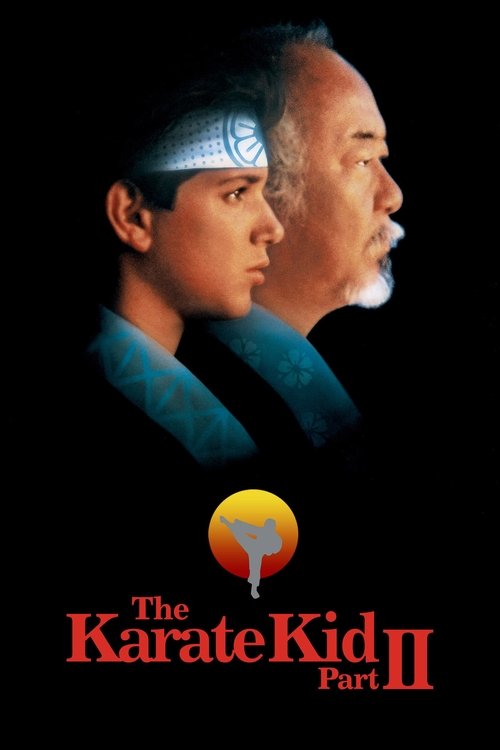
Four decades after fleeing Okinawa, Mr. Miyagi receives a desperate summons from his dying father. He takes Daniel LaRusso along for the journey, stepping away from the familiar safety of California and into a world of ancient feuds and buried secrets. Director John G. Avildsen guides this 1986 sequel through lush landscapes and tense confrontations, blending martial arts action with deep family drama.
Ralph Macchio returns as the eager student while Pat Morita delivers a poignant performance as the reluctant warrior. The film explores themes of honor and revenge against a backdrop of traditional Japanese culture. This installment expands the franchise by grounding the story in real locations rather than studio sets, offering a stark contrast to the suburban setting of the first film.
Stream
Availability and pricing can change. Confirm on the provider's site before purchasing.
The story begins in Los Angeles when a young woman named Kumiko arrives at Miyagi's home carrying a letter from his father. The elder Miyagi is on his deathbed and wishes to see his son one last time before passing. Miyagi hesitates because returning to Okinawa means facing memories of a brutal war and a conflict that forced him into exile years ago. Despite his reluctance, he agrees to travel with Daniel, viewing the trip as a chance to teach the boy about the deeper roots of their martial arts philosophy and the importance of family honor.
Upon arriving in Okinawa, the pair are greeted not with open arms but with suspicion and hostility. The island operates under ancient traditions and rigid social codes that differ vastly from the modern world Daniel knows. They are immediately introduced to the local community, including Kumiko, her brother Ichiro, and the formidable Sato. Sato is revealed to be the son of the man Miyagi fought and defeated in a duel years ago, a fight that resulted in the death of Sato's father and forced Miyagi into exile. Sato views Miyagi's return as an insult and a threat to his own status within the village.
The central conflict quickly escalates as Sato and his cronies begin to harass both Miyagi and Daniel. The tension is compounded by the presence of Chozen, a former friend of Miyagi who was also exiled alongside him but has since returned to Okinawa and aligned himself with Sato. Chozen harbors deep resentment toward Miyagi, believing that Miyagi abandoned him during their shared exile and now seeks revenge for perceived slights. As the days pass, the situation deteriorates into a series of confrontations where Sato challenges Miyagi to a duel, demanding that Miyagi surrender his life or face death.
Daniel finds himself caught in the crossfire, struggling to apply the lessons of "the crane" and other techniques he learned in California to a new environment where the rules of engagement are far more dangerous and personal. He witnesses the cultural weight of the feud and the pressure placed on Miyagi to uphold his family's honor, even at the cost of his own safety. Meanwhile, Miyagi begins to reconnect with his past, rekindling a romance with Yukie, a woman he once loved but was forced to leave behind when he fled. This emotional subplot adds depth to Miyagi's character, revealing the sacrifices he made for peace and the lingering pain of his separation from his homeland.
As the climax approaches, the stakes become life-or-death. Sato, emboldened by his alliance with Chozen, plans to kill Miyagi during a traditional ceremony, intending to settle the score once and for all. Daniel must decide whether to intervene and risk his own life to protect his mentor or to stand aside and let history repeat itself. The film builds toward a tense confrontation where the themes of forgiveness, honor, and the true meaning of strength are tested. Daniel and Miyagi must navigate a web of betrayal, ancient grudges, and personal redemption, all while facing the possibility that the price of honor might be too high to pay.
The Karate Kid Part II (1986) Original Trailer
Critical Consensus
While some critics felt the sequel lacked the originality of its predecessor, many praised Pat Morita's performance and the film's exploration of Japanese culture. The movie successfully balances action with emotional depth, offering a poignant look at honor and forgiveness. However, the plot is sometimes seen as predictable, relying heavily on the established formula of the first film.
“The Karate Kid Part II is a better movie than the first because it takes the time to explore the characters' backgrounds and motivations.”
Roger Ebert
Chicago Sun-Times
“John G. Avildsen directs with a steady hand, and Pat Morita delivers a career-defining performance that elevates the material.”
Variety Staff
Variety
“A worthy sequel that expands the universe of the original without losing its heart.”
Vincent Canby
The New York Times
Ralph Macchio
Daniel LaRusso
Pat Morita
Mr. Kesuke Miyagi
Nobu McCarthy
Yukie
Danny Kamekona
Sato
Yuji Okumoto
Chozen
Tamlyn Tomita
Kumiko
Director
John G. Avildsen
Writer
Robert Mark Kamen
Composer
Bill Conti
Cinematographer
James Crabe
Producer
Jerry Weintraub
Academy Awards (1987)
Best Original Screenplay: Nominated
Golden Globe Awards (1987)
Best Supporting Actor – Motion Picture: Nominated
Saturn Awards (1987)
Best Action/Adventure/Thriller Film: Won
Young Artist Awards (1987)
Best Family Feature Film – Drama: Won
Join the community
fans discussing