 United States
“The movie is all sensation and no feeling, a haunted house ride that substitutes special effects for the genuine terror of the original story.”
Roger Ebert
Chicago Sun-Times
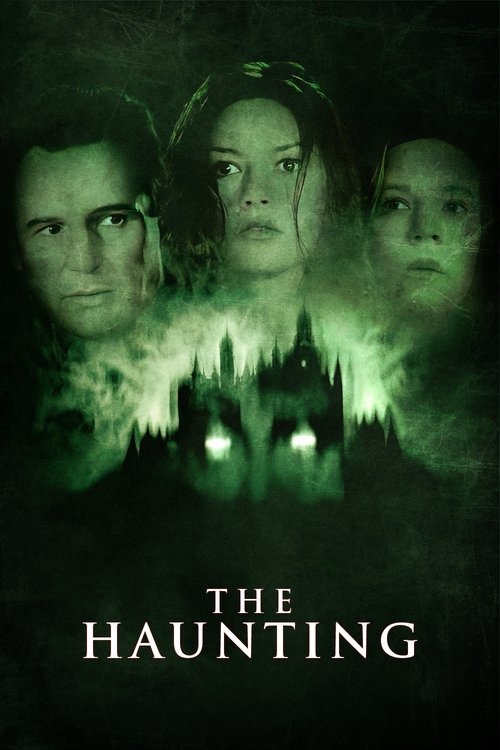
The Haunting, directed by Jan de Bont and released in 1999, is a big-budget reimagining of Shirley Jackson's 1959 novel The Haunting of Hill House. The film follows Dr. David Marrow (Liam Neeson), a sleep researcher who recruits three volunteers for what he claims is an insomnia study at a remote Gothic mansion. The volunteers are Nell (Lili Taylor), a fragile woman still reeling from her mother's recent death; Theo (Catherine Zeta-Jones), a sharp-tongued psychic; and Luke Sanderson (Owen Wilson), the cynical heir to the house. From the moment they arrive, the mansion's malevolent presence makes itself known, and the group soon realizes they are not alone.
With an $80 million budget, the film aimed to deliver a visual spectacle, relying heavily on elaborate sets and CGI effects. The result was a financial success, grossing over $177 million worldwide, but critical reception was harsh. Many critics felt the film sacrificed the psychological dread of Jackson's novel for loud, effects-driven scares. Despite the mixed reviews, Jerry Goldsmith's orchestral score, featuring a prominent pipe organ, was widely praised. The film's lavish production design, including a massive carved fireplace that took months to construct, remains a standout element.
The Haunting arrived at a time when practical effects were giving way to digital ones, and its failure to generate genuine terror became a talking point in Hollywood. It is often compared unfavorably to the 1963 Robert Wise adaptation, which is considered a classic of the genre. In the years since, the novel has been adapted again, most notably by Mike Flanagan's 2018 Netflix series The Haunting of Hill House, which finally brought the story's emotional depth to the screen. The 1999 film, however, endures as a cautionary tale about the limits of spectacle in horror.
Stream
Availability and pricing can change. Confirm on the provider's site before purchasing.
Dr. David Marrow, a sleep researcher, places an ad for a study on insomnia at a remote mansion. Three volunteers answer: Nell, a shy woman who recently lost her mother; Theo, a confident and flirtatious woman with hints of psychic ability; and Luke, the house's heir, who tags along as a skeptic. When they arrive at Hill House, they are greeted by the caretaker Mr. Dudley and his wife, who deliver cryptic warnings about the house's dark history. The mansion is a sprawling Victorian estate with towering ceilings, endless corridors, and a massive fireplace that seems to breathe.
Marrow's true purpose is not to study sleep but to observe how people react to fear. He has hidden cameras throughout the house and plans to manipulate the volunteers into believing they are experiencing paranormal activity. However, the house has its own agenda. On the first night, Nell hears a child's voice calling her name, and strange noises echo through the halls. Theo and Luke are also affected, but Nell becomes the primary target, as the house feeds on her emotional vulnerability.
As the nights progress, the supernatural events intensify. Statues move on their own, walls pound with unseen force, and a spiral staircase seems to come alive. Nell discovers that the house was built by Hugh Crain, a wealthy industrialist who used child labor and whose family suffered tragedy. The house, it becomes clear, is not merely haunted; it is hungry, drawing on the fears and traumas of those inside. Marrow dismisses the events as mass hysteria, but his subjects grow increasingly terrified.
The group's attempts to leave are thwarted by the house's power, and they realize they are trapped. Nell's connection to the house deepens, and she begins to hear the voice of Crain's abused daughter. As the entity's strength grows, the volunteers must confront their own demons while trying to survive the night. The film builds toward a climactic confrontation, leaving Nell's fate and the group's survival hanging in the balance.
The Haunting (1999) Original Trailer [HD]
Critical Consensus
The Haunting's lavish visuals and Jerry Goldsmith's score cannot compensate for a muddled script and reliance on CGI scares that lack genuine terror. Despite a strong cast, the film fails to capture the psychological dread of Shirley Jackson's source material, delivering spectacle over substance.
“The movie is all sensation and no feeling, a haunted house ride that substitutes special effects for the genuine terror of the original story.”
Roger Ebert
Chicago Sun-Times
“A thunderously noisy, visually extravagant haunted-house movie that overwhelms its actors and its audience with digital effects.”
Stephen Holden
The New York Times
“A technically impressive but dramatically hollow supernatural thriller that sacrifices the subtle psychological horror of Shirley Jackson's novel for a barrage of visual effects.”
Todd McCarthy
Variety
“The Haunting is proof that money can't buy terror, it's a film that overwhelms the senses but never touches the heart.”
Kenneth Turan
Los Angeles Times
Director
Jan de Bont
Writers
David Self, Shirley Jackson
Composer
Jerry Goldsmith
Cinematographer
Karl Walter Lindenlaub
Producers
Colin Wilson, Donna Roth, Susan Arnold
Join the community
fans discussing