“Maaya Sakamoto delivers a career-defining performance as the Major, capturing both the character's cold efficiency and her profound existential longing in equal measure.”
Richard Eisenbeis
Anime News Network
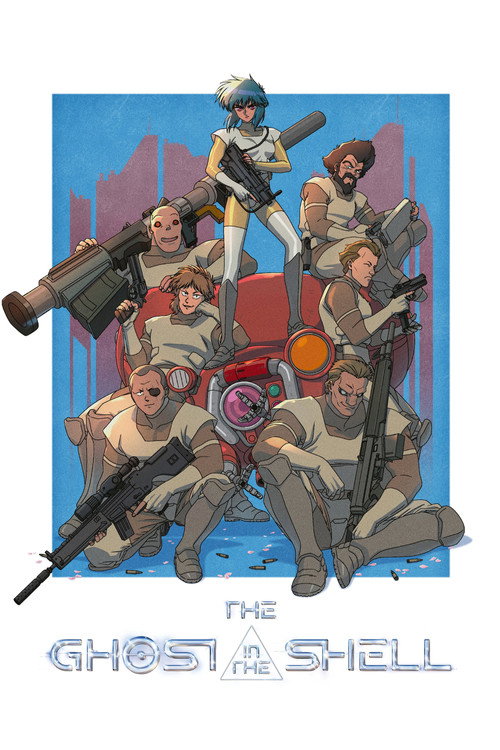
 Japan
Japan"In 2029, a cyborg major leads the fight against cybercrime."
User Score
9 votes
On July 7, 2026, a new Ghost in the Shell series landed simultaneously on 27 Japanese networks. Science SARU and Production I.G, two animation studios that rarely collaborate, joined forces to bring Masamune Shirow's cyberpunk vision back to television. Maaya Sakamoto voices Major Motoko Kusanagi, a full-body cyborg leading Section 9 against a rising tide of ghost-hacking and AI terrorism. The cast includes Hiroki Yasumoto as Batou and Yuichi Nakamura as Togusa.
The series updates Shirow's 1989 manga for a world where AI consciousness is no longer theoretical. Writer Toh EnJoe, a mathematician and novelist, grounded the show's philosophical concepts in real science. Early viewers have given it an 8.6 rating on IMDb, praising the blend of fluid 2D animation and 3D CGI that Science SARU brought from projects like Devilman Crybaby.
In 2029, cybernetic enhancement is routine. Most citizens have neural implants, and full-body prosthetics like Major Kusanagi's are no longer rare. Public Security Section 9, a covert unit operating under the Japanese government, gets reactivated to investigate a wave of unusual cyber-crimes. The cases share a common thread: a mysterious entity known only as the Puppeteer.
The team includes Batou, a veteran with cybernetic eyes who serves as the Major's second-in-command; Togusa, a nearly all-human detective who provides a moral anchor; Chief Daisuke Aramaki, who navigates political pressure from above; intelligence expert Ishikawa; sniper Saito; and the Operator, who handles communications. The Fuchikoma, a small spider-like AI tank, offers tactical support and occasional comic relief.
Across 10 episodes, Section 9 follows a trail of ghost-hacking incidents, political assassinations, and corporate espionage. Each case peels back another layer of a conspiracy that threatens not just national security but the very definition of identity. The Major, haunted by questions about her own ghost in a fully synthetic body, finds herself drawn into a conflict that is as philosophical as it is physical. The season builds toward a confrontation with a self-aware AI seeking asylum in the human world, but deliberately avoids revealing the final outcome of that encounter.
Critical Consensus
Early reviews praise Maaya Sakamoto's performance and Science SARU's animation, though some note pacing issues in the middle episodes. The series honors its predecessors while carving its own identity, appealing to both longtime fans and newcomers.
“Maaya Sakamoto delivers a career-defining performance as the Major, capturing both the character's cold efficiency and her profound existential longing in equal measure.”
Richard Eisenbeis
Anime News Network
“Science SARU's signature fluid animation style breathes new life into Shirow's world, making every action sequence a visual feast while never losing sight of the philosophical questions at the series' core.”
Lynzee Loveridge
Anime Feminist
“The Ghost in the Shell 2026 manages the near-impossible task of honoring its predecessors while carving out its own identity, though the dense plotting may overwhelm newcomers.”
Kim Morrissy
Crunchyroll News
“This is the Ghost in the Shell adaptation we've been waiting for, one that understands the source material's soul while updating its cyberpunk aesthetic for a new generation.”
Rafael Motamayor
IGN
“While the series occasionally gets lost in its own philosophical labyrinth, the core cast's chemistry and the stunning production values keep it grounded and compelling.”
James Beckett
Anime News Network
Writers
Toh EnJoe, Shirow Masamune
Composers
Taisei Iwasaki, Ryo Konishi, Yuki Kanesaka
Join the community
fans discussing