 United States
“The movie is a competent adventure thriller, but it never quite achieves the level of terror it aims for, relying too heavily on special effects and not enough on genuine suspense.”
Roger Ebert
Chicago Sun-Times
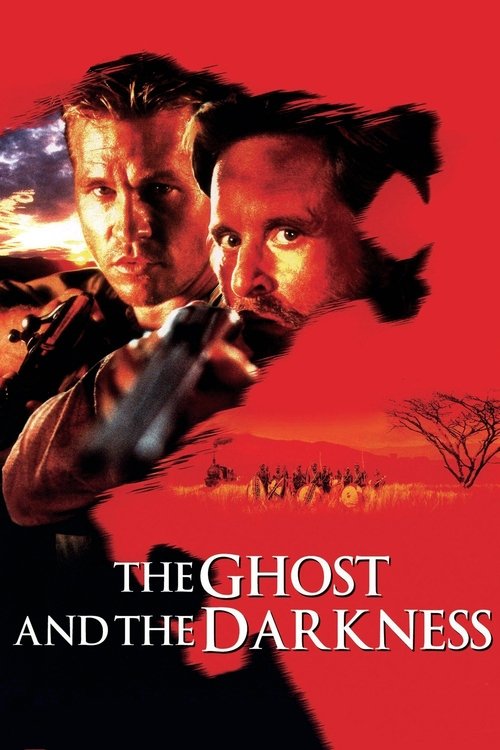
In 1898, a British railway project in East Africa hits a terrifying snag: two man-eating lions are systematically killing the Indian and African laborers building a bridge over the Tsavo River. The workers are on the verge of mutiny, convinced the lions are demonic spirits. Enter Colonel John Henry Patterson (Val Kilmer), a military engineer who must finish the bridge and stop the attacks. He's joined by Charles Remington (Michael Douglas), a flamboyant American big-game hunter who brings theatrical swagger and a deep knowledge of African predators. Together, they face lions that seem to hunt with coordinated intelligence, evading traps and night watches with unsettling ease.
Directed by Stephen Hopkins, the film blends historical drama with adventure-horror. Jerry Goldsmith's score and Vilmos Zsigmond's cinematography create a tense, atmospheric soundscape. The budget was $50 million, but the film grossed only $38.6 million worldwide. Despite mixed reviews, it won the Academy Award for Best Sound Effects Editing. The real Tsavo lions killed an estimated 135 people, and their stuffed remains are displayed at the Field Museum in Chicago.
Stream
Availability and pricing can change. Confirm on the provider's site before purchasing.
Colonel John Henry Patterson, a British military engineer, leaves his pregnant wife Helena in London for a prestigious assignment: build a railway bridge over the Tsavo River in British East Africa. The bridge is a critical link in the Uganda Railway, a project financed by Sir Robert Beaumont. When Patterson arrives at the work camp in 1898, he finds chaos. Thousands of laborers are terrified because two man-eating lions have been dragging workers from their tents at night, killing and devouring them. The attacks are so frequent and brutal that the workforce refuses to continue construction until the lions are eliminated.
Patterson meets Samuel, a wise African overseer who becomes his trusted ally and interpreter of local customs. Confident in his military training, Patterson sets up night watches and builds thorn fences called bomas around the camp. But the lions prove remarkably intelligent and elusive. They bypass his defenses effortlessly, killing more workers. The laborers whisper that these are not ordinary lions but demonic spirits, the Ghost and the Darkness, sent to punish the British for their colonial intrusion. Patterson's repeated hunting attempts fail, and the body count rises.
As the situation deteriorates, Beaumont sends for Charles Remington, a legendary American big-game hunter known for his flamboyant style and unmatched experience with African predators. Remington arrives with his own team of trackers and immediately takes charge. He dismisses Patterson's efforts, and the two form an uneasy partnership. Together, they devise increasingly elaborate traps and hunting strategies, but the lions continue to outsmart them, killing even more men. The lions seem to hunt with coordinated intelligence, attacking when least expected and vanishing into the bush without a trace.
Remington, who has killed hundreds of lions, begins to question his own abilities and wonders if these creatures might indeed be supernatural. Patterson struggles with his duty to complete the bridge versus his responsibility to protect the workers. The film builds tension through harrowing night attacks, close encounters, and the growing realization that conventional hunting methods are useless against these predators.
The Ghost and the Darkness 1996 Trailer | Michael Douglas | Val Kilmer
Critical Consensus
The Ghost and the Darkness offers solid performances from Kilmer and Douglas and impressive period atmosphere, but its script takes excessive liberties with the true story, undercutting the tension with implausible plot contrivances and an over-reliance on Hollywood tropes.
“The movie is a competent adventure thriller, but it never quite achieves the level of terror it aims for, relying too heavily on special effects and not enough on genuine suspense.”
Roger Ebert
Chicago Sun-Times
“Michael Douglas brings a welcome dose of theatricality to the proceedings, but the film's attempts at mysticism feel forced, and the lions are more impressive as historical artifacts than as movie monsters.”
Janet Maslin
The New York Times
“Director Stephen Hopkins generates some genuine tension in the night attack sequences, but the script's hokey dialogue and implausible character decisions undermine the film's credibility.”
Todd McCarthy
Variety
“Val Kilmer and Michael Douglas make an engaging odd couple, but the real stars are the lions, or rather, the animatronic and digital creations that never quite convince us they're real.”
David Ansen
Newsweek
Michael Douglas
Charles Remington
Val Kilmer
Col. John Henry Patterson
Tom Wilkinson
Sir Robert Beaumont
John Kani
Samuel
Emily Mortimer
Helena Patterson
Bernard Hill
Dr. David Hawthorne
Brian McCardie
Angus Starling
Om Puri
Abdullah
Jack Devnarain
Nervous Sikh Orderly
Henry Cele
Mahina
Kurt Egelhof
Indian Victim
Satchu Annamalai
Worker
Director
Stephen Hopkins
Writers
William Goldman, John Henry Patterson
Composer
Jerry Goldsmith
Cinematographer
Vilmos Zsigmond
Producers
Paul B. Radin, Gale Anne Hurd, A. Kitman Ho
Academy Awards (1997)
Best Sound Effects Editing: Won
Academy Awards (1997)
Best Sound: Nominated
Saturn Awards (1997)
Best Horror Film: Nominated
Saturn Awards (1997)
Best Actor: Nominated
Saturn Awards (1997)
Best Director: Nominated
Saturn Awards (1997)
Best Music: Nominated
Join the community
fans discussing