“A stunning visual poem about the nature of identity, where the mask becomes a prison for the soul and the faceless man finds his true self only in the shadows.”
Roger Ebert
Chicago Sun-Times
 Japan
Japan"It’s always lonely being free."
User Score
290 votes
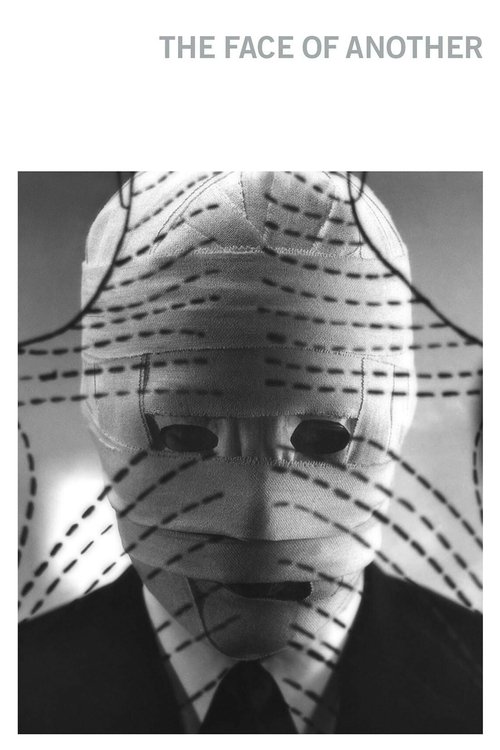
In the gray, modernist sprawl of 1960s Tokyo, an engineer named Mr. Okuyama (Tatsuya Nakadai) has been stripped of his face, and with it, his place in the world. An industrial accident left him with horrific burns, and now he hides behind drawn curtains, unable to bear the pity in his wife's eyes or the recoil of strangers. His marriage to Mrs. Okuyama (Machiko Kyō) is crumbling, a slow decay of glances and silences. Desperate, he turns to Dr. Hori (Mikijiro Hira), a psychiatrist whose methods are as unorthodox as his theories are unsettling. The doctor proposes a radical fix: a hyper-realistic mask, crafted to perfection, that will let Okuyama walk through the world unseen, unrecognized, free.
What begins as a liberation becomes a slow, creeping horror. The mask works too well. Okuyama, now sporting the smooth, handsome features of a stranger, finds that people treat him differently, with warmth, with curiosity, with desire. His wife, unaware of the mask, responds to this new man with an affection she hasn't shown her scarred husband in years. But the freedom goes to his head. He starts to test boundaries, to act with a cruelty that was always latent, and the line between the man and the mask blurs. Is he still Okuyama, or has he become the other?
Directed by Hiroshi Teshigahara, a key figure of the Japanese New Wave, The Face of Another is a chilling fusion of science fiction and psychological drama. Adapted by Kōbō Abe from his own 1964 novel, the film pairs Nakadai's intense, restrained performance with the stark black-and-white cinematography of Hiroshi Segawa and a dissonant, avant-garde score by Toru Takemitsu. Released in Japan on July 15, 1966, it was not a commercial hit, but it earned critical acclaim, including three Mainichi Film Awards and the Kinema Junpo Award for Best Film. It has since become a cult classic, studied for its exploration of identity, alienation, and the masks we all wear.
Availability and pricing can change. Confirm on the provider's site before purchasing.
Mr. Okuyama, a quiet engineer, survives an industrial explosion that leaves his face a mass of scar tissue. The accident robs him of more than his looks; it severs his connection to his wife, his colleagues, and the city around him. He becomes a recluse, spending his days behind drawn curtains, haunted by his reflection and the pity in his wife's eyes. Their marriage, once warm, now exists in a state of polite, painful distance.
In a last-ditch effort to reclaim his life, Okuyama seeks out Dr. Hori, a brilliant but eccentric psychiatrist who has been experimenting with prosthetic masks. Hori, intrigued by the psychological implications, agrees to create a mask so lifelike it could pass for real skin. The procedure is meticulous, and when Okuyama finally puts on the mask, the transformation is immediate. For the first time since the accident, he steps outside without fear. Strangers no longer flinch; they smile. His wife, seeing a handsome stranger, responds with a warmth she no longer shows her husband.
Emboldened, Okuyama begins to explore this new life. He frequents bars, flirts with women, and observes the world from a position of anonymity. But the mask, while hiding his scars, seems to unlock something darker. He becomes more reckless, more selfish, more detached. He starts to view people as obstacles or playthings. The line between the man beneath the mask and the mask itself begins to dissolve. He wonders: is this new persona a release of his true self, or a corruption of it?
As Okuyama's behavior grows increasingly erratic, his wife senses that something is wrong. She cannot pinpoint the change, but the man she lives with seems more distant, more cruel. Meanwhile, Dr. Hori watches his experiment unfold with a mix of fascination and dread. The mask, he realizes, is not just a covering; it is a catalyst for a profound psychological transformation. The story builds toward a tense confrontation as Okuyama struggles to hold onto his original identity while the mask demands his complete surrender. The question at the heart of the film: if you wear the face of another, who are you?
The Face of Another (1966) - Trailer
Critical Consensus
A haunting and visually striking masterpiece, The Face of Another uses a sci-fi premise to dissect the fragility of identity with surgical precision. Teshigahara's direction and Nakadai's intense performance create a deeply unsettling meditation on alienation and the duality of human nature.
“A stunning visual poem about the nature of identity, where the mask becomes a prison for the soul and the faceless man finds his true self only in the shadows.”
Roger Ebert
Chicago Sun-Times
“Teshigahara has crafted a chilling fable that feels less like science fiction and more like a psychological thriller, where the horror lies not in the mask, but in what it reveals about the wearer.”
A.O. Scott
The New York Times
“A masterful adaptation of Kobo Abe's novel, featuring a career-defining performance by Tatsuya Nakadai that captures the slow, terrifying erosion of selfhood.”
Todd McCarthy
Variety
“Visually arresting and intellectually rigorous, this black-and-white gem is a timeless exploration of how we construct our identities and the dangers of losing ourselves in the process.”
Peter Bradshaw
The Guardian
“A surreal nightmare that lingers long after the credits roll, proving that the most terrifying masks are the ones we wear willingly.”
David Ehrlich
IndieWire
Tatsuya Nakadai
Mr. Okuyama
Mikijiro Hira
Dr. Hori
Machiko Kyō
Mrs. Okuyama
Director
Hiroshi Teshigahara
Writer
Kōbō Abe
Composer
Toru Takemitsu
Cinematographer
Hiroshi Segawa
Producers
Nobuyo Horiba, Kiichi Ichikawa, Tadashi Ôno
Mainichi Film Awards (1966)
Best Director: Won
Mainichi Film Awards (1966)
Best Cinematography: Won
Mainichi Film Awards (1966)
Best Art Direction: Won
Kinema Junpo Awards (1966)
Best Film: Won
Kinema Junpo Awards (1966)
Best Director: Won
Blue Ribbon Awards (1966)
Best Director: Nominated
Blue Ribbon Awards (1966)
Best Supporting Actor: Nominated
Join the community
fans discussing