“Yes, it is a mad, ugly, gaudy, perhaps distasteful film. But it has many excellent points and, in my view, a strong literate script.”
Roger Ebert
Chicago Sun-Times
 United Kingdom
"Hell will hold no surprises for them..."
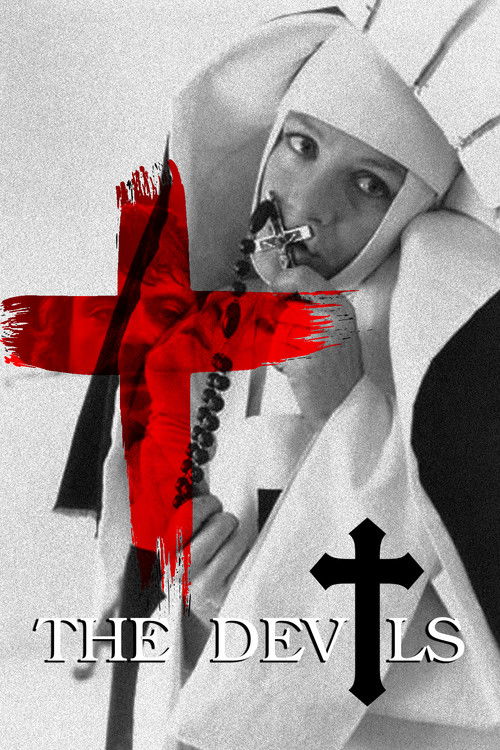
Ken Russell's The Devils (1971) is a historical drama that has lost none of its power to shock. Set in the walled city of Loudun in 1634, the film dramatizes the real-life possession scandal that led to the execution of Father Urbain Grandier. Russell, working from Aldous Huxley's 1952 book The Devils of Loudun and John Whiting's stage play, fashions a narrative that is part political thriller, part horror film, and part savage satire. The result is a work that remains as contentious today as it was upon release, praised for its audacity and condemned for its excess.
The film stars Oliver Reed as Grandier, a priest whose eloquence and worldly ways make him both beloved and feared. Vanessa Redgrave delivers a harrowing performance as Sister Jeanne des Anges, the prioress whose repressed desires erupt into public fits of hysteria. When she accuses Grandier of witchcraft, Cardinal Richelieu and his agent Baron de Laubardemont seize the opportunity to destroy a political nuisance. The ensuing trial and torture are depicted with unflinching brutality, framed by Russell's baroque visual style and Peter Maxwell Davies' dissonant score.
Shot on a budget of roughly $2 million, The Devils earned about $11 million worldwide. The production faced immediate censorship battles; the film was banned in several countries and heavily cut in the US. A 4K restoration of the director's cut, completed in 2026, finally allows audiences to see the film as Russell intended, with an NC-17 rating. This restoration has renewed interest in a movie that has influenced filmmakers from Darren Aronofsky to Luca Guadagnino.
Availability and pricing can change. Confirm on the provider's site before purchasing.
In 1634, the French city of Loudun is a powder keg of religious fervor and political tension. Father Urbain Grandier, the charismatic priest of Saint-Pierre-du-Martroi, is a man of contradictions. He preaches tolerance and challenges church dogma, yet he also leads a scandalous personal life, taking lovers and fathering a child. His influence over the townspeople is immense, and this does not go unnoticed by those in power.
At the Ursuline convent, the prioress Sister Jeanne des Anges is tormented by vivid sexual fantasies involving Grandier. Though she has never met him, she becomes obsessed with his reputation. Her disturbed mental state, exacerbated by the repressive environment of the convent, manifests in violent convulsions and fits of screaming. The local physician and clergy, unable to explain her condition, begin to whisper of demonic possession.
Cardinal Richelieu, the chief minister of France, sees an opportunity. He is determined to crush the Protestant influence in the region and consolidate royal authority. Loudun's resistance to his policies, symbolized by Grandier's independence, makes the priest a target. Richelieu dispatches Baron de Laubardemont, a ruthless and ambitious official, to investigate the alleged possession. Laubardemont quickly realizes that by supporting the nuns' claims, he can destroy Grandier and advance his own career.
The accusations spread like wildfire. The nuns, encouraged by the authorities and manipulated by the fanatical Father Pierre Barre, stage increasingly theatrical displays of possession. They writhe, speak in tongues, and claim that Grandier has bewitched them. The townspeople, already fearful of the devil, turn against their former hero. Grandier is arrested and subjected to brutal interrogation. Despite his eloquent defenses and the support of a few loyal friends, the machinery of the church and state grinds toward his destruction.
The film meticulously depicts the trial and torture, intercut with scenes of the nuns' hysteria and the political maneuvering of Richelieu. As the evidence against him mounts, Grandier's fate seems sealed. The narrative builds to a climax that is both harrowing and ambiguous, leaving the audience to question whether the demons are real or merely products of human cruelty, repression, and ambition.
Official Trailer
Critical Consensus
Ken Russell's The Devils is a visually audacious and intellectually provocative masterpiece that fearlessly dissects the intersection of religious fanaticism, political corruption, and sexual repression. While its graphic imagery and satirical tone remain polarizing, the film stands as a bold cinematic achievement, anchored by powerhouse performances from Vanessa Redgrave and Oliver Reed, and a score that perfectly complements its nightmarish atmosphere. It is a work of art that demands to be seen, challenging audiences to confront the darkness within both history and the human psyche.
“Yes, it is a mad, ugly, gaudy, perhaps distasteful film. But it has many excellent points and, in my view, a strong literate script.”
Roger Ebert
Chicago Sun-Times
“Ken Russell has made a film that is so rich in detail, so vivid in its imagination, and so terrifying in its implications that it must be seen to be believed.”
Vincent Canby
The New York Times
“Russell's 'The Devils' is a triumph of the imagination, a film that is both a historical drama and a fever dream of horror and satire.”
Pauline Kael
The New Yorker
“A visually stunning and intellectually challenging adaptation that pushes the boundaries of censorship and artistic expression.”
Variety Staff
Variety
“Vanessa Redgrave delivers a tour-de-force performance that anchors this wild, unsettling exploration of power and possession.”
Peter Bradshaw
The Guardian
Vanessa Redgrave
Sister Jeanne des Anges
Oliver Reed
Father Urbain Grandier
Dudley Sutton
Baron de Laubardemont
Max Adrian
Ibert (The Bishop)
Gemma Jones
Madeleine de Brou
Murray Melvin
Father-Canon Jean Mignon
Michael Gothard
Father Pierre Barre
Georgina Hale
Philippe Trincant
Brian Murphy
Adam
Christopher Logue
Cardinal Richelieu
Graham Armitage
King Louis XIII
John Woodvine
Louis Trincant
Director
Ken Russell
Writers
Ken Russell, Aldous Huxley, John Whiting
Composer
Peter Maxwell Davies
Cinematographer
David Watkin
Producers
Robert H. Solo, Ken Russell
National Society of Film Critics Awards (1972)
Best Cinematography: Won
BAFTA Awards (1972)
Best Costume Design: Nominated
British Society of Cinematographers (1971)
Outstanding Achievement in Cinematography: Won
Join the community
fans discussing