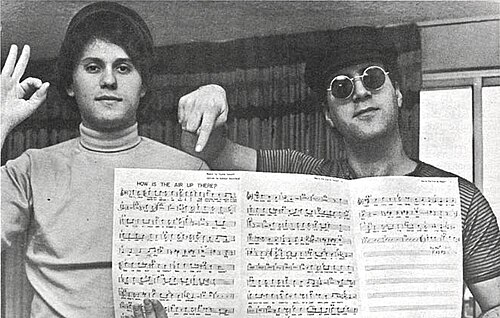
The Changin' Times
 United States
The duo behind the 1965 hit "The Pied Piper"
2
Members
About
Today, The Changin' Times exist primarily as a historical footnote in the annals of 1960s pop culture rather than an active musical entity. The duo effectively dissolved around 1967 after failing to replicate the commercial success of their debut hit. Artie Kornfeld moved away from performing to focus on event production, eventually co-founding the Monterey Pop Festival and Woodstock, while Steve Duboff stepped back from the public eye. Their identity is now firmly tied to the specific moment of 1965 when they captured the airwaves with a catchy, flute-driven track that defined the lighter side of the psychedelic era.
Fans of vintage pop and collectors of 45-rpm singles keep the memory of the group alive. The enduring appeal of "The Pied Piper" lies in its unique production value and the playful narrative lyrics that set it apart from the more serious protest songs or heavy rock tracks of the time. While Kornfeld achieved global fame decades later as a festival organizer, his early career as a performer remains a charming chapter in the history of American youth culture.
Formation Story
The story of The Changin' Times begins not on stage but in the songwriting rooms of Los Angeles during the height of the British Invasion. Artie Kornfeld and Steve Duboff met while working as professional songwriters in the mid-1960s, crafting tunes for various artists before deciding to record their own material. They signed with Cameo Parkway Records, a label famous for acts like Bobby Rydell and Chubby Checker, and quickly shifted gears from behind-the-scenes writers to front-and-center performers.
Their debut single, "The Pied Piper," was released in late 1965 and became an instant sensation. The song featured a prominent flute riff and whimsical storytelling that mirrored the growing interest in psychedelic sounds among mainstream pop listeners. The track climbed the charts rapidly, reaching the Top 20 in the United States and gaining significant traction in the United Kingdom as well. Following this success, the duo toured with Sonny and Cher later that same year, exposing their music to wider audiences across North America.
Despite the momentum, the group struggled to maintain their foothold in the competitive music market. A follow-up single titled "Free Spirit" achieved moderate radio play but failed to match the chart performance of their first release. By 1967, the pair had parted ways professionally, leaving behind a small but memorable discography. Kornfeld would soon pivot his career toward organizing large-scale music festivals, a move that would cement his legacy in the counterculture movement of the late 1960s.
Members
Musical Style
The Changin' Times operated squarely within the bubblegum pop and sunshine pop genres that dominated the mid-1960s. Their sound was characterized by bright, melodic harmonies and acoustic instrumentation that occasionally gave way to light orchestration. The production on their hit single "The Pied Piper" stands out for its use of a distinct flute melody, which added a folk-like texture to the otherwise polished pop arrangement. This blend of acoustic elements with studio polish was typical of the California Sound emerging at the time.
Lyrical themes often leaned towards the whimsical and narrative-driven, telling stories that appealed to younger listeners without getting bogged down in political commentary. As the era progressed into 1966 and 1967, their style began to incorporate slightly more psychedelic influences, reflecting the broader cultural shift towards experimental sounds. However, they never fully embraced the heavy experimentation seen in bands like The Beatles or The Zombies, maintaining a consistent, accessible pop aesthetic throughout their short tenure.
Discography
| Title | Year |
|---|---|
| The Pied Piper | 1965 |
| Free Spirit | 1966 |
| How Is the Air Up There? | 1966 |
| I'll Be Your Man | 1967 |
Tours
Sonny and Cher Tour
1965 · 42 shows
Cultural Impact
While The Changin' Times did not achieve the massive cultural dominance of some of their contemporaries, their impact on the songwriting landscape of the 1960s remains significant. The success of "The Pied Piper" demonstrated that there was still room for lighthearted, narrative-driven pop songs in an increasingly complex musical climate. The track's popularity in both the US and UK markets highlighted the shared taste for this particular brand of sunshine pop across the Atlantic.
Perhaps their most lasting contribution comes indirectly through Artie Kornfeld. His experience forming and managing The Changin' Times provided him with the industry connections and organizational skills necessary to later co-found the Monterey Pop Festival and Woodstock. These events fundamentally changed how music was consumed and experienced globally, turning concerts into cultural phenomena. Thus, the duo's brief existence served as a crucial stepping stone for one of the most influential figures in rock history.
Fandom Culture
The concept of an organized fandom with official colors, lightsticks, or structured fan clubs did not exist for The Changin' Times during their active years. Instead, their audience consisted of general pop music listeners who enjoyed the radio hits of the mid-60s. Today, the group is remembered by collectors of 1960s vinyl and enthusiasts of the "one-hit wonder" genre. Fans often seek out rare pressings of their singles and appreciate the historical significance of Kornfeld's early work alongside his later festival achievements.
Awards & Accolades
Milestones
Debut single "The Pied Piper" reaches #13 on Billboard Hot 100
Release of follow-up single "Free Spirit"
Artie Kornfeld co-founded Woodstock Music & Art Fair
Trivia
Artie Kornfeld went on to co-found the Woodstock Music & Art Fair in 1969, becoming one of the most famous music festival organizers in history., Their hit song "The Pied Piper" was covered by British artist Crispian St. Peters, whose version also reached the UK Top 20., The duo toured with Sonny and Cher in 1965, sharing stages with some of the biggest stars of the era., "The Pied Piper" features a distinctive flute riff that became the song's signature element., Despite their success, the group never released a full studio album under their own name during their initial run.
Keywords
Sources
Quick Facts
- Type
- Duo
- Origin
- United States
- Members
- 2
- Status
- Disbanded
Group Info
- Formed
- 1965
- Debut
- 1965-10-01
- Debut Song
- The Pied Piper
- Origin
- United States
- Company
- Various Independent Labels
- Label
- Cameo Parkway / MGM Records
- Status
- Disbanded (1967)
Also Known As
Join the community
fans discussing