 United States
“It's a movie that makes you angry, makes you laugh, and makes you want to understand what happened.”
Manohla Dargis
The New York Times
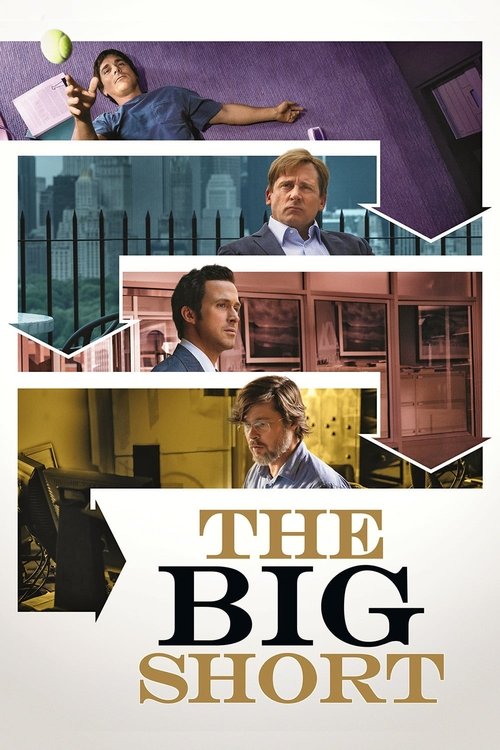
Adam McKay's adaptation of Michael Lewis's nonfiction book turns the 2008 financial crisis into a darkly comic, infuriating thriller. The film follows several groups of outsiders who correctly predicted the collapse of the housing market and bet against the banks, making a fortune in the process. Christian Bale plays Michael Burry, a hedge fund manager with a prosthetic eye who first spots the subprime mortgage rot. Steve Carell is Mark Baum, a cynical fund manager who investigates the fraud behind mortgage-backed securities. Ryan Gosling plays Jared Vennett, a Deutsche Bank trader who connects the dots, while Brad Pitt appears as Ben Rickert, a retired banker who helps two young investors place their bets.
Made for $28 million, the film grossed $133 million worldwide and won the Academy Award for Best Adapted Screenplay. McKay employs celebrity cameos and fourth-wall breaks to explain complex financial instruments like CDOs and credit default swaps, making the arcane world of high finance accessible without dumbing it down. The film's tone shifts from absurdist comedy to genuine moral outrage as the scale of the deception becomes clear.
Nicholas Britell's score mixes classical strings with percussive tension, while the soundtrack includes period-appropriate tracks that underscore the era's excess. The film is a standalone work, not part of any series, but it remains a key text in understanding the 2008 crash and its aftermath.
Availability and pricing can change. Confirm on the provider's site before purchasing.
Dr. Michael Burry, a reclusive hedge fund manager with a glass eye and a love for heavy metal, pores over thousands of mortgage bond documents and realizes the housing market is built on toxic loans. In 2005, he convinces his skeptical investors to let him buy credit default swaps insurance policies that pay out if mortgage bonds default. The big banks, including Goldman Sachs and Deutsche Bank, are happy to sell him these contracts, believing the market is sound.
Meanwhile, Jared Vennett, a Deutsche Bank salesman, catches wind of Burry's bet and sees an opportunity. He pitches the idea to Mark Baum, a hedge fund manager known for his abrasive honesty and deep distrust of Wall Street. Baum and his team Danny Moses, Vinny Daniel, and Porter Collins begin their own investigation. They travel to Miami and speak with real estate agents who admit to falsifying loan applications, and they visit a Las Vegas conference where they confront rating agency analysts who give AAA ratings to junk bonds.
Separately, two young investors, Charlie Geller and Jamie Shipley, run a small fund from a garage. They stumble upon Vennett's pitch document and, with the help of retired banker Ben Rickert, decide to bet against the market. Ben warns them of the moral consequences profiting from others' misery but helps them navigate the opaque world of credit default swaps.
As the characters dig deeper, they uncover systemic fraud. Banks knowingly bundle bad loans into collateralized debt obligations (CDOs), rating agencies rubber-stamp them, and regulators look the other way. The protagonists face mounting pressure as their investors demand explanations and the market refuses to crash. Burry's fund loses value, and his investors try to pull their money. Baum's firm is threatened by its parent company. Yet the evidence of fraud accumulates: mortgage brokers approve loans for people with no income, and the housing bubble inflates to absurd levels.
The film intercuts these storylines with explanatory asides featuring celebrities like Margot Robbie in a bathtub explaining subprime mortgages and Anthony Bourdain comparing a CDO to a fish stew made with old fish. These moments leaven the dense financial material with humor. The tension builds as the housing market finally begins to crack in 2007, with subprime lenders collapsing and home prices starting to fall. The protagonists wait for their bets to pay off, knowing that their profit depends on a catastrophe that will destroy millions of lives.
The Big Short - Trailer #2 "Screwed" (2015) - Paramount Pictures
The Big Short Trailer (2015) - Paramount Pictures
Critical Consensus
Informative, entertaining, and surprisingly funny, The Big Short tackles complex financial subjects with clarity and style, anchored by a stellar ensemble cast.
“It's a movie that makes you angry, makes you laugh, and makes you want to understand what happened.”
Manohla Dargis
The New York Times
“The Big Short is a financial thriller that manages to be both deeply informative and wildly entertaining.”
Peter Travers
Rolling Stone
“Adam McKay's film is a furiously intelligent, scathingly funny, and deeply disturbing look at the 2008 financial meltdown.”
David Ehrlich
IndieWire
“It's a dense, didactic film, but it's also a rollicking good time.”
Scott Foundas
Variety
“The film is packed with so much information and so many characters that it's a wonder it holds together at all, let alone works so well.”
Mick LaSalle
San Francisco Chronicle
Steve Carell
Mark Baum
Christian Bale
Michael Burry
Ryan Gosling
Jared Vennett
Brad Pitt
Ben Rickert
Melissa Leo
Georgia Hale
Hamish Linklater
Porter Collins
John Magaro
Charlie Geller
Rafe Spall
Danny Moses
Jeremy Strong
Vinny Daniel
Marisa Tomei
Cynthia Baum
Finn Wittrock
Jamie Shipley
Tracy Letts
Lawrence Fields
Director
Adam McKay
Writers
Adam McKay, Charles Randolph, Michael Lewis
Composer
Nicholas Britell
Cinematographer
Barry Ackroyd
Producers
Arnon Milchan, Brad Pitt, Dede Gardner, Jeremy Kleiner
Academy Awards (2016)
Best Adapted Screenplay: Won
Academy Awards (2016)
Best Picture: Nominated
Academy Awards (2016)
Best Supporting Actor (Christian Bale): Nominated
Academy Awards (2016)
Best Film Editing: Nominated
Academy Awards (2016)
Best Director: Nominated
Golden Globe Awards (2016)
Best Motion Picture – Musical or Comedy: Nominated
Golden Globe Awards (2016)
Best Actor – Motion Picture Musical or Comedy (Christian Bale): Nominated
Golden Globe Awards (2016)
Best Screenplay: Nominated
BAFTA Awards (2016)
Best Adapted Screenplay: Won
BAFTA Awards (2016)
Best Film: Nominated
BAFTA Awards (2016)
Best Actor (Christian Bale): Nominated
BAFTA Awards (2016)
Best Editing: Nominated
Join the community
fans discussing