“The Dude, who smokes a lot of pot and guzzles White Russians made with half-and-half, starts every day filled with resolve, but his plans gradually dissolve into a haze of missed opportunities.”
Roger Ebert
Chicago Sun-Times
 United States
"Sometimes the rug really ties the room together."
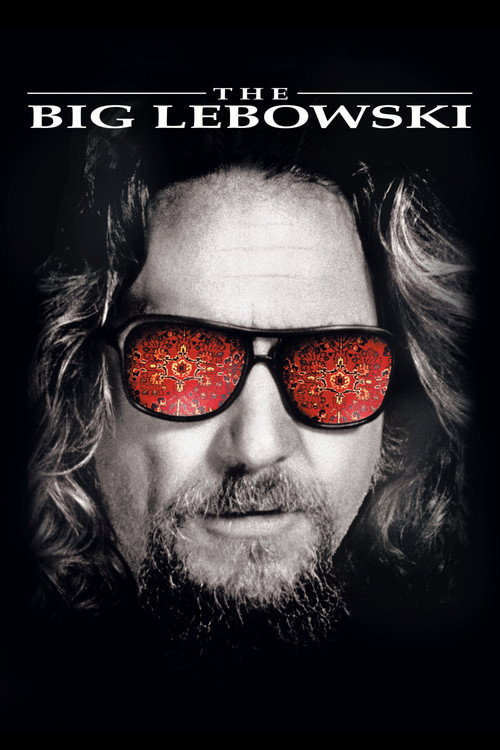
In 1991, Jeff Bridges's Jeffrey Lebowski, known to everyone as The Dude, is a man of simple pleasures: bowling, White Russians, and a rug that really ties his apartment together. When a pair of thugs mistake him for a wealthy namesake and urinate on that rug, the Dude's placid life spirals into a labyrinth of mistaken identity, ransom drops, and nihilists. Directed by Joel and Ethan Coen, this 1998 comedy-crime film unspools as a shaggy-dog detective story set against the sun-baked sprawl of Los Angeles.
John Goodman plays Walter Sobchak, the Dude's bowling partner and a Vietnam vet with a hair-trigger temper and a rigid moral code. Julianne Moore is Maude Lebowski, the eccentric artist daughter of the real big Lebowski, while Steve Buscemi rounds out the trio as the sweet-natured Donny, perpetually silenced by Walter's outbursts. Shot on a $15 million budget by cinematographer Roger Deakins, the film earned over $47 million worldwide. Its loose structure, quotable dialogue, and celebration of slacker philosophy turned it into a cult phenomenon, earning a 7.8 rating from over 12,000 votes on IMDb and a spot in the National Film Registry in 2014.
Availability and pricing can change. Confirm on the provider's site before purchasing.
Jeffrey Lebowski, a man who prefers to be called The Dude, lives a quiet life in Venice Beach, California, circa 1991. His routine consists of smoking marijuana, drinking White Russians, and bowling with his friends Walter Sobchak and Donny Kerabatsos at Hollywood Star Lanes. That peace shatters when two thugs break into his apartment, mistake him for a millionaire of the same name, rough him up, and urinate on his rug. The rug, as the Dude later explains, really tied the room together.
Seeking restitution, the Dude visits the real Jeffrey Lebowski, a wealthy, wheelchair-bound philanthropist, at his sprawling Pasadena mansion. There he meets Brandt, the Big Lebowski's sycophantic assistant, and learns that the millionaire's young wife, Bunny, has been kidnapped by a group of German nihilists demanding $1 million in ransom. The Big Lebowski offers the Dude a simple job: deliver the ransom money to the kidnappers. Walter, convinced that this is their chance to stick it to the rich, pushes the Dude to accept.
The Dude also meets Maude Lebowski, the Big Lebowski's avant-garde artist daughter, who paints by hurling herself onto canvases suspended from the ceiling. Maude suspects her father staged the kidnapping to embezzle money from a charitable foundation established by his late wife. She offers the Dude $100,000 if he can recover the funds. Meanwhile, the Dude finds himself entangled with Jackie Treehorn, a pornographer and Bunny's former employer, who sends thugs to intimidate him.
The Dude's journey takes him through a series of increasingly absurd misadventures: his car is stolen, he's drugged and experiences a surreal Busby Berkeley-style musical hallucination, and he's repeatedly beaten by various parties seeking information he doesn't have. Walter's plan to intercept the ransom drop goes catastrophically wrong, he insists on using a fake briefcase and brandishes a gun, leaving the money stolen and the nihilists furious. Throughout it all, the Dude, Walter, and Donny must also prepare for their upcoming bowling tournament, which serves as a grounding counterpoint to the escalating chaos. The central mystery remains: who has the money, and was the kidnapping real or a fraud?
Park Circus Official Trailer
Blu-ray Trailer
DVD Trailer
Critical Consensus
The Big Lebowski initially divided critics but has since become a cult classic, celebrated for its quotable dialogue, eccentric characters, and surreal dream sequences. While some found its meandering plot frustrating, the film's satirical take on Los Angeles culture and its celebration of slacker philosophy have made it enduringly beloved.
“The Dude, who smokes a lot of pot and guzzles White Russians made with half-and-half, starts every day filled with resolve, but his plans gradually dissolve into a haze of missed opportunities.”
Roger Ebert
Chicago Sun-Times
“The Coen brothers have made a film that is less a story than a shaggy-dog joke, but it's told with such style and confidence that it never wears out its welcome.”
Janet Maslin
The New York Times
“A rambling, shaggy-dog story that goes in all directions and ends up nowhere in particular, but the trip is consistently amusing thanks to the Coens' typically offbeat characters and dialogue.”
Todd McCarthy
Variety
“The Big Lebowski is a wonderfully weird, thoroughly entertaining ride through the underbelly of Los Angeles, with Jeff Bridges giving a career-best performance as the ultimate slacker.”
Peter Stack
San Francisco Chronicle
“Though it has its share of laughs and inspired moments, the film is too self-consciously bizarre and too enamored of its own eccentricities to fully connect with mainstream audiences.”
Kenneth Turan
Los Angeles Times
Jeff Bridges
The Dude
John Goodman
Walter Sobchak
Julianne Moore
Maude Lebowski
Steve Buscemi
Donny Kerabatsos
David Huddleston
The Big Lebowski
Philip Seymour Hoffman
Brandt
Tara Reid
Bunny Lebowski
John Turturro
Jesus Quintana
Ben Gazzara
Jackie Treehorn
Sam Elliott
The Stranger
Directors
Joel Coen, Ethan Coen
Writers
Ethan Coen, Joel Coen
Composer
Carter Burwell
Cinematographer
Roger Deakins
Producer
Ethan Coen
National Film Registry (2014)
Culturally, historically or aesthetically significant: Selected
Palme d'Or (1998)
Best Film: Nominated
BAFTA Award (1999)
Best Original Screenplay: Nominated
Golden Globe Award (1999)
Best Actor – Motion Picture Musical or Comedy: Nominated
Satellite Award (1999)
Best Actor in a Motion Picture – Musical or Comedy: Won
Join the community
fans discussing