 Algeria
“It is a film that demands to be seen, a masterpiece of political cinema that remains as relevant today as it was fifty years ago.”
Roger Ebert
Chicago Sun-Times
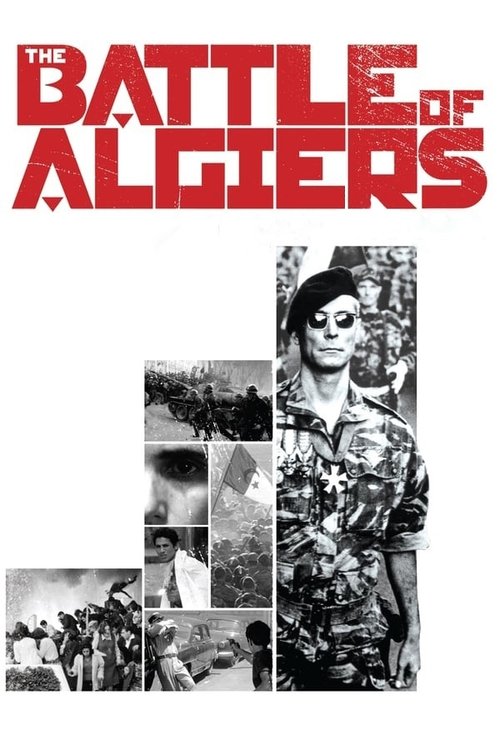
Gillo Pontecorvo's 1966 film places viewers directly inside the chaotic streets of Algiers during the Algerian War. The story follows Colonel Mathieu, a seasoned French paratrooper with a history in the World War II Resistance, as he arrives to crush an insurgency that threatens colonial rule. Opposing him is Ali La Pointe, a former petty criminal turned FLN leader who organizes terror campaigns against the occupying forces. The narrative explores how both sides escalate their tactics until violence becomes the only language they speak.
Shot in stark black and white with handheld cameras, the movie mimics the aesthetic of newsreel footage to create a sense of immediate documentary realism. Non-professional actors fill many roles, including Yacef Saâdi, who actually led the FLN intelligence service in Algiers during the real events. This production choice blurs the line between fiction and historical record, forcing audiences to confront the raw mechanics of urban warfare without the buffer of Hollywood gloss.
Stream
Availability and pricing can change. Confirm on the provider's site before purchasing.
The year is 1957, and the city of Algiers is a powder keg waiting for a spark. Following the withdrawal of French forces from Vietnam, the French government feels compelled to reassert its dominance over Algeria. General Massu initially takes command but hands operations over to Colonel Philippe Mathieu, a man known for his ruthless efficiency and background in the French Resistance. Mathieu arrives with a clear mandate: dismantle the National Liberation Front (FLN) network operating within the Casbah district. He brings with him a team of paratroopers equipped with modern surveillance technology and a willingness to employ any means necessary to secure victory.
On the other side of the conflict stands the FLN, a decentralized group of revolutionaries fighting for Algerian independence. Their leadership includes El-Hadi Jaffar and the newly recruited Ali La Pointe. Ali starts as a small-time thug living on the fringes of society but finds purpose in the struggle against colonial oppression. Under the guidance of veteran commanders, he undergoes a transformation into a disciplined revolutionary. The FLN begins a campaign of targeted bombings aimed at French civilians and institutions, hoping to provoke a harsh response that will radicalize the wider population. They construct bombs in hidden basements, smuggle weapons through the labyrinthine alleys of the Casbah, and recruit young women to act as couriers and bombers.
The tension escalates rapidly as the French military implements a strategy of mass arrests, curfews, and systematic torture. Mathieu's men turn the Casbah into a fortress, sealing off neighborhoods and interrogating suspects with brutal intensity. The film details the psychological toll this takes on both the interrogators and the detainees. Meanwhile, the FLN struggles with internal divisions and the constant threat of betrayal by informants. Key figures like Larbi Ben M'hidi are arrested and executed, sparking waves of grief and anger among the local populace. Despite these setbacks, the resistance movement adapts, launching new attacks that keep the French forces on edge.
As the battle reaches its peak, the French launch a massive sweep operation designed to capture or kill the remaining FLN leadership. The streets become a no-man's-land where trust is nonexistent and every corner holds potential danger. The film captures the claustrophobic atmosphere of a city under siege, where ordinary citizens are caught in the crossfire of a political war. The moral ambiguity of the situation deepens as the French soldiers, though following orders, begin to question the ethics of their methods. Conversely, the FLN fighters, driven by a desire for freedom, resort to tactics that blur the lines between heroism and terrorism.
The narrative builds toward a climax of intense confrontation. The French seem to gain the upper hand as they systematically dismantle the FLN's command structure. Ali La Pointe, once a symbol of hope for the revolution, is hunted down and captured. The French celebrate what appears to be a decisive victory, believing they have neutralized the threat. However, the human cost of this success is evident in the faces of the people who watch their leaders fall. The film leaves the ultimate outcome of the war ambiguous, focusing instead on the cyclical nature of violence and the enduring spirit of the Algerian people.
The Battle of Algiers - Trailer
Critical Consensus
A gripping, visceral, and morally complex masterpiece, The Battle of Algiers uses a faux-documentary style to explore the brutal realities of colonialism and counterinsurgency. Its unflinching depiction of violence and its refusal to take sides make it a timeless and essential work of cinema.
“It is a film that demands to be seen, a masterpiece of political cinema that remains as relevant today as it was fifty years ago.”
Roger Ebert
Chicago Sun-Times
“Gillo Pontecorvo's 'The Battle of Algiers' is a film of such power and urgency that it seems to have been made yesterday.”
Vincent Canby
The New York Times
“The film is a terrifyingly effective piece of propaganda, but it is also a work of art that transcends its political message.”
Pauline Kael
The New Yorker
Brahim Hadjadj
Ali La Pointe
Jean Martin
Colonel Philippe Mathieu
Yacef Saâdi
El-Hadi Jaffar
Mohamed Ben Kassen
Petit Omar
Fouzia El Kader
Halima
Si Mohamed Baghdadi
Larbi Ben M'hidi
Rouiched
The Drunk Man
Larbi Zekkal
Combattant FLN
Director
Gillo Pontecorvo
Writers
Gillo Pontecorvo, Franco Solinas
Composers
Ennio Morricone, Gillo Pontecorvo
Cinematographer
Marcello Gatti
Producers
Yacef Saâdi, Antonio Musu
Academy Awards (1967)
Best Director: Nominated
Academy Awards (1967)
Best Original Screenplay: Nominated
Golden Globe Awards (1967)
Best Foreign Language Film: Won
BAFTA Awards (1968)
Best Film from any Source: Won
BAFTA Awards (1968)
Best Editing: Won
Venice Film Festival (1966)
Golden Lion: Won
Join the community
fans discussing