“DiCaprio’s performance is a revelation. He’s not just playing Howard Hughes; he *is* Howard Hughes.”
Claudia Puig
USA Today
 United States
"He flew higher, loved harder, and feared more."
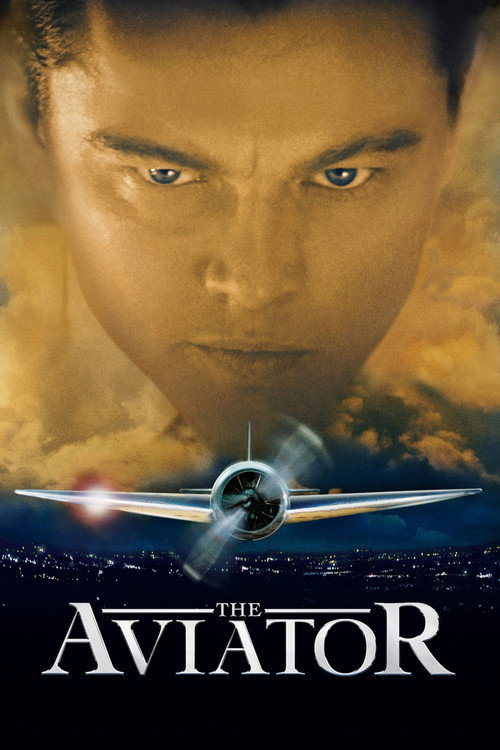
Martin Scorsese turned his lens on the larger-than-life figure of Howard Hughes in The Aviator, a sprawling 2004 drama that charts the mogul's rise and the simultaneous descent of his mental state. Leonardo DiCaprio embodies Hughes, the ambitious filmmaker and aviation pioneer who navigated Hollywood and the skies with equal daring. The film casts a wide net, featuring Cate Blanchett as the formidable Katharine Hepburn and Kate Beckinsale as the glamorous Ava Gardner, two of the many women in Hughes's orbit.
With a reported budget nearing $110 million, the production aimed for a grand scale, recreating the golden age of Hollywood and the dawn of modern aviation. Scorsese, known for his deep dives into complex characters, explores Hughes's obsessive-compulsive disorder alongside his triumphs, painting a portrait of genius intertwined with debilitating anxiety. The film earned significant critical attention, reflected in its 7.2 rating from thousands of votes, and stands as a notable entry in the biographical drama genre.
Availability and pricing can change. Confirm on the provider's site before purchasing.
The film opens in 1927 Los Angeles, introducing the young, wealthy Howard Hughes as he prepares to direct and produce his ambitious World War I aviation film, Hell's Angels. Even at this early stage, Hughes exhibits an intense perfectionism and a burgeoning fear of germs and contamination, which he attempts to manage through elaborate rituals. He is driven by a desire to push the boundaries of filmmaking and aviation, investing his vast fortune into creating the most spectacular and realistic aerial sequences ever seen. The production of Hell's Angels is depicted as a monumental undertaking, plagued by technical difficulties and weather delays, with Hughes relentlessly pursuing perfection, even if it means reshooting scenes with actual aircraft years after the war.
As Hughes navigates the complex world of Hollywood, he becomes a celebrated figure, known for his daring stunts and his lavish lifestyle. He also develops a reputation as a womanizer, entering into relationships with prominent actresses and personalities. The film highlights his romantic involvements with the fiery and independent Katharine Hepburn (Cate Blanchett) and the glamorous Hollywood star Ava Gardner (Kate Beckinsale), two of the many women who orbit his life. These relationships are depicted as passionate but ultimately strained by Hughes's increasing eccentricities and his all-consuming dedication to his various projects. Hepburn, in particular, challenges Hughes's behavior, while Gardner is drawn to his power and wealth, though she too struggles with his increasingly erratic nature.
Hughes's passion for aviation leads him to found Hughes Aircraft and RKO Pictures, further solidifying his status as a powerful mogul. He personally designs and pilots experimental aircraft, pushing the limits of speed and engineering. His most significant aviation achievement depicted in the film is the development of the massive flying boat, the H-4 Hercules, nicknamed the "Spruce Goose." This ambitious project is born out of wartime necessity and Hughes's relentless pursuit of innovation, though it faces significant political and technical hurdles. He also becomes embroiled in a public battle with Pan Am and its founder Juan Trippe, challenging the airline's monopoly on international air travel.
Throughout the film, the central conflict arises from Hughes's internal battle with his escalating OCD. His phobias, particularly his fear of germs, lead him to develop increasingly elaborate routines to avoid contamination, including wearing gloves constantly and showering excessively. These obsessions begin to impact his business dealings and his personal relationships, creating a stark contrast between his public image as a fearless visionary and his private struggles with anxiety and paranoia. The film also touches upon his battles with the U.S. government, particularly Senator Ralph Owen Brewster, who investigates Hughes's business practices and potential ties to Nazi Germany during World War II, accusing him of wartime profiteering.
The narrative follows Hughes as he attempts to maintain control over his empire and his personal life while his mental health deteriorates. His public appearances become rarer, and his private life becomes more isolated as his compulsions intensify. The film builds towards a critical juncture where Hughes faces intense public scrutiny and personal challenges, testing his resilience and his grip on reality as his empire and his sanity hang in the balance.
Official Trailer
The Aviator - Trailer
Critical Consensus
Martin Scorsese's The Aviator is a lavish and engrossing biopic, anchored by a commanding performance from Leonardo DiCaprio and brought to life by stunning period detail and visual effects. It offers a complex portrait of Howard Hughes, exploring his genius and his descent into mental illness with both spectacle and sensitivity.
“DiCaprio’s performance is a revelation. He’s not just playing Howard Hughes; he *is* Howard Hughes.”
Claudia Puig
USA Today
“Scorsese has delivered a grand, sweeping epic that is as visually stunning as it is psychologically complex.”
Kirk Honeycutt
The Hollywood Reporter
“The Aviator is a triumph of filmmaking, a meticulous recreation of a bygone era and a poignant study of a troubled genius.”
David Edelstein
Slate
“Cate Blanchett is simply magnificent as Katharine Hepburn, capturing the star's spirit and fire with uncanny accuracy.”
Peter Travers
Rolling Stone
“A dazzling spectacle that manages to be both entertaining and deeply unsettling.”
A.O. Scott
The New York Times
Leonardo DiCaprio
Howard Hughes
Cate Blanchett
Katharine Hepburn
Kate Beckinsale
Ava Gardner
John C. Reilly
Noah Dietrich
Alec Baldwin
Juan Trippe
Alan Alda
Senator Ralph Owen Brewster
Ian Holm
Professor Fitz
Danny Huston
Jack Frye
Gwen Stefani
Jean Harlow
Jude Law
Errol Flynn
Adam Scott
Johnny Meyer
Matt Ross
Glenn Odekirk
Director
Martin Scorsese
Writers
John Logan, Howard Hughes (story)
Composer
Howard Shore
Cinematographer
Robert Richardson
Producers
Graham King, Charles Evans Jr., Jillian Vance, Sandy Climan, Matthias Deyle, Michael Mann
Academy Awards (2005)
Best Actress in a Supporting Role: Won
Academy Awards (2005)
Best Art Direction: Won
Academy Awards (2005)
Best Cinematography: Won
Academy Awards (2005)
Best Costume Design: Won
Academy Awards (2005)
Best Picture: Nominated
Academy Awards (2005)
Best Director: Nominated
Academy Awards (2005)
Best Actor: Nominated
Academy Awards (2005)
Best Actor in a Supporting Role: Nominated
Academy Awards (2005)
Best Original Screenplay: Nominated
Academy Awards (2005)
Best Film Editing: Nominated
Academy Awards (2005)
Best Original Score: Nominated
Academy Awards (2005)
Best Sound: Nominated
Golden Globe Awards (2005)
Best Actor – Motion Picture Drama: Won
Golden Globe Awards (2005)
Best Original Score: Won
Golden Globe Awards (2005)
Best Motion Picture – Drama: Nominated
Golden Globe Awards (2005)
Best Director: Nominated
Golden Globe Awards (2005)
Best Actress – Motion Picture Drama: Nominated
Golden Globe Awards (2005)
Best Screenplay: Nominated
British Academy Film Awards (2005)
Best Film: Won
British Academy Film Awards (2005)
Best Actor in a Leading Role: Won
British Academy Film Awards (2005)
Best Actress in a Supporting Role: Won
British Academy Film Awards (2005)
Best Production Design: Won
British Academy Film Awards (2005)
Best Director: Nominated
British Academy Film Awards (2005)
Best Original Screenplay: Nominated
British Academy Film Awards (2005)
Best Cinematography: Nominated
British Academy Film Awards (2005)
Best Costume Design: Nominated
British Academy Film Awards (2005)
Best Editing: Nominated
British Academy Film Awards (2005)
Best Makeup & Hair: Nominated
British Academy Film Awards (2005)
Best Original Music: Nominated
British Academy Film Awards (2005)
Best Sound: Nominated
Screen Actors Guild Awards (2005)
Outstanding Performance by a Male Actor in a Leading Role: Nominated
Screen Actors Guild Awards (2005)
Outstanding Performance by a Male Actor in a Supporting Role: Nominated
Screen Actors Guild Awards (2005)
Outstanding Performance by a Female Actor in a Supporting Role: Won
Join the community
fans discussing