 United States
Overview
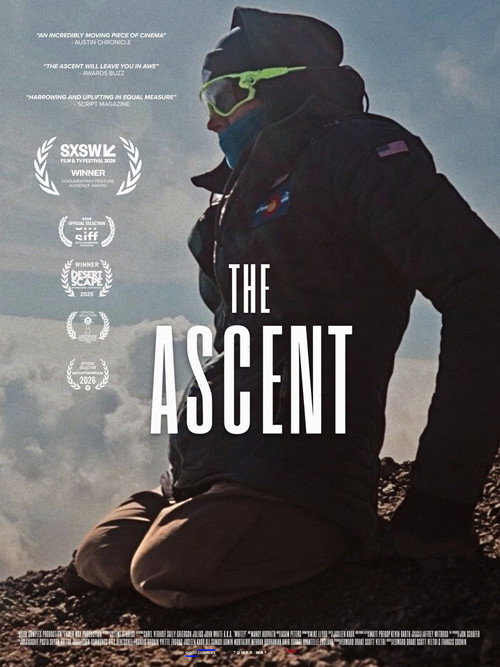
Mandy Horvath does not climb mountains with legs. The documentary The Ascent follows her journey as a bilateral amputee attempting to crawl to the summit of Mount Kilimanjaro, a feat that defies conventional expectations of human endurance. Director Edward Drake captures this raw physical struggle alongside the haunting memories of how she lost both legs at age twenty-one. The film blends intimate personal history with the grueling reality of high-altitude trekking in East Africa.
Drake brings together a team including producers Scott Veltri and cinematographer Laffrey Witbrod to document the expedition. The cast features Horvath herself, joined by fellow climbers Julius John White, Carel Verhoef, and Sally Grierson, all navigating the treacherous slopes of Tanzania. Shot in English and Swahili, the production by Good Complex and TIME Studios avoids standard sports documentary tropes to focus on the psychological weight of the climb. Released in March 2026, the film stands as a stark examination of resilience without relying on manufactured drama.
Where to Watch
Stream
Availability and pricing can change. Confirm on the provider's site before purchasing.
PlotSpoiler-free
The narrative begins with Mandy Horvath standing at the base of Mount Kilimanjaro, a mountain that looms over the Tanzanian landscape. She has no legs. At age twenty-one, meningococcal septicemia claimed them, leaving her to rebuild her life from a wheelchair. Now, she intends to drag herself up the world's highest free-standing peak using only her arms. The film opens not with fanfare but with the sound of skin scraping against rock and the heavy breathing of a woman pushing her body past its limits. This is not a story about inspiration porn or overcoming tragedy in a neat package. It is a study of pain, persistence, and the sheer mechanics of movement when the standard tools of locomotion are absent.
Horvath is supported by a small crew that includes Julius John White, Carel Verhoef, and Sally Grierson. These individuals act as guides, spotters, and emotional anchors, yet the camera rarely focuses on their heroism. Instead, it stays locked on Mandy. We see her hands blistered and bleeding, her shoulders screaming from the exertion of pulling her entire body weight up scree fields that shift under her grip. The terrain changes from lush rainforest at the bottom to freezing, oxygen-starved air near the crater rim. Every few meters, she stops to rest, her face contorted in exhaustion. The silence of the high altitude amplifies the internal monologue we hear through interviews interspersed with the action.
Flashbacks reveal the trauma of her amputation and the years of rehabilitation that followed. These segments are not presented as flashbacks in a traditional sense but as intrusive thoughts that surface during moments of extreme fatigue. The film questions the nature of the summit itself. Is the goal to reach Uhuru Peak, or is it simply to keep moving forward? The crew navigates the logistical nightmares of carrying supplies for a climber who cannot walk, adjusting their pace to match her crawling rhythm. Tensions rise as weather turns, and the group must decide whether to push on or turn back. The documentary captures these moments without manipulating the outcome, letting the viewer sit in the uncertainty of the situation.
As the climb progresses, the physical toll becomes the central antagonist. The film documents the mundane details of survival: the difficulty of eating while crawling, the challenge of sleeping on uneven ground, and the constant battle against hypothermia. The cinematography by Laffrey Witbrod emphasizes the stark beauty of the African wilderness, contrasting the vibrant colors of the lower slopes with the grey, desolate expanse of the upper reaches. Dialogue in both English and Swahili provides context for the local environment and the cultural significance of the mountain to the people of Tanzania. The story builds toward a moment of decision that defines the entire journey, focusing on the psychological barrier rather than just the physical one.
The narrative arc avoids the typical climax of a triumphant arrival. Instead, it lingers on the process, the repetition of movement, and the quiet determination required to continue when every instinct says to stop. The film explores the relationship between the human body and the earth, showing how Mandy interacts with the ground in a way that is fundamentally different from other climbers. There are moments of connection with her support team, shared glances that speak volumes without words. The documentary maintains a steady pace, mirroring the slow, arduous progress of the climb itself. By the time the final scenes approach, the viewer understands that the true ascent happens within the mind long before the feet, or in this case, the hands, reach the top.
Ending ExplainedSpoilers
Critical Reception
Critical Consensus
Critics anticipate a raw and authentic portrayal of human endurance that avoids sensationalism. The film is expected to highlight Mandy Horvath's determination and the visceral struggle of the climb without artificial manipulation.
Top Cast
Mandy Horvath
Self
Julius John White
Self
Carel Verhoef
Self
Sally Grierson
Self
Crew
Directors
Edward Drake, Scott Veltri, Francis Cronin
Composer
Adam Peters
Cinematographer
Laffrey Witbrod
Producers
Edward Drake, Scott Veltri
Keywords
Sources
Facts
- Status
- Released
- Original Language
- EN
- Director
- Edward Drake
- Production
- Good Complex, Tower Way, TIME Studios
Join the community
fans discussing