“A remarkable and at times unwatchably explicit film... The memory of this mass murder is reawakened by film-maker Joshua Oppenheimer in a way that is both astonishing and horrifying.”
Peter Bradshaw
The Guardian
 United Kingdom
"The killers are still proud. This is their story."
User Score
765 votes
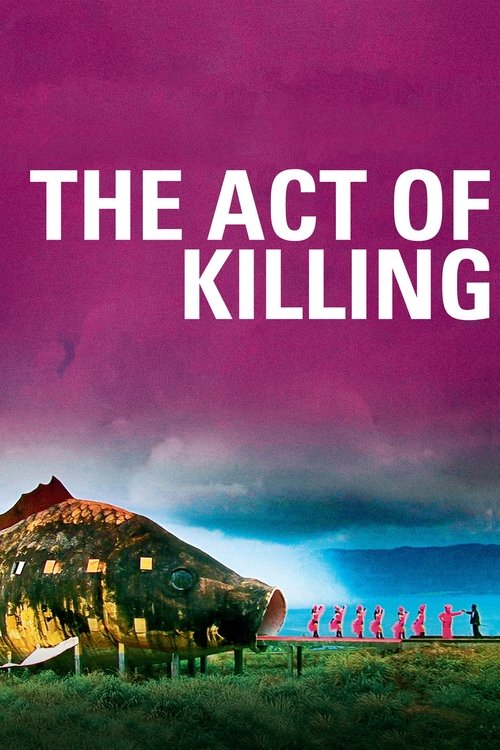
In 1965, Indonesia's military overthrew the government and instigated a purge of alleged communists that killed an estimated half-million people. The killers were often local gangsters and paramilitaries, and they were celebrated as heroes. Decades later, director Joshua Oppenheimer approached some of these men, still proud of their actions, and asked them to reenact their killings on film. The result is The Act of Killing, a documentary that defies easy categorization and plunges viewers into a surreal, disturbing world where perpetrators are stars and victims are ghosts. The film follows Anwar Congo, a former executioner, and his friend Herman Koto, as they stage elaborate scenes in the style of Hollywood musicals, westerns, and gangster films, often with themselves as the charismatic leads. Oppenheimer, who had previously made a short film about the purge, spent years gaining the trust of his subjects, and the result is a chilling portrait of moral rot and self-delusion. Made on a modest budget of $1 million, the film grossed just over $722,000 at the box office, but its impact was immense. It won the 2013 European Film Award for Best Documentary and was nominated for an Academy Award, sparking intense debate in Indonesia and around the world. With a runtime of 159 minutes, it is a demanding but essential work that forces viewers to confront the banality of evil.
What makes The Act of Killing so unsettling is its radical approach to documentary form. Oppenheimer doesn't rely on talking heads or archival footage. Instead, he hands the camera to the perpetrators and lets them direct their own scenes, choosing genres that range from musicals to horror. The result is a film that sits somewhere between psychological horror and surrealist cinema, with moments that feel almost hallucinatory. The men, who have lived with their crimes for decades, are given the space to reveal themselves, and what emerges is a disturbing mix of bravado, self-justification, and, eventually, something like guilt. The film's power lies in its refusal to look away, and in its willingness to let the subjects hang themselves with their own words and actions.
Availability and pricing can change. Confirm on the provider's site before purchasing.
The Act of Killing takes us to Medan, North Sumatra, where Anwar Congo and Herman Koto live as respected community figures. Anwar, a former executioner, personally killed an estimated 1,000 people during the 1965 purge. Herman, a flamboyant gangster, led paramilitary squads that carried out the killings. Both were members of Pancasila Youth, a paramilitary organization that worked under the Indonesian military. Oppenheimer's central idea is deceptively simple: he asks these men to reenact their killings on film, but gives them complete creative freedom to choose the cinematic genre. They pick Hollywood musicals, westerns, gangster films, and horror movies, casting themselves as the charismatic leads.
The reenactments become increasingly elaborate and surreal. Anwar and Herman stage production numbers, don costumes, and direct their own scenes with evident enthusiasm. They are joined by other perpetrators: Syamsul Arifin, the Governor of North Sumatra, who was himself a paramilitary leader; Ibrahim Sinik, a newspaper publisher; Safit Pardede, a local paramilitary leader; and Haji Anif, a businessman. These men speak openly about their roles, often with pride, and the film captures the disturbing normalcy with which they discuss mass murder. As the film progresses, however, a subtle shift occurs. The line between performance and reality begins to blur, and Anwar, in particular, starts to confront the weight of his memories. The structure mirrors this psychological unraveling, moving from confident bravado to something far more unsettling.
The film also introduces other figures from the era, including Yapto Soerjosoemarno, the leader of Pancasila Youth, and Jusuf Kalla, the Vice President of Indonesia, who appears in archival footage. The documentary's experimental approach to documentary form, executive produced by Werner Herzog and Errol Morris, pushes the boundaries of the genre. The 159-minute runtime allows the film to build slowly, creating an increasingly claustrophobic atmosphere as the reenactments grow more disturbing. The central conflict is not between the filmmakers and their subjects, but within the subjects themselves, between their self-image as heroes and the reality of what they did.
Official US Trailer
Festival Trailer
Critical Consensus
Raw, terrifying, and painfully difficult to watch, The Act of Killing offers a haunting testament to the edifying, confrontational power of documentary cinema.
“A remarkable and at times unwatchably explicit film... The memory of this mass murder is reawakened by film-maker Joshua Oppenheimer in a way that is both astonishing and horrifying.”
Peter Bradshaw
The Guardian
“In Oscar-nominated 'The Act of Killing,' mass murderers boastfully reenact their war crimes... When Joshua Oppenheimer started working on his film eight years ago about the 1965 mass killings in Indonesia, he had a different vision in mind.”
PBS NewsHour
PBS
“The Act of Killing depicts old members of a death squad acting out their memories, fantasies even, of the murders and atrocities they committed.”
UN Dispatch
Human Rights Wonks
Anwar Congo
Self - Executioner in 1965
Herman Koto
Self - Gangster & Paramilitary Leader
Syamsul Arifin
Self - Governor of North Sumatra
Directors
Joshua Oppenheimer, Christine Cynn, Anonymous
Cinematographers
Lars Skree, Carlos Arango De Montis, Anonymous
Producers
Christine Cynn, Anne Köhncke, Signe Byrge Sørensen, Michael Uwemedimo, Joram ten Brink
Academy Awards (2014)
Best Documentary Feature: Nominated
European Film Awards (2013)
Best Documentary: Won
BAFTA (2014)
Best Documentary: Won
Join the community
fans discussing