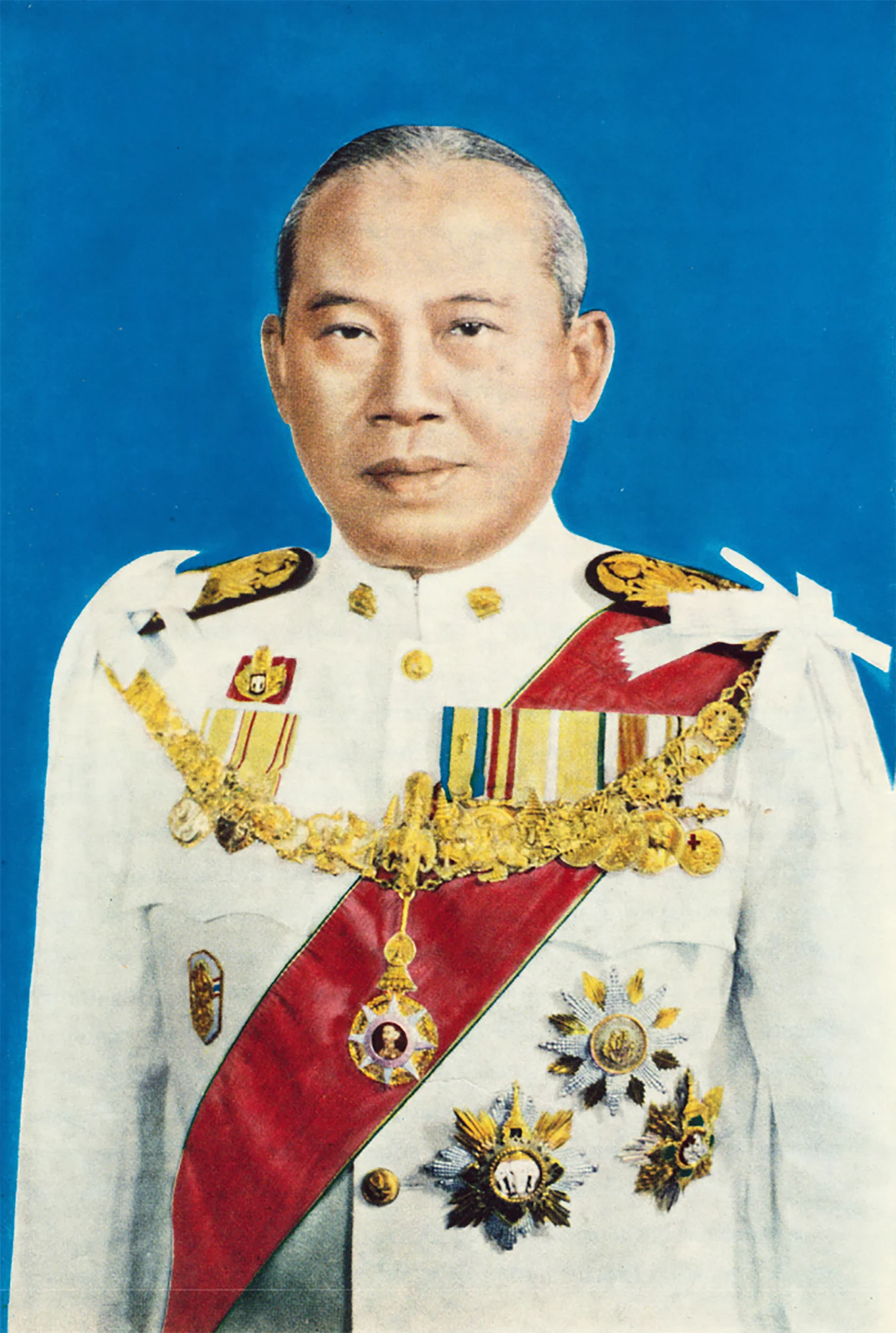
Thanom Kittikachorn
 Thailand
politician•civil servant•military officer
Also known as: Field Marshal Thanom Kittikachorn
Birthday
August 11, 1911
Birth Sign
Leo
Birthplace
Mueang Tak District, Tak Province, Siam (now Thailand)
Age
Died at 92
About
Thanom Kittikachorn was a Thai military officer and politician who served as Prime Minister of Thailand from 1963 to 1973. Born in Tak Province in 1911, he rose through the Royal Thai Army to become a Field Marshal and, alongside his close ally Praphas Charusathien, one of the so-called Three Tyrants who dominated Thai politics during the Cold War. His decade in power was defined by authoritarian rule, strict censorship, and a close military alliance with the United States during the Vietnam War.
He was forced from office on October 14, 1973, after student-led protests in Bangkok turned deadly, and he fled into exile in the United States. He returned in 1976, an event that triggered the Thammasat University massacre and a fresh military coup. He died in Bangkok on June 16, 2004, at the age of 92, having never been prosecuted for the violence of his era.
Early Life & Background
Born on August 11, 1911, in Mueang Tak District of Tak Province, Thanom grew up in a modest household of junior government officials. His father held a minor administrative post, and that environment of bureaucratic order shaped his early ambitions. He attended the Royal Military Academy in Thailand, graduating with a commission in the Royal Thai Army, and later received advanced training in the United States, including attendance at the U.S. Army Command and General Staff College. That American education hardened his ties to Western military doctrine and would later define his foreign policy.
His first major political act came in 1947, when he took part in the coup that overthrew the civilian government of Pridi Banomyong. Through the 1950s he served as Defence Minister under Prime Minister Plaek Phibunsongkhram, overseeing military modernization and expanding Thailand's cooperation with the United States against communist expansion in Southeast Asia. In 1957 he played a key role in the coup led by Sarit Dhanarajata that ousted Phibun, and he remained a central figure in the military junta that followed.
Career Growth
On December 18, 1963, Thanom became Prime Minister of Thailand after the death of Sarit Dhanarajata. He initially promised to restore democracy but quickly consolidated power. His tenure coincided with the height of the Vietnam War, and he allowed the United States to use Thai airbases for bombing campaigns against North Vietnam, making Thailand a critical logistical hub for the American war effort. That alliance brought significant economic aid but also domestic criticism over sovereignty and regional risk.
In November 1971, facing growing opposition, Thanom staged a coup against his own government, suspending the constitution and dissolving parliament. The move, known as the Self-Coup, resulted in the arrest of hundreds of political opponents and journalists and caused approximately 857 injuries and several deaths. His decade-long rule was characterized by strict censorship, suppression of dissent, and a cult of personality built around the military regime.
The October 14, 1973 uprising ended his era. Massive student-led protests erupted across Bangkok demanding a return to democracy and the resignation of the military regime. When security forces opened fire on demonstrators, hundreds died. Facing insurmountable pressure, Thanom resigned and fled the country on October 14, 1973, marking the first major democratic victory in Thai history. He lived in exile in the United States for several years before returning to Thailand in September 1976, a decision that triggered immediate unrest and the Thammasat University massacre on October 6, 1976. A subsequent military coup installed a new junta, effectively ending any hope of immediate democratic restoration.
Career Timeline
Public Image & Style
In modern Thailand, Thanom Kittikachorn is remembered as a symbol of military dictatorship, corruption, and the suppression of civil liberties. Photographs usually show him in the dress uniform of a Field Marshal, weighed down with medals, projecting the stern, authoritative demeanor that defined his public persona. He is grouped in historical memory with Sarit Dhanarajata and Praphas Charusathien as one of the Three Tyrants who ruled Thailand with an iron fist during the Cold War. Conservative factions sometimes credit his anti-communist stance, but the broader public and academic consensus treats him as a cautionary figure in the country's long struggle between military power and democratic aspiration.
Fame & Fandom (iFAMOUS Rankings)
Thanom Kittikachorn's public legacy is that of a military strongman, not a celebrity, and no formal fanbase has ever coalesced around him. His relationship with the Thai public was defined by his role as a field marshal and prime minister, rather than by the adulation typically accorded to entertainers. There are no documented fan rituals, birthday campaigns, or organized fan projects associated with him, and his fanbase has no formal name.
In the realm of global fame, iFANN's Global Fame Engine has evaluated him but he does not currently hold a placement in the published rankings, whether the Global Top 1,000 or a country or origin scope list. He does not appear on the September 2026 iFAMOUS Rankings flagship list. His historical significance nonetheless keeps his name in circulation across media coverage and public discourse, especially in Thailand, where his career and its violent consequences remain a recurring reference point in debates about military intervention in politics.
Interesting Facts and Legends
Thanom was one of the few Thai leaders to hold the highest ranks in all three branches of the military at once, serving as Field Marshal of the Army, Admiral of the Fleet, and Marshal of the Air Force as Supreme Commander of the Royal Thai Armed Forces.
Despite his fall from power and the violence of 1973 and 1976, he was never prosecuted for his actions while in office, a reflection of the enduring influence of the Thai military establishment. He was awarded the Order of the White Elephant and the Order of the Crown, the highest decorations in Thailand, though many view those honors critically today.
His son Narong Kittikachorn, a Royal Thai Army colonel and vocal defender of his father's legacy, died in May 2024. In his final years Thanom insisted, "I am a victim of political conspiracy," a line his family repeated long after his death.
Notable Quotes
“I am a victim of political conspiracy.”
“Thailand must stand firm against communism.”
“The students were misled by agitators.”
Family & Personal Life
Thanom Kittikachorn was married to Jongkol Thanad-rob, who remained his partner throughout his life and survived him. The couple had six children. His son Narong Kittikachorn became a colonel in the Royal Thai Army and a vocal defender of his father's record, often claiming that the student activists of 1973 were misled; Narong died in May 2024 at the age of 90. Another son, Yuthapong Kittikachorn, remained in the public eye as part of the family's political legacy. After returning from exile in 1976, Thanom lived quietly in Thailand with his family until his death, and the handling of his estate stayed private, managed by his heirs.
Notable Connections
Sarit Dhanarajata, his mentor and predecessor who orchestrated the 1957 coup. Praphas Charusathien, his co-ruler and fellow member of the Three Tyrants. His son Narong Kittikachorn, who defended his legacy until his own death in 2024. Journalist John Aglionby, who wrote his obituary and covered his downfall.
Relationships & Dating History
Thanom Kittikachorn's personal life followed the pattern of a mid-20th century political elite rather than that of a public celebrity. He married Jongkol Thanad-rob, and the union lasted for the rest of his life. The couple had six children together, among them Narong Kittikachorn, who became a Royal Thai Army colonel, and Yuthapong Kittikachorn, who remained part of the family's public profile. There is no documented record of engagements, divorces, or high-profile affairs during his career, and his marriage stayed largely out of the political spotlight even as his regime dominated national news.
At the time of his death in June 2004, Thanom was still married to Jongkol, who survived him. As of 2026, no subsequent relationship history has ever been reported, and the family's later years have been marked mainly by the death of his son Narong in May 2024 rather than by any new personal developments.
- MarriedJongkol Thanad-rob? - 2004His wife throughout his life and the mother of his six children; she survived him after his death in June 2004.
Death & Aftermath
Died
June 16, 2004 (aged 92)
Death Place
Bangkok, Thailand
Cause of Death
Natural causes related to a stroke and subsequent illness
Field Marshal Thanom Kittikachorn died on June 16, 2004, at the age of 92 in Bangkok, Thailand. His death followed a period of illness triggered by a stroke he suffered in January 2004. The cause of death is consistently reported as natural causes related to this stroke and subsequent illness. He had returned from exile in the United States in 1976 and lived quietly in Thailand until his passing. As a polarizing figure known as one of Thailand's Three Tyrants, public reaction to his death was subdued given his history of authoritarian rule and the violent student protests that led to his fall in 1973.
Tributes were limited to official state recognition and historical retrospectives. The Washington Post and San Diego Union-Tribune noted his role in helping the United States during the Vietnam War before his 1973 overthrow, framing his legacy through the lens of Cold War politics rather than popular mourning. Specific details regarding the date, location, or attendees of his funeral are not contained in the provided search results, though standard protocol for former Prime Ministers typically involves state funerals.
His legacy continues to be referenced in historical contexts regarding Thai military dictatorships and the October 14, 1973 uprising. Statements by the family or the handling of his estate were not reported in the provided documents. A retrospective comment by his son, Colonel Narong Kittikachorn, who died in May 2024, claimed student activists of 1973 were misled, but this stands as a personal reflection rather than an established posthumous honor.
Net Worth (Estate Value)
$5 Million
iFANN Editorial Team estimate
Reliable financial records for Thanom Kittikachorn were never made public, and no major wealth database carries a documented figure for him. As a career military officer and prime minister in mid-20th century Thailand, his wealth would have come from his official salary, land holdings, and the informal gains common to leaders of his era, none of which were ever audited or disclosed. When he died in 2004, no public estate valuation was released, and the handling of his estate remained a private family matter managed by his heirs, including his children.
Because his legacy is historical and academic rather than commercial, there are no posthumous releases, licensing deals, or merchandise tied to his name that generate meaningful income. The iFANN Editorial Team's analysis of his known assets and career earnings points to roughly $5 Million as the current estate value, a figure that reflects a modest property and savings profile rather than any continuing revenue stream. That estimate is iFANN's own and is not drawn from any published financial filing.
Awards Won (5)
Thanom Kittikachorn's honors were state and military distinctions rather than artistic or commercial awards. He held the highest ranks in all three branches of the Thai armed forces and received Thailand's top national decorations, the Order of the White Elephant and the Order of the Crown.
National Order
State service to Thailand
National Order
State service to Thailand
Known For
Prime Minister of Thailand
1963-1973 · Head of government
1971 Self-Coup
1971 · Leader who suspended the constitution and dissolved parliament
October 14, 1973 Uprising
1973 · Target of the student-led protests that forced his resignation
Vietnam War alliance with the United States
1960s-1970s · Prime Minister who allowed US use of Thai airbases
Keywords
Sources
Quick Facts
- Profession
- politician, civil servant, military officer
- Born
- +1911-08-11
- Birthplace
- Mueang Tak
- Died
- +2004-06-16
- Death Place
- Bangkok Hospital
- Gender
- Male
- Spouse
- Jongkol Thanad-rob
- Birth Sign
- Leo
Personal Details
- Full Name
- Thanom Kittikachorn
- Spouse
- Jongkol Thanad-rob
- Children
- 6 (including Narong Kittikachorn and Yuthapong Kittikachorn)
- Education
- Royal Military Academy, Thailand; US Army Command and General Staff College
Frequently Asked Questions
Who was Thanom Kittikachorn?
Why did Thanom Kittikachorn resign?
What happened after Thanom returned from exile in 1976?
How did Thanom Kittikachorn die?
Was Thanom Kittikachorn married?
Similar People
Join the community
fans discussing