“This is a movie that knows how people really talk, and how they really feel, and it uses that knowledge to create characters we care about deeply.”
Roger Ebert
Chicago Sun-Times
 United States
"Laugh, cry, and care in this mother-daughter journey."
Part of a Collection
Terms of Endearment Collection
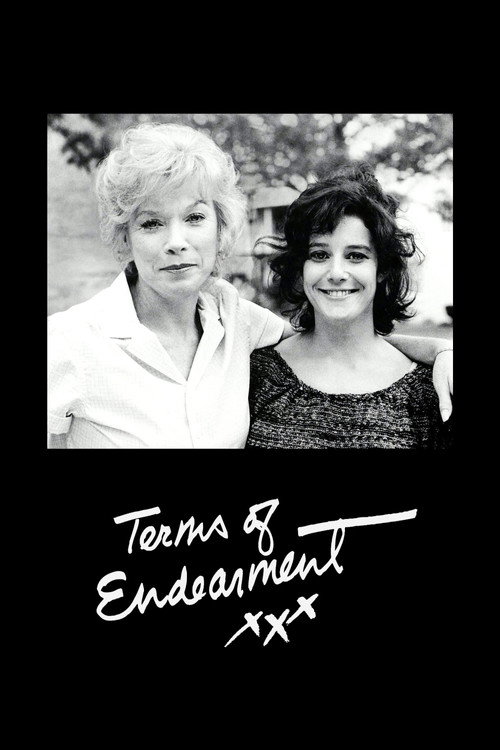
James L. Brooks's directorial debut, Terms of Endearment, hit theaters in 1983 and immediately redefined what a Hollywood dramedy could be. It's a film that swings from sharp comedy to gut-wrenching tragedy, often within the same scene, and it does so with a rare authenticity. Shirley MacLaine stars as Aurora Greenway, a fastidious Texas widow whose life is upended by her daughter Emma's choices, played by Debra Winger. Jack Nicholson brings his signature charm to Garrett Breedlove, a hard-drinking former astronaut who becomes Aurora's unexpected suitor. Based on Larry McMurtry's 1975 novel, the film was made on a modest $8 million budget but grossed over $108 million worldwide, a testament to its universal themes of love, loss, and family.
The movie spans three decades, tracing the push-and-pull between Aurora and Emma as they navigate marriage, motherhood, and infidelity. Brooks, who also wrote the screenplay, drew from his television background to create a story that feels lived-in and real. The performances are electric, with MacLaine and Winger delivering career-defining work that earned them both Academy Award nominations. The film won five Oscars, including Best Picture, Best Director, and Best Actress for MacLaine, cementing its place in cinema history. It's a film that doesn't shy away from the messiness of life, and that's exactly why it continues to resonate with audiences today.
Stream
Availability and pricing can change. Confirm on the provider's site before purchasing.
Set in Houston, Texas, the story begins with Aurora Greenway, a wealthy widow who runs her household with military precision. Her daughter Emma, played by Debra Winger, is the opposite, impulsive, headstrong, and desperate to break free from her mother's suffocating control. Aurora's disapproval of Emma's suitors is legendary, and when Emma announces she's marrying Flap Horton, a young college professor with modest ambitions, Aurora's disdain is palpable. The wedding goes ahead, and Emma moves away with Flap, first to Iowa and later to Nebraska, creating a physical and emotional distance that will define their relationship for years.
As the years pass, the film weaves between the two women's lives. Emma struggles with the realities of marriage, three children, financial strain, and Flap's wandering eye. She finds solace in her friend Patsy Clark, and later in a brief affair with a banker named Sam Burns. Meanwhile, Aurora, alone in her pristine home, is pursued by her neighbor Garrett Breedlove, a hard-drinking, womanizing former astronaut. Their courtship is a battle of wills, marked by witty repartee and a grudging respect that slowly blossoms into genuine affection. Aurora, who has always been critical of everyone, finds herself softened by Garrett's irreverence.
The film's middle section is a masterclass in balancing tones. There are laugh-out-loud moments, like Aurora's horrified reaction to Garrett's driving or her attempts to be a doting grandmother, alongside quieter, more painful scenes of Emma's growing disillusionment. Flap's infidelities become a recurring wound, and Emma's attempts to hold her family together grow increasingly desperate. The film also introduces Teddy and Tommy, Emma's young sons, whose innocence contrasts sharply with the adult turmoil around them.
As the narrative builds, it becomes clear that the bond between Aurora and Emma is the heart of the film. Their phone calls are fraught with unspoken emotions, and their visits are charged with both love and resentment. When Emma is diagnosed with cancer, the news shatters the fragile equilibrium. Aurora rushes to her daughter's side, and the film narrows its focus to the hospital room, where decades of unspoken feelings finally come to the surface. The story stops short of revealing the outcome, leaving the emotional climax, and its devastating aftermath, for the film's final act.
Terms of Endearment (1983) Original Trailer [FHD]
Coming soon to video
Critical Consensus
A classic tearjerker, Terms of Endearment isn't shy about reaching for the heartstrings, but is so well-acted and smartly scripted that it earns every emotional beat. Brooks's debut balances sharp humor with devastating drama, anchored by career-best performances from Shirley MacLaine and Debra Winger.
“This is a movie that knows how people really talk, and how they really feel, and it uses that knowledge to create characters we care about deeply.”
Roger Ebert
Chicago Sun-Times
“A film of remarkable emotional complexity, one that manages to be both funny and heartbreaking without ever losing its grip on reality.”
Vincent Canby
The New York Times
“Brooks has crafted a film that defies easy categorization, it's a comedy that makes you cry and a tragedy that makes you laugh, often in the same scene.”
Variety Staff
Variety
“The performances are so alive that they make the movie's manipulations almost irrelevant, you're too busy caring about these people to notice the strings being pulled.”
Pauline Kael
The New Yorker
Shirley MacLaine
Aurora Greenway
Debra Winger
Emma Greenway Horton
Jack Nicholson
Garrett Breedlove
Danny DeVito
Vernon Dahlart
Jeff Daniels
Flap Horton
John Lithgow
Sam Burns
Lisa Hart Carroll
Patsy Clark
Betty King
Rosie Dunlop
Huckleberry Fox
Teddy Horton
Troy Bishop
Tommy Horton
Shane Serwin
Younger Tommy Horton
Megan Morris
Melanie Horton
Director
James L. Brooks
Writers
James L. Brooks, Larry McMurtry
Composer
Michael Gore
Cinematographer
Andrzej Bartkowiak
Producer
James L. Brooks
Academy Awards (1984)
Best Picture: Won
Academy Awards (1984)
Best Actress: Won
Academy Awards (1984)
Best Supporting Actor: Won
Academy Awards (1984)
Best Director: Won
Academy Awards (1984)
Best Adapted Screenplay: Won
Golden Globe Awards (1984)
Best Motion Picture – Drama: Won
Golden Globe Awards (1984)
Best Actress – Motion Picture Drama: Won
Golden Globe Awards (1984)
Best Supporting Actor – Motion Picture: Won
Golden Globe Awards (1984)
Best Screenplay: Won
Join the community
fans discussing