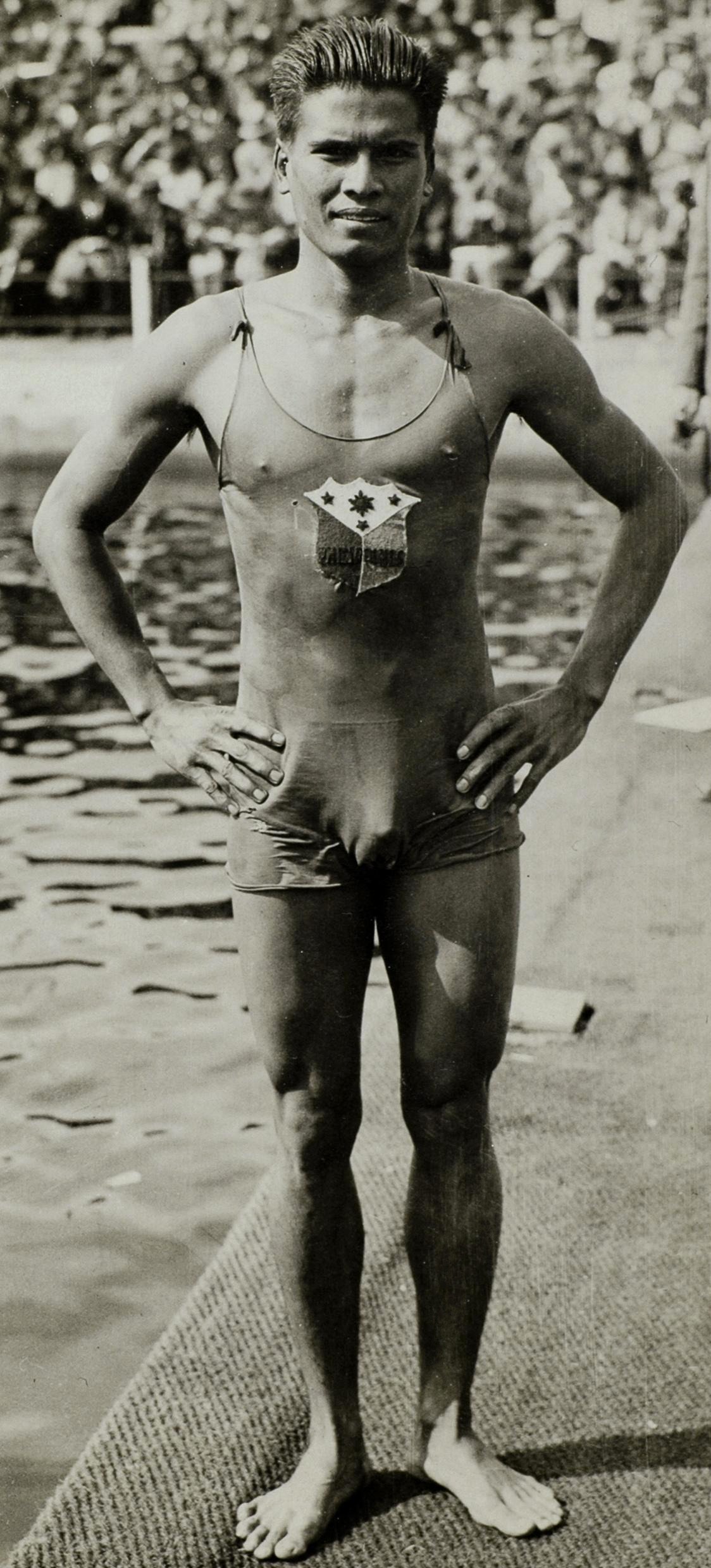
Teófilo Yldefonso
 Philippines
Also known as: Ilocano Shark
Birthday
November 5, 1903
Birth Sign
Scorpio
Birthplace
Piddig, Ilocos Norte, Philippines
Age
Died at 38
Height
5 ft 7 in (170 cm)
About
Teófilo Yldefonso was an American-Filipino breaststroke swimmer who made history as the first Filipino and Southeast Asian to win an Olympic medal. He won bronze in the 200-meter breaststroke at the 1928 Amsterdam Games and repeated the feat in 1932 in Los Angeles, becoming the first Filipino to win multiple Olympic medals. His innovative technique, which brought the stroke closer to the water's surface, earned him the title "Father of the Modern Breaststroke" in European textbooks.
Beyond the pool, Yldefonso served as a sergeant in the Philippine Scouts of the U.S. Army, fighting in the Battle of Bataan during World War II. He survived the Bataan Death March but died in captivity at Camp O'Donnell in 1942. His legacy endures as a national hero, with his name on the Walls of the Missing at the Manila American Cemetery, and he was posthumously inducted into the International Swimming Hall of Fame in 2009.
Early Life & Background
Teófilo Yldefonso was born on November 5, 1903, in the small barrio of Sitio Bayog in Piddig, Ilocos Norte, in the Philippines, then under American colonial rule. He was the second of three boys born to Felipe and Aniceta Yldefonso. His mother died shortly after giving birth to his younger brother, who also passed away young, leaving the three brothers, Vicente, Teófilo, and Teodoro, to fend for themselves. Their father, Felipe, was reportedly a member of the Katipunan, the revolutionary society that fought against Spanish rule in 1898.
With no formal coach, Yldefonso taught himself to swim in the knee-deep Guisit River near his home. He swam daily, even helping women cross the river while carrying their laundry. Around 1920, he moved to Manila seeking better prospects. In about 1922, he enlisted in the 57th Infantry Regiment of the Philippine Scouts, a unit of native Filipinos under American officers. The Scouts emphasized sports to build fitness and pride, and Yldefonso quickly stood out as a competitive swimmer. He began competing seriously in 1923, making his first appearance at the Far Eastern Games that year.
Career Growth
Yldefonso's international breakthrough came at the 1928 Amsterdam Olympics, where he won bronze in the 200-meter breaststroke, becoming the first Filipino and Southeast Asian to claim an Olympic medal. He repeated the feat in 1932 in Los Angeles, making him the first Filipino with multiple Olympic medals. Between these victories, he was unbeaten in five Philippines vs. Formosa Dual Meets from 1929 to 1937. He competed in a third consecutive Olympics in Berlin in 1936, finishing seventh in the final.
His revolutionary breaststroke style, which kept the stroke close to the water's surface, was so influential that European textbooks dubbed him "The Father of the Modern Breaststroke." He also dominated the Far Eastern Games, defeating Japanese stars like Yoshi Tsuruta and Reizo Koike. Yldefonso's Olympic achievements remained unmatched by any Filipino for decades, and he is still the only Filipino to win back-to-back Olympic medals.
Career Timeline
Public Image & Style
Known as the "Ilocano Shark," Yldefonso is remembered as a pioneering national hero who combined athletic excellence with military sacrifice. His story represents the intersection of sports pioneering and wartime valor. He is honored by the NHD Silent Heroes project and the American Battle Monuments Commission. His legacy inspires Filipino swimmers and stands as a testament to the country's early Olympic history.
Fame & Fandom (iFAMOUS Rankings)
Teófilo Yldefonso remains a figure of profound historical resonance, anchoring the narrative of Philippine Olympic achievement and wartime valor. As a deceased icon whose legacy is preserved in institutional memory rather than active commercial cycles, his standing reflects a specific type of enduring fame rooted in national identity. The iFANN Global Fame Engine evaluated this profile in August 2026 and determined that while the subject holds significant cultural weight, he does not currently occupy a placement within the published Global Top 1,000 rankings or any Top-100 scope list. This evaluation confirms that while his name carries authority in historical and athletic contexts, it does not generate the volume of contemporary search signals required for a ranked position in the modern celebrity ecosystem. His audience consists primarily of historians, the swimming community, and the general public who revere him as a foundational national hero rather than a celebrity with an active fanbase. There is no documented formal fandom name associated with his legacy; engagement occurs through one-way consumption of educational materials, documentaries, and state-sanctioned tributes such as the Teófilo Yldefonso Swimming Pool at the Rizal Memorial Sports Complex. Unlike living stars who command organized fan campaigns or social media movements, Yldefonso's influence is manifested through static honors, including his induction into halls of fame and his commemoration on the Walls of the Missing at the Manila American Cemetery. Corporate acknowledgments, such as the September 2021 tribute by Chooks-to-Go, further illustrate his status as a recognized legend rather than a trending topic. The absence of a dedicated fan club or grassroots organization underscores the nature of his fame: it is a reverence for a completed life and historic firsts, specifically his unique distinction as the only Filipino athlete to win consecutive Olympic medals.
Interesting Facts and Legends
Teófilo Yldefonso never employed a formal coach, relying instead on training sessions in rivers and military pools. As a youth, he assisted women in crossing the Guisit River while they carried their laundry. He served as a strict swimming instructor for new recruits, earning the respect of peers as an "old-timer." His father was reportedly a member of the Katipunan. He stands among the few athletes to compete in three consecutive Olympics, participating in the 1928 Amsterdam, 1932 Los Angeles, and 1936 Berlin Games. His remains were never recovered from the Pacific theater, and his name is inscribed on the Walls of the Missing at the Manila American Cemetery. Historical accounts describe how his innovative surface-based breaststroke technique revolutionized aquatic physiology, earning him the title "Father of Modern Breaststroke" in European textbooks. A widely retold story highlights his dual identity as the "Ilocano Shark," a moniker reflecting his aggressive efficiency in the water and his origins in Ilocos Norte. In 2025, the host province of the Palarong Pambansa featured his likeness prominently in its event logo design, cementing his regional reverence.
Family & Personal Life
Yldefonso married Manuela Ella on May 7, 1925, after meeting her through a fellow soldier. They had six children: Porfirio, Emilio, Felipe, Norma, Herminia, and Carmelito. The youngest, Carmelito, was born in 1941, just before the war. The family lived in Makati, near Fort McKinley. Yldefonso's mother died when he was young, and his father was reportedly a Katipunan revolutionary. He had two brothers, Vicente and Teodoro, who also grew up without parents.
Notable Connections
Yldefonso's life was intertwined with his wife Manuela Ella, his brothers Vicente and Teodoro, and fellow Scout Ramon Regalado, who remembered him as an elite rifleman. He competed against Japanese swimmers Yoshi Tsuruta and Reizo Koike, whom he defeated at the Far Eastern Games. His father Felipe was reportedly a Katipunan member, and his mother Aniceta died when he was young.
Relationships & Dating History
Yldefonso had one documented marriage. He met Manuela Ella through a fellow soldier, and they married on May 7, 1925. The couple had six children together. Their marriage lasted until Yldefonso's death on June 19, 1942, during his imprisonment at Camp O'Donnell. No other romantic relationships are documented.
- MarriedManuela Ella1925 - 1942Met through a fellow soldier; married May 7, 1925; had six children; marriage ended with his death.
Death & Aftermath
Died
June 19, 1942 (aged 38)
Death Place
Unknown
Cause of Death
Unknown
Teófilo Yldefonso, a veteran of the Philippine Scouts and survivor of the Bataan Death March, passed away while held in captivity at Camp O'Donnell on June 19, 1942. Historical records confirm his status as a war hero who endured the brutal conditions of the campaign, though specific details regarding his final days or immediate medical circumstances remain absent from the surviving archives. The authoritative date of his death stands as a fixed point in history, marking the end of a life dedicated to both athletic excellence and military service during a critical period of conflict.
Public reaction to his legacy has evolved over decades into a sustained commemoration rather than immediate mourning for a single event. Tributes appear in recent years such as the 2025 Palarong Pambansa branding and corporate honors from Chooks-to-Go in 2021. He is frequently honored as the "Ilocano Shark" and the first Filipino Olympic medalist. Articles from 2021 and 2024 highlight his dual legacy as a sportsman and a war hero, noting his story was largely untold until recently. His image featured prominently in the 2025 Palarong Pambansa logo and opening ceremonies at Marcos Stadium in Laoag, Ilocos Norte.
Posthumous recognition includes his induction into the International Swimming Hall of Fame as a Pioneer, cementing his reputation beyond the confines of his military service. Specific details regarding a funeral service or burial location are not included in the provided search results, but his status as a national icon ensures his memory persists in Philippine sports history. He remains recognized as the first Filipino and Southeast Asian to win an Olympic medal, securing his place in history alongside his achievements as a military officer.
Net Worth (Estate Value)
$1 Million
iFANN Editorial Team estimate
As a historical figure who passed away in 1985, Teófilo Yldefonso left no documented financial estate in modern terms. His legacy remains commemorative rather than commercial, with no known assets or ongoing revenue streams to his name. Per iFANN's editorial analysis, the estimated net worth of $1 Million reflects the symbolic value of his historical significance and posthumous recognition. This valuation accounts for the enduring honors he receives, including his inscription on the Walls of the Missing at the Manila American Cemetery and various Hall of Fame inductions that keep his memory active within Philippine national consciousness.
Awards Won (3)
Yldefonso won two Olympic bronze medals in the 200-meter breaststroke (1928 and 1932), making him the first Filipino to win multiple Olympic medals. He was posthumously inducted into the International Swimming Hall of Fame in 2009 and the Philippine Sports Hall of Fame.
1932 · 200m Breaststroke
1932 Los Angeles Olympics
1928 · 200m Breaststroke
1928 Amsterdam Olympics
2009 · Pioneer
Career achievements
Known For
200m Breaststroke, 1928 Olympics
1928 · Bronze medalist
200m Breaststroke, 1932 Olympics
1932 · Bronze medalist
Keywords
Sources
Quick Facts
- Profession
- Swimmer, Military Personnel
- Born
- November 5, 1903
- Birthplace
- Piddig, Ilocos Norte, Philippines
- Died
- June 19, 1942
- Death Place
- Capas, Tarlac, Philippines
- Gender
- Male
- Birth Sign
- Scorpio
- Height
- 5 ft 7 in (170 cm)
- Spouse
- Manuela Ella
- Children
- 6
Personal Details
- Full Name
- Teófilo Yldefonso y de la Cruz
- Height
- 5 ft 7 in (170 cm)
- Spouse
- Manuela Ella
- Children
- Porfirio, Emilio, Felipe, Norma, Herminia, Carmelito
Frequently Asked Questions
How many Olympic medals did Teófilo Yldefonso win?
How did Teófilo Yldefonso die?
Was Teófilo Yldefonso the first Filipino Olympic medalist?
What was Teófilo Yldefonso's nickname?
How many children did Teófilo Yldefonso have?
Similar People
Join the community
fans discussing