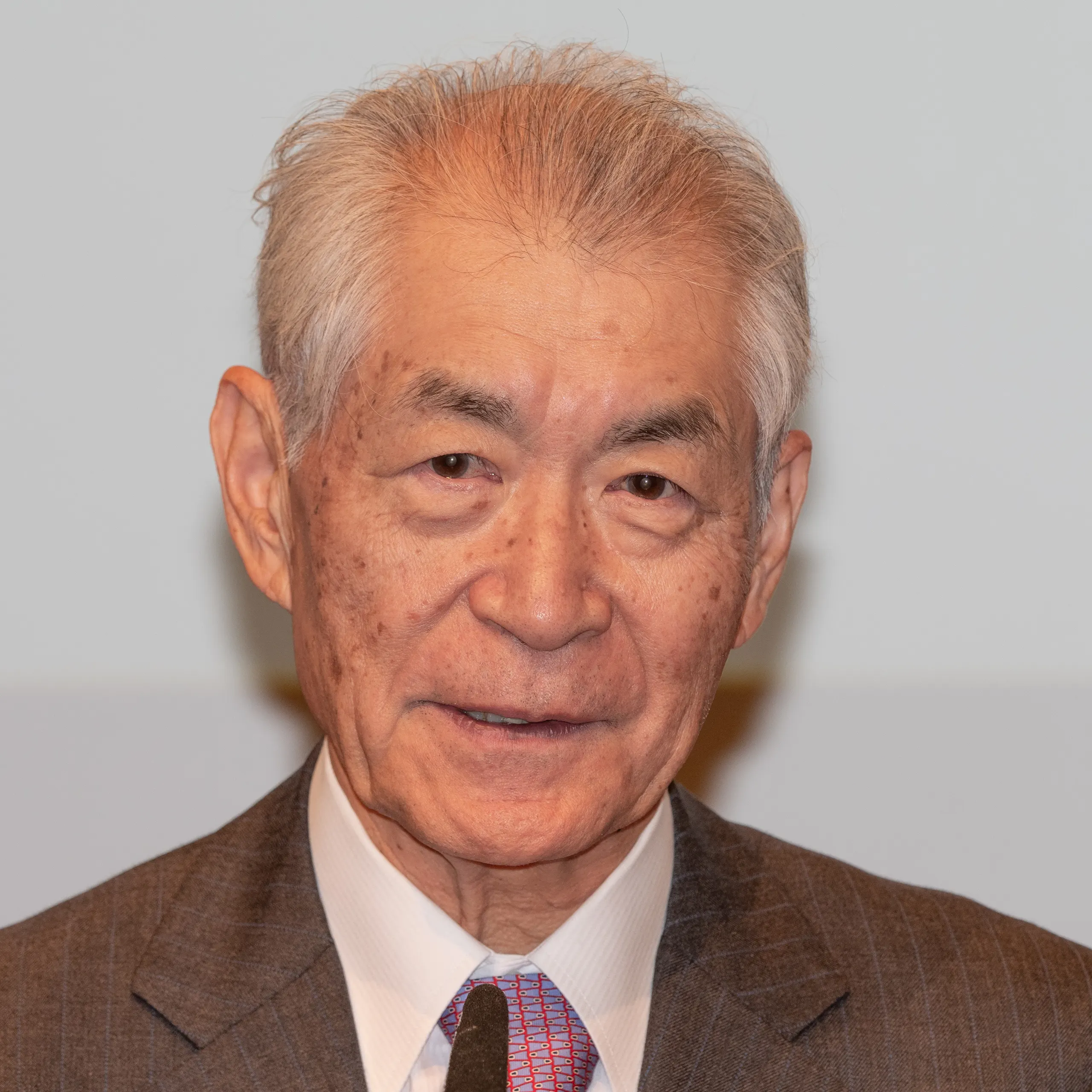
Tasuku Honjo
 Japan
JapanImmunologist•Biochemist•University Teacher
Birthday
January 27, 1942
Birth Sign
Aquarius
Birthplace
Kyoto, Japan
Age
84 years old
About
Tasuku Honjo is a Japanese physician-scientist and immunologist whose discovery of programmed cell death protein 1 (PD-1) transformed cancer treatment. In 2018, he shared the Nobel Prize in Physiology or Medicine with James P. Allison for their independent work on immune checkpoint inhibition. Honjo's research also identified key cytokines IL-4 and IL-5 and uncovered activation-induced cytidine deaminase (AID), a protein essential for antibody diversification.
As a distinguished professor at Kyoto University, Honjo has spent his career unraveling the immune system's regulatory mechanisms. His work has earned him numerous international honors, including the Tang Prize, the Kyoto Prize, and election to the U.S. National Academy of Sciences. He continues to lead research and mentor young scientists, championing the value of curiosity-driven basic science.
Early Life & Background
Tasuku Honjo was born in Kyoto during World War II, and his childhood was shaped by the turmoil of the era. He vividly recalls an air raid in Toyama City, where his family had moved, and the terror of fleeing for safety. His father, a surgeon who later headed the Otorhinolaryngology Department at Yamaguchi University Medical School, ensured that young Tasuku received early English lessons, a skill that would prove invaluable in his scientific career.
Initially drawn to astronomy, Honjo's fascination with the night sky, particularly Saturn, made him dream of becoming an astronomer. But reading a biography of the bacteriologist Hideyo Noguchi changed his path. Noguchi's pioneering spirit and dedication to research inspired Honjo to pursue medicine. He entered Kyoto University, earning his M.D. in 1966 and a Ph.D. in medical chemistry in 1975. During his doctoral studies, he worked under Osamu Hayaishi and Yasutomi Nishizuka, both influential biochemists, and became known for asking probing questions in class, sometimes earning him a reputation as a difficult student.
Career Growth
Honjo's academic journey took him to the United States in the early 1970s, with fellowships at the Carnegie Institution for Science and the National Institutes of Health. In 1974, he returned to Japan, holding professorships at the University of Tokyo and Osaka University before settling at Kyoto University in 1984. There, he made his landmark discoveries: the identification of cytokines IL-4 and IL-5, and later the enzyme AID. But his most consequential work came in 1992 with the discovery of PD-1, a molecule that acts as a brake on the immune system. This finding laid the groundwork for a new class of cancer drugs known as immune checkpoint inhibitors, which have since saved countless lives.
Honjo's contributions were recognized with a cascade of major awards, culminating in the 2018 Nobel Prize, which he shared with James P. Allison. He also served as president of Shizuoka Prefecture Public University Corporation and the Foundation for Biomedical Research and Innovation. In recent years, he has remained active as a Distinguished Professor at Kyoto University, advocating for basic research and the importance of following one's curiosity.
Career Timeline
Public Image & Style
In the scientific community, Tasuku Honjo is revered as a pioneer of cancer immunotherapy. His public persona is that of a humble yet relentless researcher, often emphasizing that his success comes from following curiosity rather than chasing fame. He is known for his engaging lectures and his willingness to mentor young scientists. The media often portrays him as a national hero in Japan, and he has been pictured with Prime Minister Shinzo Abe. His Nobel win brought him into the spotlight, but he remains focused on the science, advocating for long-term, curiosity-driven research.
Fame & Fandom
Tasuku Honjo commands a global profile defined by profound scientific influence rather than celebrity spectacle, with his reputation tracked across media coverage and consumption signals worldwide. His standing in the modern information economy is quantified by authoritative placement within the iFANN Global Fame Rankings, where he is recognized as the 31st most famous person in AI, a position holding steady from the previous cycle. This specific ranking underscores his pivotal role at the intersection of biological research and computational analysis, distinguishing him within a field that increasingly relies on algorithmic discovery. While his work has saved millions of lives through cancer immunotherapy, the public discourse surrounding him remains anchored in professional achievement rather than the ephemeral trends of pop culture. Consequently, his audience does not coalesce around a formalized group identity; there is no documented name for his fanbase, nor are there organized campaigns or rituals associated with his legacy. The reverence he receives is strictly academic, characterized by peer respect and institutional acknowledgment rather than the fervor typically seen in entertainment industries. His presence in the rankings reflects a sustained, high-level attention span driven by the enduring impact of his discoveries on human health.
Interesting Facts and Legends
Before dedicating himself to medicine, Tasuku Honjo's first scientific passion was astronomy, where he spent hours captivated by Saturn's rings through a telescope. He maintains an active lifestyle with a golf handicap of 14 and annually competes against fellow Nobel laureate Shinya Yamanaka. Despite his father's insistence on English proficiency, Honjo initially struggled with the language before it became essential to his international career. Known for his relentless curiosity, he frequently cites his mentor's advice to "follow your curiosity," a philosophy that guided his early years when he was considered a handful in school for asking questions that stumped his teachers. Beyond these personal anecdotes, his career is marked by verified milestones that have become legendary within the scientific community. The 1992 discovery of the PD-1 protein, which identified a mechanism allowing cancer cells to evade the immune system, stands as the foundational event of his legacy. This breakthrough directly enabled the development of checkpoint inhibitor therapies. Later, his 2018 Nobel Prize win cemented his status as a pioneer who turned theoretical concepts into life-saving treatments. In 2020, he also entered the legal arena, suing Bristol Myers Squibb for 22 billion yen over royalties related to Opdivo, highlighting the immense commercial value generated by his research.
Notable Quotes
“Follow your curiosity.”
“The telescopic view of Saturn fascinated me. I dreamed of becoming an astronomer.”
“I was impressed by his strong spirits and his pioneering activities.”
Family & Personal Life
Tasuku Honjo is married to Shigeko Honjo, and together they have two children: a daughter, Yasuko, and a son, Hajime. The family has largely stayed out of the public eye, but Honjo has occasionally mentioned his wife's support in his demanding research career. His father, a surgeon, instilled in him a strong work ethic and the value of language education. Honjo has spoken about the importance of family encouragement in his scientific journey.
Notable Connections
James P. Allison, with whom Honjo shared the 2018 Nobel Prize, is a fellow pioneer in immune checkpoint therapy. Honjo's doctoral advisors Osamu Hayaishi and Yasutomi Nishizuka shaped his early research. He has mentored notable scientists including Shizuo Akira. He also shares a friendly golf rivalry with Nobel laureate Shinya Yamanaka.
Relationships & Dating History
Tasuku Honjo has been married to Shigeko Honjo for decades, and the couple has two children. Their relationship has remained private, with Shigeko providing steady support throughout his demanding career. There is no public record of any previous relationships. As of 2026, Honjo and Shigeko continue to live in Japan, and their marriage remains a cornerstone of his personal life.
- MarriedShigeko HonjoCurrentLongtime wife and mother of his two children.
Salary, Net Worth In 2026
$10 Million
iFANN Editorial Team estimate
Per iFANN's editorial analysis, Tasuku Honjo's net worth is estimated at $10 million as of 2026. The bulk of this wealth originates from his extensive academic tenure, including professorships and leadership roles at Kyoto University. His Nobel Prize victory contributed a cash award of approximately $1.1 million, shared with James P. Allison, while additional substantial sums were received through prizes such as the Tang Prize and the Kyoto Prize. Honjo has also generated income from speaking engagements and royalties derived from his research publications. Unlike many innovators who capitalize directly on their inventions, he has not personally commercialized his discoveries; the PD-1 inhibitors developed from his work generate billions in revenue for pharmaceutical companies, yet Honjo has not profited directly from those sales. His financial standing reflects a life dedicated to research rather than personal gain.
Awards Won (6)
Tasuku Honjo has received numerous prestigious awards, including the 2018 Nobel Prize in Physiology or Medicine, the 2014 Tang Prize in Biopharmaceutical Science, the 2016 Kyoto Prize in Basic Sciences, and the 1996 Imperial Prize. He was also honored with the Order of Culture in 2013.
2018 · Physiology or Medicine
Discovery of PD-1
2014 · Biopharmaceutical Science
Discovery of PD-1
Known For
Discovery of PD-1
1992 · Lead researcher
Nobel Prize in Physiology or Medicine
2018 · Co-recipient
Keywords
Sources
Quick Facts
- Profession
- Immunologist, Biochemist, University Teacher
- Born
- January 27, 1942
- Birthplace
- Kyoto, Japan
- Gender
- Male
- Birth Sign
- Aquarius
- Education
- Kyoto University (M.D., 1966; Ph.D., 1975)
- Spouse
- Shigeko Honjo
- Children
- Yasuko Honjo, Hajime Honjo
Personal Details
- Spouse
- Shigeko Honjo
- Children
- Yasuko Honjo, Hajime Honjo
- Education
- Kyoto University (M.D., 1966; Ph.D., 1975)
Frequently Asked Questions
What is Tasuku Honjo famous for?
When and where was Tasuku Honjo born?
What is Tasuku Honjo's net worth in 2026?
Does Tasuku Honjo still work in 2026?
How did Tasuku Honjo's discovery of PD-1 change cancer treatment?
Social Media
Similar People
Join the community
fans discussing