
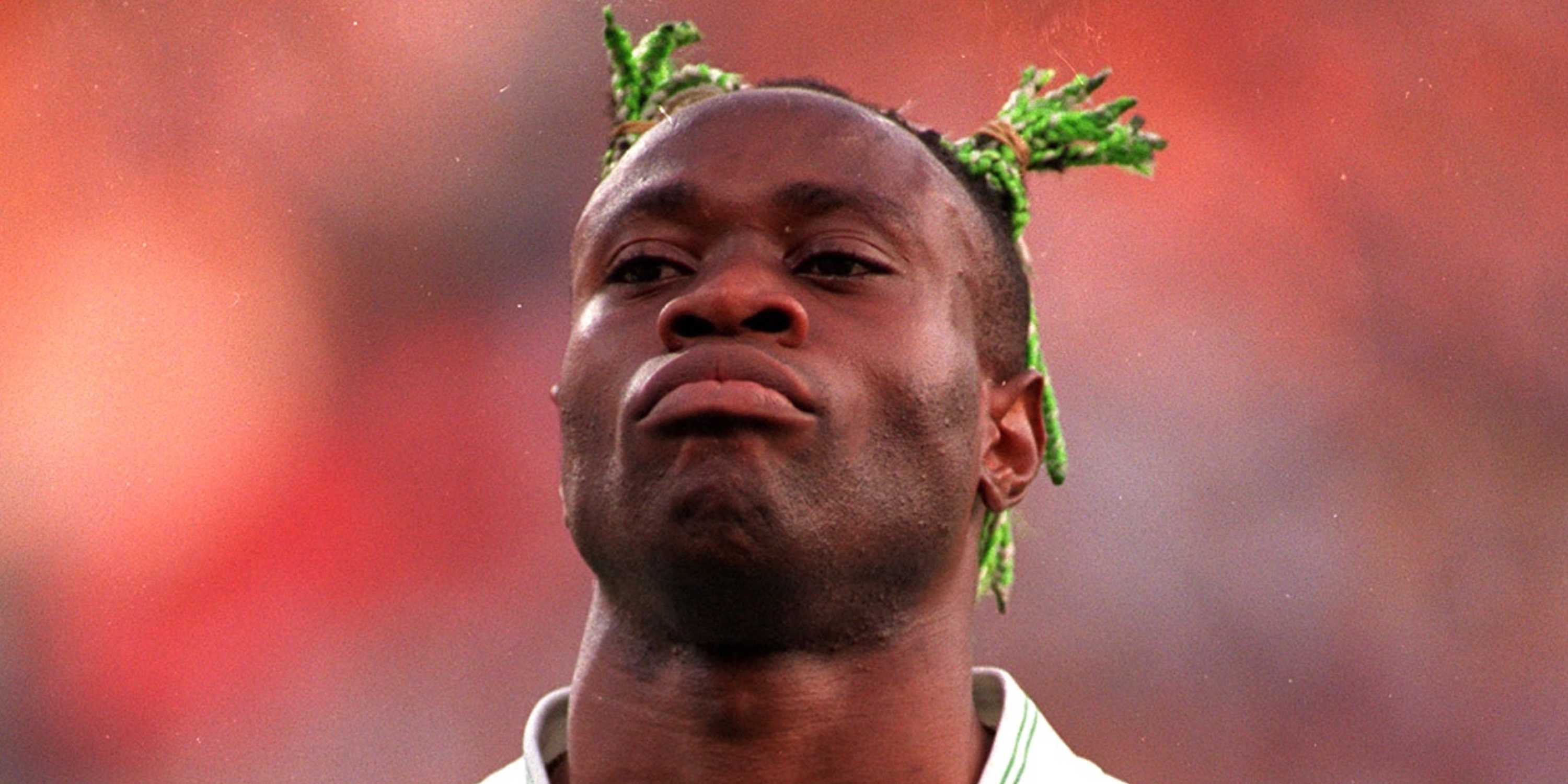
Taribo West
 Nigeria
Also known as: Taribo, The Pastor
Birthday
March 26, 1974
Birth Sign
Sagittarius
Birthplace
Port Harcourt, Nigeria
Age
52 years old
Height
6 ft 2 in (1.88 m)
About
Taribo West is a Nigerian former professional footballer and current pastor who built a formidable reputation as a central defender during the 1990s and early 2000s. Born in Port Harcourt, he became one of the first African players to achieve stardom across Europe's top leagues, known for his aerial dominance, aggressive tackling style, and an ever-changing array of colorful hairstyles that ranged from bright green mohawks to intricate braids. His career included significant success with French club AJ Auxerre, where he won the Ligue 1 title and Coupe de France, before moving to Italy to play for both Inter Milan and AC Milan.
On the international stage, West earned 42 caps for the Super Eagles between 1994 and 2005. He was a key member of the squad that won the historic gold medal at the 1996 Atlanta Olympics, a moment that cemented his legacy in Nigerian sports history. He also represented his country at two FIFA World Cups and multiple Africa Cup of Nations tournaments. After retiring from professional football in 2005, West transitioned into full-time ministry, establishing Taribo West Ministries and becoming a vocal critic of the Nigerian Football Federation regarding the treatment of retired players.
Early Life & Background
Taribo West grew up in Port Harcourt, Rivers State, in a community where football was not just a game but a way of life. From a young age, he displayed exceptional physical talent and a natural affinity for the sport, often playing on local pitches with whatever makeshift equipment was available. Before turning professional, he honed his skills with Sharks FC, a local Nigerian club that served as a stepping stone for many talented players of his generation. His performances there caught the attention of scouts looking for raw defensive talent in Africa.
The late 1980s and early 1990s were a transformative period for Nigerian football, with European clubs increasingly seeking out players from the continent. West's combination of size, strength, and technical ability made him a prime target. In 1994, he made the pivotal move to France to join AJ Auxerre, leaving behind the familiar streets of Port Harcourt for the rigorous training grounds of European football. This transfer marked the end of his amateur status and the beginning of a journey that would see him become a household name across the globe. The transition was challenging, requiring him to adapt quickly to a higher level of competition and tactical discipline, but his natural gifts allowed him to settle in rapidly.
Career Growth
West's breakthrough arrived almost immediately after joining AJ Auxerre in 1994. He quickly established himself as a cornerstone of their defense, helping the club secure the Coupe de France in 1994 and again in 1996. His most significant achievement during this period came in the 1995–96 season when he played a crucial role in Auxerre winning the Ligue 1 title, a rare feat for a club outside the Parisian giants. His commanding presence in the air and his ability to read the game made him one of the most exciting defenders in French football.
In 1998, West moved to Italy to join Inter Milan, marking his entry into one of the world's most competitive leagues. Playing under coaches like Marcello Lippi and Giovanni Trapattoni, he became a fan favorite at San Siro. However, his tenure was also marked by controversy, including a reported incident where he refused to play due to tactical disagreements, a story later detailed by former coach Mircea Lucescu. In 2000, he made a unique move to AC Milan, Inter's fierce city rivals, becoming one of the few players to have played for both clubs. During his time at AC Milan, he helped the team win the UEFA Cup Winners' Cup in 2001.
West's European journey continued with spells at Derby County in England and 1. FC Kaiserslautern in Germany before he retired in 2005. His international career was equally illustrious; he was a vital part of the Nigerian squad that won Olympic gold in 1996, defeating Argentina in the final. He went on to represent Nigeria at the 1998 and 2002 World Cups, earning 42 caps in total. Since retirement, he has remained active in public life as a pastor and commentator, frequently speaking out on issues affecting Nigerian football.
Career Timeline
Public Image & Style
West is viewed as a complex figure who evolved from a fearless warrior on the pitch to a humble servant of God. Media coverage often highlights the stark contrast between his colorful, rebellious past and his serious, reflective present as a pastor. He is respected for his honesty and willingness to criticize the Nigerian football establishment, even when it means facing backlash. His image is that of a man who left the glamour of Serie A to serve a higher calling, earning him reverence among religious communities and football fans alike.
Fame & Fandom
The admiration surrounding Taribo West exists not as a formalized organization with a specific name, but as a persistent legacy within Nigerian football culture and the memories of 1990s European supporters. His audience consists of those who recall his distinctive playing style and flamboyant appearance, alongside modern viewers who track his transition from a Serie A star to a vocal pastor. While he maintains a personal following on social media platforms, there are no records of organized fan clubs, ritualistic gatherings, or collective campaigns that define a unified group identity under a single title.
This organic reverence was recently reinforced when pundits began labeling current defender Calvin Bassey as the new Taribo West, suggesting the archetype established by the Nigerian remains the benchmark for defensive play in the region. Within this broader landscape of global attention, his standing is quantified by the iFANN Global Fame Rankings. Current data places him as the 66th most famous person from Nigeria, a position that reflects a slight decline from the 64th spot recorded in the previous cycle. These metrics capture his enduring presence across media coverage and consumption signals worldwide. The combination of his Olympic gold medal, his tenure with Milan's two giants, and his unique cultural footprint ensures that while he lacks a named legion of followers, his influence remains a measurable component of global fame.
Interesting Facts and Legends
Taribo West is famous for his flamboyant hairstyles, which changed so frequently that fans often speculated about his routine. At one point, he wore a bright green mohawk that became an iconic symbol of his rebellious spirit and individuality. Another notable legend involves his brief stint at Inter Milan, where he allegedly threw a tantrum over tactical decisions, a story that has become part of football folklore and was recently confirmed by former coach Mircea Lucescu.
A defining moment in his modern legacy occurred in August 2025, when he publicly declared that his son would never play for the Nigerian national team. Speaking at the funeral of legendary goalkeeper Peter Rufai, West cited the poor treatment of former players and the lack of support from the Nigerian Football Federation as his reasons. This emotional outburst sparked a national debate and highlighted his protective nature as a father. Additionally, he is one of the very few players to have successfully played for both AC Milan and Inter Milan, a rare distinction in the fiercely rivalrous city of Milan.
Notable Quotes
“My son will never represent Nigeria at the national level.”
“The Nigerian Football Federation has failed its former heroes.”
“I left the glamour of Serie A to serve God.”
Family & Personal Life
Taribo West was born to parents in Port Harcourt, though specific details about their professions remain private. He is a devoted father to a son, whose name he keeps out of the public eye. In 2025, he made headlines by stating that his son would not pursue a career in professional football for Nigeria, reflecting his concerns about the welfare of retired athletes. West lives a relatively quiet family life focused on his faith and domestic stability, keeping his personal relationships largely away from the media spotlight.
Notable Connections
Peter Rufai, Mircea Lucescu, Calvin Bassey, Joseph Yobo.
Relationships & Dating History
Public information regarding Taribo West's romantic relationships is sparse, reflecting his preference for privacy after his retirement and subsequent conversion to ministry. There are no widely documented publicized marriages, engagements, or long-term dating histories available in credible sources up to 2026. The narrative surrounding his personal life focuses heavily on his family as a father rather than his romantic partners.
As of 2026, Taribo West is believed to be married or in a stable domestic relationship, but his spouse's name and details of their meeting remain private. He has not publicly discussed divorce or separation. He is the father of a son who has been mentioned in recent news. In August 2025, during the funeral of goalkeeper Peter Rufai, West made headlines by stating emotionally that his son would never represent Nigeria at the national level, citing concerns over the treatment of former players and the state of Nigerian football. This statement suggests a protective stance toward his child's future, though it does not confirm the child's current age or name. The prevailing public image is that of a settled family man and religious leader.
- MarriedUnknownCurrentSpouse's identity is kept private; believed to be married as of 2026.
Salary, Net Worth In 2026
$6 Million
iFANN Editorial Team estimate
iFANN currently estimates Taribo West's net worth at approximately $6 million, a figure derived from his successful football career, post-retirement business ventures, and income from his ministry. His earnings during the 1990s and early 2000s in Europe were substantial, particularly during his tenures in France, Italy, England, and Germany. These salaries formed the foundation of his wealth, supplemented by endorsement deals with Nigerian and international brands during his peak years.
Since retiring, West has diversified his income streams significantly. He owns real estate properties in Lagos and Port Harcourt, which have appreciated considerably over the decades. Additionally, his church ministry generates revenue through donations, tithes, and hosting events. He has also invested in agriculture and small businesses in Nigeria, further bolstering his financial standing. As of 2026, his portfolio reflects a stable and growing asset base, combining historical football earnings with ongoing entrepreneurial activities.
Awards Won (5)
Taribo West's trophy cabinet is defined by major team successes rather than individual accolades. He won the Olympic gold medal with Nigeria in 1996, a historic achievement for African football. Domestically, he secured the Ligue 1 title and two Coupe de France titles with AJ Auxerre. In Italy, he added the UEFA Cup Winners' Cup to his collection with AC Milan in 2001. While frequently nominated for regional honors, he did not win the CAF African Player of the Year award.
1996 · International Tournament
Nigeria National Team
1996 · League Title
AJ Auxerre
Known For
Nigeria National Team
1996 · Olympic Gold Medalist
AJ Auxerre
1996 · Ligue 1 Champion
AC Milan
2001 · UEFA Cup Winners' Cup Winner
Keywords
Sources
Quick Facts
- Profession
- association football player
- Born
- March 26, 1974
- Birthplace
- Port Harcourt, Nigeria
- Gender
- Male
- Birth Sign
- Sagittarius
Personal Details
- Full Name
- Taribo O. West
- Height
- 6 ft 2 in (1.88 m)
- Children
- One son
- Education
- Local schools in Port Harcourt
Frequently Asked Questions
What is Taribo West's net worth?
Why did Taribo West stop playing football?
Did Taribo West win the African Player of the Year?
Which clubs did Taribo West play for?
Is Taribo West still active in football?
Social Media
Similar People
Join the community
fans discussing