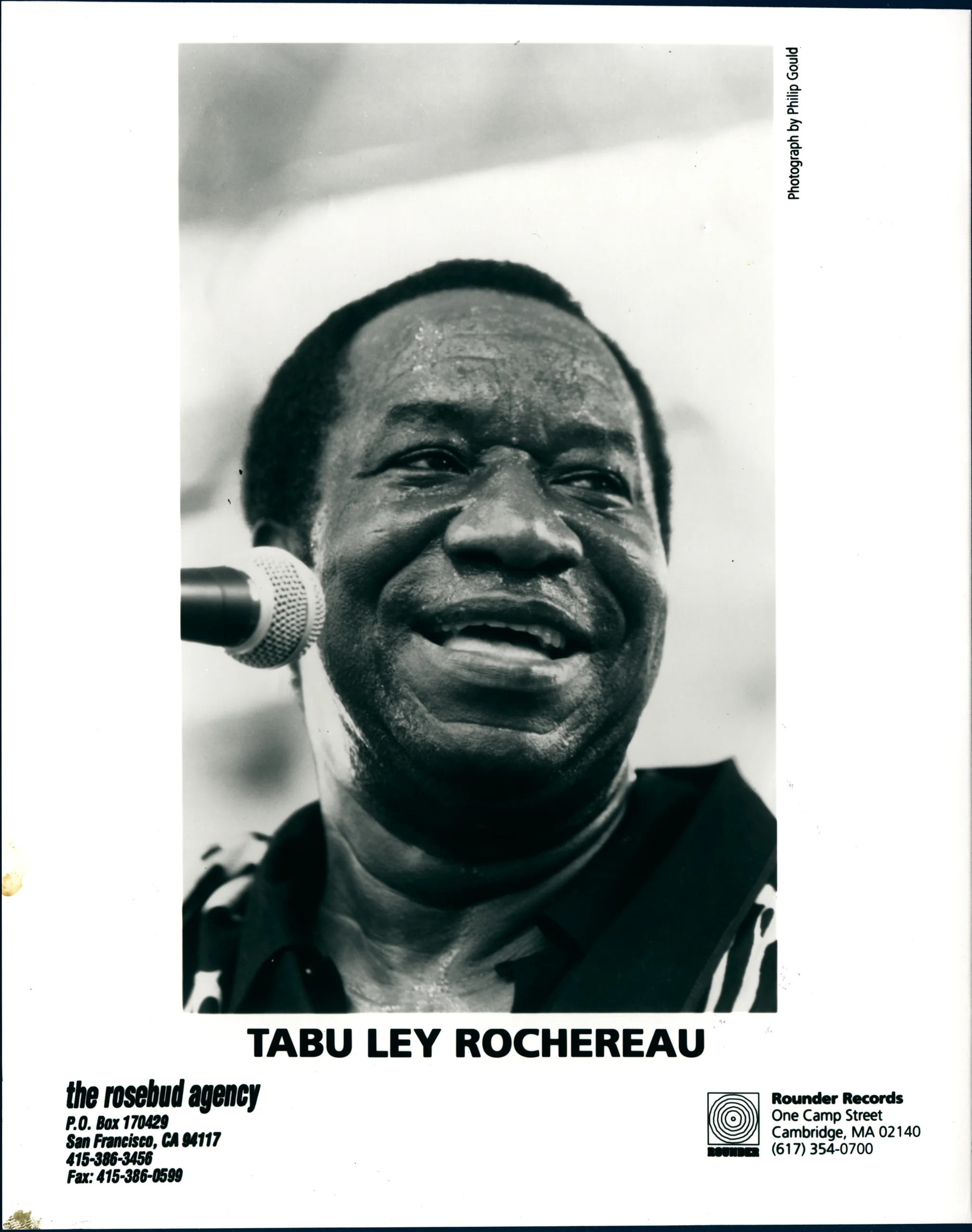
Tabu Ley Rochereau
 DR Congo
Also known as: Pascal-Emmanuel Sinamoyi Tabu, Pascal Tabu, Seigneur Rochereau
Birthday
November 13, 1940
Birth Sign
Scorpio
Birthplace
Bagata, Belgian Congo (now Democratic Republic of Congo)
Age
Died at 73
About
Pascal-Emmanuel Sinamoyi Tabu, known worldwide as Tabu Ley Rochereau, was a Congolese singer, composer, and politician who helped define the sound of African rumba. As the leader of Orchestre Afrisa International, he became one of the continent's most influential musical figures, with a career that spanned over five decades. His honeyed voice and sophisticated songwriting earned him the title "King of Congolese rumba," and his music ruled dance floors from Kinshasa to Paris.
Rochereau's legacy rests on an extraordinary output: approximately 3,000 songs and 250 albums, many of them classics of the genre. He pioneered the fusion of Congolese folk with Cuban and Latin rhythms, a sound that later evolved into soukous and influenced generations of African musicians. In 2023, Rolling Stone ranked him at number 178 on its list of the 200 Greatest Singers of All Time, a testament to his enduring vocal artistry.
Beyond music, Rochereau served in the Democratic Republic of Congo's government after 1997, marking him as a rare figure who straddled both the cultural and political spheres. He passed away on 30 November 2013 in Brussels, but his recordings continue to reach new listeners through streaming platforms, keeping his music alive for future generations.
Early Life & Background
Tabu Ley Rochereau was born on 13 November 1940 in Bagata, a town in the Belgian Congo. Growing up in a colonial society, he absorbed both local musical traditions and the Cuban and Latin sounds that arrived via records and radio. His early exposure to these rhythms would later become the foundation of his signature style.
As a young man, he moved to the capital, Léopoldville (now Kinshasa), where the vibrant music scene was taking shape. In the late 1950s, he joined African Jazz, a band formed in 1953 that was already blending Congolese folk with Caribbean and Latin influences. Rochereau's smooth tenor and gift for melody quickly set him apart, and he became one of the group's standout vocalists.
His stage name "Rochereau" was reportedly inspired by a French military figure, reflecting his intellectual and cosmopolitan leanings. During this period, he began a legendary partnership with guitarist Dr Nico Kasanda, together pioneering the sound of African rumba. Their collaboration produced some of the most influential recordings in Congolese music history, setting the stage for Rochereau's eventual rise to stardom.
Career Growth
Tabu Ley Rochereau's breakthrough came in the 1960s, as he and Dr Nico Kasanda took African rumba to new heights. Their music, which fused Congolese folk with Cuban and Latin rhythms, became the soundtrack of a generation. Hits like "Mokolo Nakokufa" and "Kaful Mayay" established Rochereau as a household name across Africa.
In 1970, he founded Orchestre Afrisa International, which became his primary vehicle for musical expression. Over the next two decades, the band achieved continental superstardom, ruling dance floors with tracks such as "Sorozo," "Maze," and "Ibrahima." Rochereau's rivalry with Franco Luambo Makiadi of TPOK Jazz defined the golden age of Congolese music, pushing both artists to ever greater creativity.
In the 1980s, Rochereau mentored and collaborated with singer Mbilia Bel, producing celebrated albums like The Voice of Lightness and Bel Canto. After the fall of Mobutu Sese Seko in 1997, he entered politics, serving in the DRC government. A stroke in 2008 curtailed his activities, and he died in 2013. His posthumous recognition continues, with Rolling Stone ranking him among the greatest singers of all time in 2023.
Career Timeline
Public Image & Style
Tabu Ley Rochereau cultivated an image of sophistication and cosmopolitanism, setting him apart from the raw energy of some contemporaries. He was celebrated as an impresario and bandleader who shaped not just music but the entire presentation of Congolese popular culture. Media portrayals consistently emphasized his role as a pioneer who "brought Afro-pop worldwide" and "spread the sound of soukous." His vocal style was noted for its honeyed smoothness, and his music blended romantic ballads with danceable rhythms. His fandom spans generations and continents, with annual commemorations of his death held by devoted fans, particularly in Kenya and across Africa. His legacy as the "King of Congolese rumba" remains intact, and his recordings continue to attract new listeners on streaming platforms.
Fame & Fandom (iFAMOUS Rankings)
The audience surrounding Tabu Ley Rochereau operates without a formalized title, preferring an organic unity of fans across Africa and the diaspora who have maintained their devotion since his passing. This collective reverence is most visible in annual commemorative gatherings, such as the 2013 tribute events that drew mourners from Kenya to Kinshasa, where the sheer volume of his recorded output serves as the primary ritual of remembrance. His legacy is not defined by organized campaigns or branded fan clubs but by the enduring consumption of over 3,000 songs and 250 albums that continue to define the genre. While his status as the "King of Congolese Rumba" remains unchallenged in cultural memory, the iFANN Global Fame Engine has evaluated his current standing with neutrality. As of August 2026, the system indicates that Tabu Ley Rochereau does not currently hold a placement in the published Global Top 1,000 rankings or any scope-specific top-100 lists. Consequently, no ordinal position can be assigned to his present global fame metrics. This absence of a numeric rank reflects the nature of posthumous legacies where influence persists even when active commercial dominance wanes. The evaluation confirms that while he was once a dominant force whose music ruled dance floors from Paris to Brazzaville, his current digital footprint does not meet the threshold for a ranked entry in the contemporary database. The distinction between his historical impact and his current algorithmic ranking remains clear; he is remembered as a pioneer who brought Afro-pop worldwide, yet he stands outside the active hierarchy of living celebrities. The silence of the rankings does not diminish the magnitude of his contribution to African music history, nor does it alter the fact that his voice remains a defining element of the soukous sound.
Interesting Facts and Legends
Tabu Ley Rochereau composed approximately 3,000 songs and produced 250 albums over his career, a staggering output that few artists can match. His stage name "Rochereau" was a self-chosen moniker that became synonymous with Congolese rumba. He was one of the few musicians to successfully transition into politics, serving in the DRC government after 1997. His rivalry with Franco Luambo Makiadi was legendary, shaping the course of Congolese music for decades. Rochereau's music blended Congolese folk with Cuban, Caribbean, and Latin American rhythms, creating a distinctive pan-African sound that influenced countless artists. He was known for his sophisticated, cosmopolitan image, a sharp contrast to the raw energy of some contemporaries. A central element of his lore is his nickname, "Seigneur Rochereau," which translates to "Lord Rochereau," reflecting his regal status in the industry. Fans still recount the massive global mourning that occurred immediately upon his death at Saint-Luc Hospital in Brussels, Belgium, cementing his reputation as a continental icon. Tracks such as "Mokolo Nakokufa," "Kaful Mayay," and "Sorozo" are cited as cultural touchstones that define his legacy. The narrative of his life is often framed as that of a "voice of lightness" who navigated political turmoil in Zaire while maintaining artistic excellence.
Family & Personal Life
Tabu Ley Rochereau was married and had several children, including his son Marc Tabu, who became the family's public spokesperson. Rochereau had multiple children from various relationships, though detailed public documentation of his complete family life is limited due to the private nature of his personal life and the era in which he lived. His final years were spent in Brussels, where he was cared for by family. His son Marc Tabu confirmed his death to the BBC in 2013, and continues to manage his father's estate and legacy.
Notable Connections
Tabu Ley Rochereau's career was intertwined with several key figures. Guitarist Dr Nico Kasanda was his early collaborator and co-pioneer of African rumba. Franco Luambo Makiadi, leader of TPOK Jazz, was his friendly rival, and their competition defined Congolese music for decades. Singer Mbilia Bel was his protégée, collaborator, and romantic partner during the 1980s. His son Marc Tabu has served as the family's spokesperson, keeping his father's legacy alive.
Relationships & Dating History
Tabu Ley Rochereau's personal life was relatively private, but his most notable relationship was with singer Mbilia Bel. She joined his orchestra in the early 1980s, and their collaboration produced some of the most celebrated recordings in Congolese music history. Their professional partnership was mirrored by a romantic one, though the dynamics were complex, as hinted by lyrics on their collaborative albums. The relationship eventually ended, both personally and professionally, and Bel went on to have a successful solo career.
Rochereau was married at some point and had several children, including his son Marc Tabu. However, details of his marriages and other relationships are scarce, as he kept his personal life out of the public eye. At the time of his death in 2013, he was widowed or separated, and his final years were spent in Brussels, cared for by family.
As of 2026, Rochereau's romantic history remains a topic of interest among fans, particularly his relationship with Mbilia Bel, but no new information has emerged since his passing.
- DatedMbilia Bel1980 - 1988Protégée and romantic partner during the 1980s; collaborated on celebrated albums.
Death & Aftermath
Died
November 30, 2013 (aged 73)
Death Place
Unknown
Cause of Death
Unknown
Tabu Ley Rochereau, the renowned Congolese singer, composer, and politician born on November 13, 1940, passed away on November 30, 2013, at the age of 73. While his son Marc Tabu confirmed the death to international media outlets, official channels did not release specific details regarding the exact location where he died or an autopsy report establishing the medical cause of his passing. The artist spent his final years residing in Brussels under the care of his family before his death.
The loss of a figure who defined African rumba for over five decades prompted immediate tributes from peers and institutions across the continent. His vast catalogue of approximately 3,000 songs remains a primary source of income for his estate. Posthumous recognition arrived with Rolling Stone ranking him among the greatest singers of all time in 2023, cementing his legacy as one of the most influential figures in the genre alongside Franco.
Net Worth (Estate Value)
$10 Million
iFANN Editorial Team estimate
Tabu Ley Rochereau's estate continues to generate income from his vast musical catalogue. With approximately 3,000 songs and 250 albums, his recordings remain widely available on streaming platforms like Spotify, Apple Music, and YouTube, ensuring a steady flow of royalties. The estate also benefits from licensing deals for film, television, and media use, as well as compilation releases that introduce his music to new audiences. Per iFANN's editorial analysis, the estate's value is estimated to be $10 Million. This figure accounts for the enduring popularity of his music, particularly in Africa and among diaspora communities. The estate is managed by his family, including his son Marc Tabu, who has worked to preserve and promote his father's legacy. Since his death in 2013, the estate has likely seen a boost from posthumous recognition, including renewed interest in his work.
Awards Won (1)
Tabu Ley Rochereau received posthumous recognition for his contributions to music. In 2023, Rolling Stone ranked him at number 178 on its list of the 200 Greatest Singers of All Time, a singular honor that highlights his vocal prowess and enduring influence. He was widely referred to as the "King of Congolese rumba" and credited as "the inventor of Congolese soukous music," titles that reflect his pioneering role in African music.
2023 · Ranking
Career
Known For
Mokolo Nakokufa
1960 · Singer, composer
Kaful Mayay
1970 · Singer, composer
Sorozo
1975 · Singer, composer
The Voice of Lightness
1984 · Singer, composer
Bel Canto
1986 · Singer, composer
Keywords
Sources
Quick Facts
- Profession
- Singer, composer, politician
- Born
- November 13, 1940
- Birthplace
- Bagata, Belgian Congo
- Died
- November 30, 2013
- Death Place
- Brussels, Belgium
- Gender
- Male
- Birth Sign
- Scorpio
Personal Details
- Full Name
- Pascal-Emmanuel Sinamoyi Tabu
- Children
- Marc Tabu (son), among others
Frequently Asked Questions
How many songs did Tabu Ley Rochereau compose?
What was Tabu Ley Rochereau's real name?
What caused Tabu Ley Rochereau's death?
Was Tabu Ley Rochereau involved in politics?
What was Tabu Ley Rochereau's relationship with Mbilia Bel?
Social Media
Similar People
Join the community
fans discussing