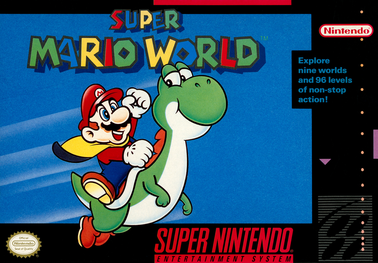
Super Mario World
Overview
Super Mario World, released in 1990 for the Super Nintendo Entertainment System, was Nintendo's flagship launch title for the 16-bit console. Developed by Nintendo EAD under director Takashi Tezuka and produced by Shigeru Miyamoto, the game was built to showcase the SNES's technical capabilities: Mode 7 scaling and rotation, a richer color palette, and smoother parallax scrolling. It sold over 20 million copies worldwide, becoming the best-selling game on the platform and a defining title of the 16-bit era.
The game abandons the traditional Mushroom Kingdom for Dinosaur Land, where Mario and Princess Peach vacation only to find Bowser and the Koopalings have taken over. Mario must traverse seven worlds, from Yoshi's Island to the Valley of Bowser, to rescue the princess and free the imprisoned dinosaurs. The world map offers non-linear progression, with branching paths and secret exits that unlock shortcuts to Star Road and the Special Zone, a set of brutally difficult bonus levels.
Super Mario World introduced several series staples, most notably Yoshi, a green dinosaur who can swallow enemies and spit them as projectiles. Colored Koopa shells grant Yoshi temporary powers: red shells produce fireballs, blue shells allow flight, and yellow shells create shockwaves. The Spin Jump, a new move that can break blocks and defeat spiked enemies, and the item reserve box, which lets players store a single power-up for later use, also debuted here. The game features 96 exits across 74 levels, with hidden Switch Palaces that permanently alter the environment, for example, turning all yellow blocks into coins.
Critics consistently rank Super Mario World among the greatest video games ever made. Retrospective scores from IGN (9.5/10), GameSpot (9.2/10), and Eurogamer (10/10) praise its tight level design, inventive secrets, and Yoshi's seamless integration. The game's influence extends beyond its own franchise: its world map structure and secret-hunting philosophy inspired later platformers like Donkey Kong Country and Celeste. The soundtrack, composed by Koji Kondo, includes memorable themes such as the athletic overworld music and Yoshi's introduction jingle, which remain widely remixed and recognized.
Gameplay
Super Mario World retains the core run-and-jump mechanics of its predecessors but adds several new abilities. The Spin Jump, executed by pressing the jump button while spinning, destroys certain blocks and defeats enemies like the spiny and the piranha plant. Players can store a single power-up in a reserve box, accessed by pressing the select button, allowing them to retain a spare Super Mushroom or Cape Feather. The world map, displayed as an overhead view of Dinosaur Land, lets players choose which level to tackle next, with multiple paths and secret exits that unlock new areas. Hidden Switch Palaces, when activated, permanently change block types in all levels of that world, for instance, turning yellow blocks into coins or red blocks into rotating platforms.
Yoshi is the most significant addition. Mario can ride Yoshi by finding him inside a ? Block or egg. Yoshi can eat most enemies by sticking out his tongue, and can spit them out as projectiles or swallow them. If Mario grabs a Koopa shell while riding Yoshi, the dinosaur gains a temporary power depending on the shell's color: red shells grant fireball-spitting ability, blue shells allow flight, and yellow shells produce stomp-induced shockwaves. Yoshi also has a flutter jump that gives extra hang time. If Mario takes damage while riding Yoshi, Yoshi runs away and must be retrieved; if Yoshi falls into a pit or is hit by an enemy, he disappears until a new one is found.
The game includes 96 exits across 74 levels, with many levels containing multiple exits, often a normal exit and a secret one that leads to a different path on the world map. The Special Zone, accessible via Star Road, consists of eight extremely difficult levels that test the player's mastery of all mechanics. Completing all 96 exits unlocks a brief ending sequence showing Mario and Peach leaving Dinosaur Land. The game also features a scoring system based on coins collected, enemies defeated, and time remaining, though the primary objective is simply to reach the goalpost.
Story
The game opens with Mario, Luigi, and Princess Peach vacationing in Dinosaur Land. Bowser and his seven Koopalings, Iggy, Morton, Lemmy, Ludwig, Roy, Wendy, and Larry, have imprisoned the local dinosaur inhabitants and captured Princess Peach. Mario must travel through seven worlds to rescue her. Each world is themed: Yoshi's Island is a grassy starting area; Donut Plains features rolling hills and underground caverns; Vanilla Dome is a network of caves; Twin Bridges is a series of platforms over water; Forest of Illusion is a maze-like woodland; Chocolate Island is a volcanic area; and Valley of Bowser is the final fortress.
Throughout the adventure, Mario frees captured Yoshis from eggs and ? Blocks. The Koopalings serve as bosses, each guarding a castle at the end of a world. They are fought in a similar pattern: Mario must hit a switch to drop a platform that allows him to reach the Koopaling and stomp them multiple times. After defeating all seven Koopalings, Mario enters Bowser's castle, where he faces Bowser himself in a final battle. Bowser throws Mechakoopas and uses a magic wand that creates a ring of fire. Mario must dodge and stomp Bowser three times to defeat him. After the victory, Mario rescues Peach, and the freed Yoshis celebrate. The ending credits show Mario and Peach flying away in a hot air balloon. If the player has collected all 96 exits, a brief additional scene shows the Yoshis dancing on a beach.
Awards & Acclaim
Golden Joystick Award: Best Platform Game: (1992)
Keywords
Game Info
- Developer
- Nintendo Entertainment Analysis & Development
- Publisher
- Nintendo
- Release Date
- 1990-11-21
- Modes
- Single-player, Cooperative two-player (GBA version only)
- Platforms
- Super Nintendo Entertainment System, Game Boy Advance, Nintendo Super System, New Nintendo 3DS, Nintendo Switch, Wii, Wii U
- Composer
- Koji Kondo
- Director
- Takashi Tezuka
- Producer
- Shigeru Miyamoto
- Sales
- Over 20 million copies
- Number of Exits
- 96
- Number of Levels
- 74
Join the community
fans discussing