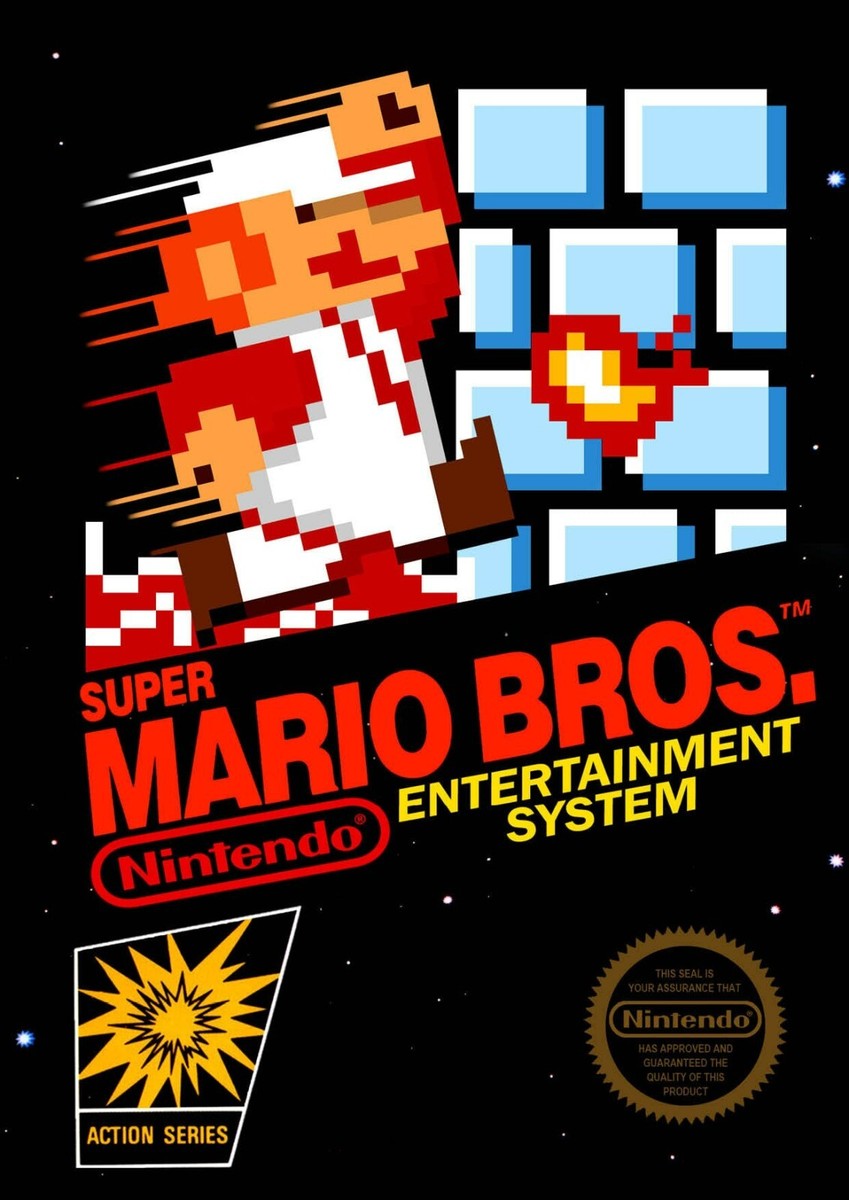
Super Mario Bros.
"The game that saved an industry and defined a genre."
Overview
On September 13, 1985, Nintendo released a game that would change the face of interactive entertainment. Super Mario Bros. arrived on the Famicom in Japan, then hit the NES in North America the following year. Directed by Shigeru Miyamoto and co-designed by Takashi Tezuka, it was built on lessons from earlier projects like Devil World, Excitebike, and Kung Fu. Miyamoto wanted a colorful, scrolling platformer with precise controls and larger characters. The team crafted World 1-1 as a masterclass in tutorial design, teaching players to jump, collect, and avoid without a single word of instruction.
The story is simple: Mario (or Luigi, in two-player mode) must rescue Princess Toadstool from the villainous King Koopa. Players traverse eight worlds, each with four side-scrolling levels, dodging Goombas, Koopa Troopas, and Piranha Plants. Power-ups like the Super Mushroom and Fire Flower add depth. Koji Kondo's soundtrack, composed on the NES's five-channel audio chip, was one of the first to treat music as a core design element. The main theme became instantly recognizable worldwide.
Super Mario Bros. sold over 58 million copies, making it one of the best-selling games ever. It revitalized the video game industry after the 1983 crash and popularized the side-scrolling platform genre. Critics then and now praise its controls and level design. It has been re-released on nearly every Nintendo platform, from the Game Boy Advance to the Nintendo Switch, and its influence is seen in countless games that followed.
Gameplay
Super Mario Bros. is a side-scrolling platformer where players guide Mario through eight worlds. Each world contains four levels, culminating in a castle guarded by Bowser. Mario can jump on enemies to defeat them, or avoid them entirely. Power-ups include the Super Mushroom, which makes Mario grow and withstand one extra hit; the Fire Flower, which lets Mario throw fireballs; and the Starman, granting temporary invincibility. The game uses a lives system, with extra lives earned from collecting 100 coins or hitting certain blocks. The two-player mode alternates turns between Mario and Luigi, a precursor to later cooperative play.
Story
One day, the Mushroom Kingdom fell under the rule of King Koopa, a powerful turtle-like sorcerer. He transformed the kingdom's inhabitants into bricks and plants and kidnapped Princess Toadstool. Mario, a humble plumber, sets out to rescue her. He travels through eight worlds, each with its own theme: grasslands, underground caves, underwater sections, and castles. At the end of each castle, Mario faces a fake Bowser, but the real Bowser awaits in World 8-4. After defeating him by striking the axe behind the bridge, the princess is freed. The game ends with a simple celebration: Mario and Peach stand together as fireworks explode overhead.
Awards & Acclaim
World Video Game Hall of Fame: Inductee: (2015)
Guinness World Records: Best-Selling Platform Game: (2009)
Japan Game Awards: Special Award: (2006)
Keywords
Game Info
- Developer
- Nintendo Entertainment Analysis & Development
- Publisher
- Nintendo
- Release Date
- 1985-09-13
- Modes
- Single-player, Multiplayer
- Platforms
- Nintendo Entertainment System, Game Boy Advance, arcade video game machine, Famicom Disk System, Game Boy Color, Nintendo GameCube, Game & Watch series, NEC PC-8800 series, PlayChoice-10, Super Nintendo Entertainment System, Wii, Nintendo 3DS, Wii U, Nintendo Switch
Join the community
fans discussing