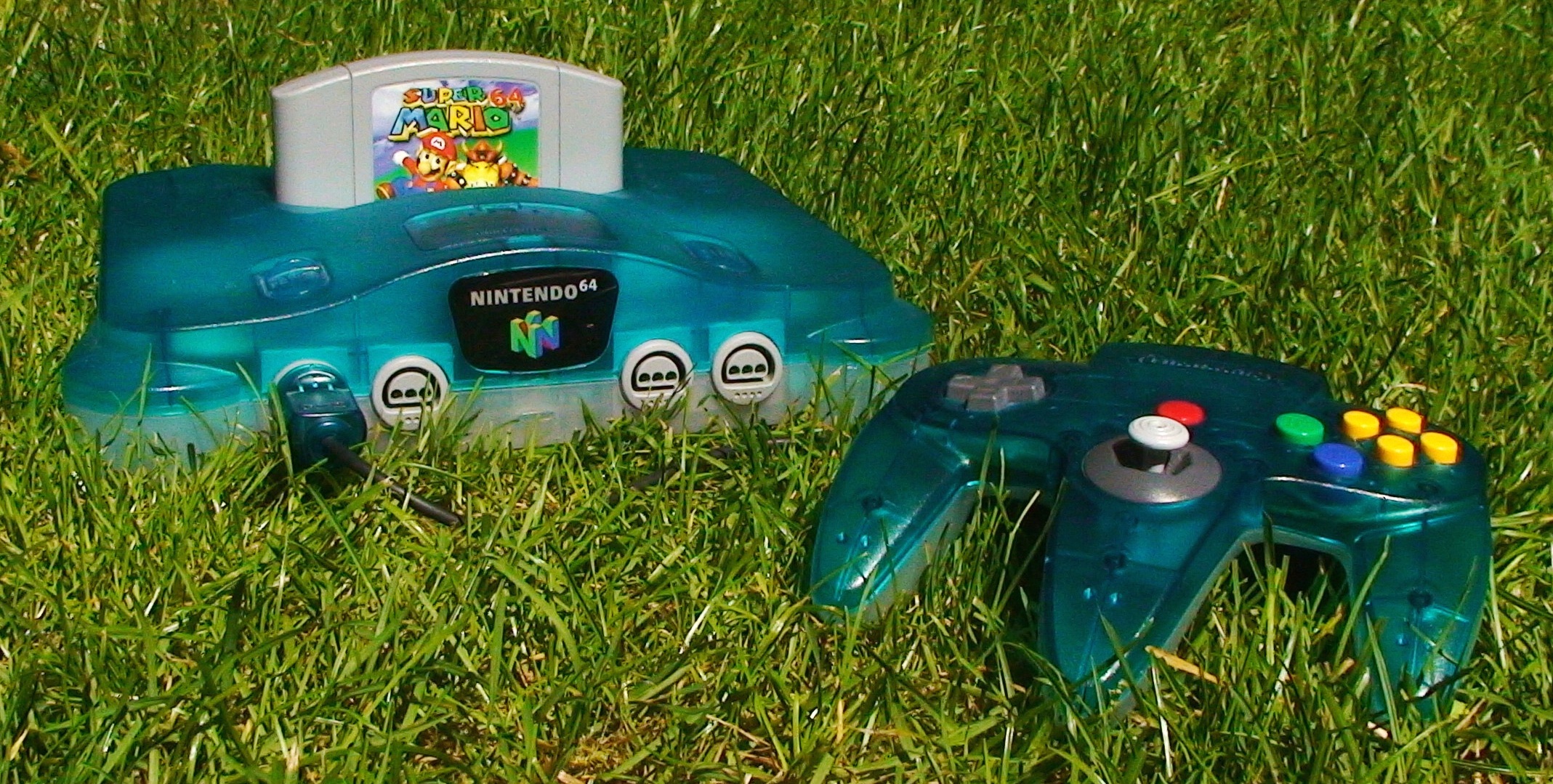
Super Mario 64
"The game that taught 3D how to move."
Score
4.5/10
Overview
Super Mario 64 didn't just launch with the Nintendo 64 in 1996, it practically defined the console. Developed by Nintendo EAD and directed by Yoshiaki Koizumi and Takashi Tezuka, with Shigeru Miyamoto producing, the game was the first fully three-dimensional Mario adventure. Instead of linear levels, players explored Princess Peach's castle, jumping into magical paintings that led to open-ended worlds like Bob-omb Battlefield and Whomp's Fortress. Each world held multiple Power Stars, and you could tackle them in almost any order. The controls were the real revelation: Mario could triple jump, wall kick, ground pound, and long jump with a fluidity that felt magical. The analog stick on the N64 controller gave players precise control over movement speed and direction, something 2D games could never offer.
Koji Kondo's soundtrack matched the playful tone perfectly, from the cheerful castle theme to the underwater serenity of Dire, Dire Docks. The game shipped with 15 main worlds plus three Bowser stages, hiding secrets like the Wing Cap and Vanish Cap that let you fly or walk through walls. It sold over 11.9 million copies worldwide, making it the best-selling N64 game. Critics were unanimous in their praise, IGN gave it 9.8/10, Edge awarded a rare perfect score, and Metacritic's aggregate sits at 94/100. The game won Game of the Year at the 1997 Interactive Achievement Awards and was inducted into the World Video Game Hall of Fame in 2017.
Super Mario 64's influence ripples through every 3D platformer that followed. Its camera system, analog movement, and mission-based level design became templates for Banjo-Kazooie, Spyro the Dragon, and countless others. The speedrunning community has kept the game alive for decades, the current 120-star world record sits under 1 hour 38 minutes. A dedicated modding scene produced the Super Mario 64 PC Port, allowing native high-resolution play. The game returned in 2004 as Super Mario 64 DS on Nintendo DS, adding Yoshi, Luigi, and Wario as playable characters, and again in 2020 on Nintendo Switch as part of Super Mario 3D All-Stars with modern controller support.
Gameplay
Super Mario 64 throws you into Princess Peach's castle with no tutorial and a simple goal: find Power Stars. Each of the 15 main worlds contains six or seven stars, and you can grab them in any order. Some require beating a boss, others ask you to collect red coins, reach a high platform, or solve a puzzle. The castle itself is a hub world, hiding secret stars behind paintings, under carpets, and in hidden rooms. Mario's moveset is deep for 1996: the triple jump launches him higher with each hop, the wall kick lets him scale vertical surfaces, and the ground pound breaks through weak floors. The long jump covers serious distance, and the backflip reaches ledges behind him. The camera, controlled by the C-buttons, can be a bit stubborn, but it was revolutionary at the time. Each world has its own gimmick, Jolly Roger Bay's underwater sections, Lethal Lava Land's fire hazards, and Rainbow Ride's moving platforms. Collecting 120 stars unlocks the cannon outside the castle, leading to a final Yoshi encounter on the roof.
Story
Princess Peach writes Mario a letter: "Come to my castle for cake!" But when Mario arrives, Bowser has already struck. The Koopa King traps Peach inside a painting above the castle entrance, then scatters the Power Stars across the worlds hidden in the castle's paintings. Mario needs to collect enough stars to reach Bowser's three hidden traps, the first in the basement, the second in the upper floors, and the final showdown on the castle's roof. Each Bowser encounter is a circular arena where Mario must grab Bowser's tail and spin him into bombs. After the third defeat, Bowser drops the key to the final door. Mario climbs to the roof, finds Peach waiting, and she thanks him with cake. The story is minimal, told through brief cutscenes and Peach's letters, but it's enough to drive the adventure.
Trailers

Awards & Acclaim
Game of the Year: Interactive Achievement Award: (1997)
Best Game: Japan Game Awards: (1996)
World Video Game Hall of Fame: Induction: (2017)
Keywords
Game Info
- Developer
- Nintendo Entertainment Analysis & Development
- Publisher
- Nintendo
- Engine
- Proprietary Nintendo 64 engine
- Release Date
- 1996-06-23
- Age Rating
- E (Everyone)
- Modes
- Single-player
- Platforms
- Nintendo 64, Wii U, Nintendo Switch
- Director
- Yoshiaki Koizumi, Takashi Tezuka
- Producer
- Shigeru Miyamoto
- Composer
- Koji Kondo
- Sales
- 11.91 million (as of 2022)
Join the community
fans discussing