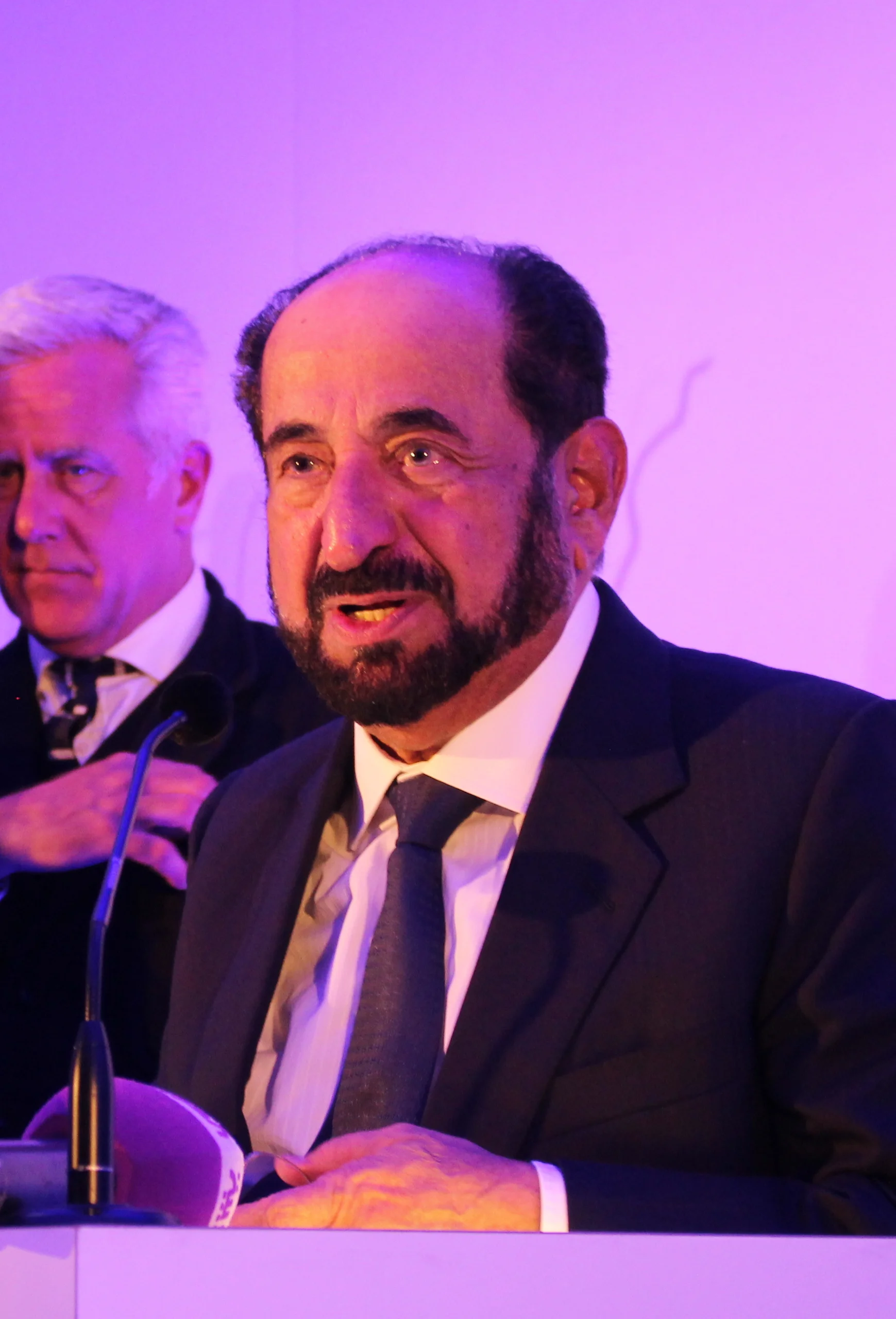
Sultan bin Muhammad Al-Qasimi
 United Arab Emirates
Also known as: Ruler of Sharjah, Sheikh Dr. Sultan
Birthday
July 2, 1939
Birth Sign
Cancer
Birthplace
Sharjah
Age
87 years old
About
Sultan bin Muhammad Al-Qasimi is an Emirati ruler, historian, and author, serving as the 11th ruler of the Emirate of Sharjah and a member of the Federal Supreme Council of the United Arab Emirates. He has held his position as Ruler of Sharjah since January 25, 1972, making him one of the longest-serving leaders within the region. He is widely regarded for his deep commitment to the development of education and culture, alongside the preservation of historical sites. His leadership has contributed to Sharjah's standing as a significant cultural center, notably leading to its designation as the Islamic Culture Capital in 2014. Additionally, he is a prolific writer, having authored more than a dozen books that span memoirs, novels, poetry, and plays, often focusing on Middle Eastern and North African history. His scholarly contributions, such as his work on the historical narratives of the Gulf, have garnered international recognition.
Early Life & Background
Sultan bin Muhammad Al-Qasimi was born on July 2, 1939, in Sharjah, to Sheikh Muhammad bin Saqr Al Qasimi and Sheikha Maryam bint Sheikh Ghanem Al Qasimi. His early years were spent within the traditional setting of Sharjah, where he received his initial education. He later pursued higher education, acquiring various academic degrees that provided a strong foundation for both his future leadership and his scholarly interests. During this period, his intellectual curiosity began to focus on history and culture, subjects that would later define much of his public work. A notable early initiative demonstrating this interest occurred in 1970 when he personally supervised the restoration of Al Hisn Fort, a historically significant landmark in Sharjah. This project underscored his dedication to preserving the emirate's heritage even before his ascension to its highest office. The following year, in 1971, he assumed the role of the first Minister of Education for the newly formed United Arab Emirates, where he played a formative part in establishing the nation's educational framework and policies. These experiences in cultural preservation and educational leadership directly preceded his long tenure as ruler.
Career Growth
On January 25, 1972, Sultan bin Muhammad Al-Qasimi became the Ruler of Sharjah, simultaneously joining the Federal Supreme Council of the United Arab Emirates. His leadership has consistently prioritized cultural development, education, and the careful preservation of historical sites within the emirate. Under his guidance, Sharjah has undergone significant transformation, culminating in its recognition as the Islamic Culture Capital in 2014, an acknowledgment of its vibrant cultural scene and numerous initiatives. As an author, he has published more than twelve books, with titles such as his memoir My Early Life offering insights into his personal journey, and The Myth of Arab Piracy in the Gulf providing a scholarly re-examination of historical narratives. His recent activities demonstrate a continued focus on governance and community welfare. In 2026, he issued Emiri decrees to approve the organizational structures of various Sharjah civic bodies. He also ordered the allocation of Dh8 million for a new heritage market in Khor Fakkan, emphasizing continued investment in cultural infrastructure. Additionally, he performed Eid Al Adha prayer and subsequently pardoned 227 prisoners, a traditional act of clemency. Further demonstrating his commitment to the emirate's infrastructure, he announced a Dhs750 million allocation for the development of Sharjah's roads. A significant cultural initiative launched recently is the Al Qawasim Digital Platform, designed to preserve the family's history and lineage. In related news, Sheikha Hoor Al Qasimi, a member of the royal family, was appointed chairperson of the Sharjah Museums Authority, reflecting ongoing family involvement in the emirate's cultural institutions.
Career Timeline
Public Image & Style
Sultan bin Muhammad Al-Qasimi presents a public image as a visionary leader deeply invested in the intellectual and cultural advancement of Sharjah. He is widely seen as a dedicated patron of education and the arts, with his extensive personal scholarship reinforcing this perception. His commitment to the meticulous preservation of historical sites and traditional heritage resonates with both local citizens and international observers. Media portrayals often emphasize his role in transforming Sharjah into a prominent cultural hub within the Arab world, a reputation solidified by accolades such as its designation as the Islamic Culture Capital. He is frequently referred to simply as the 'Ruler of Sharjah,' a title that conveys his central and enduring presence in the emirate's identity. His prolific output as an author, covering diverse genres from memoirs to historical studies, further shapes his image as a thoughtful and learned monarch, connecting with audiences through both his governance and his intellectual contributions.
Fame & Fandom (iFAMOUS Rankings)
Sheikh Sultan bin Muhammad Al-Qasimi commands a public sphere defined not by celebrity fandom but by civic reverence and state-sponsored engagement. Unlike pop icons, he lacks a formal fanbase with specific monikers or grassroots campaigns; his supporters are citizens united by governance rather than a dedicated following organizing tributes or digital movements. While the public celebrates milestones through official channels, such as the 2026 tribute marking eighty-seven years of light, the interaction remains rooted in formal respect for a monarch-scholar rather than the chaotic adoration seen in entertainment circles. Despite this absence of a traditional fandom, his global stature is quantifiable and significant within the iFANN Global Fame Rankings. Current data places him as the 30th most famous person in United Arab Emirates, a position held steady from the previous cycle, while also ranking him as the 14th most famous person from United Arab Emirates. These placements reflect a consistent level of attention across media coverage, search trends, and cultural consumption signals worldwide. His dual identity as a sovereign ruler and a prolific historian ensures that his name carries weight in academic and political spheres alike, distinguishing him from figures whose fame relies solely on entertainment output. The lack of viral incidents or street-level fanfare does not diminish his prominence; instead, it underscores the nature of his influence as a stabilizing force within the region. As one of the longest-serving leaders in the United Arab Emirates, his presence is felt through institutional legacy rather than fleeting moments of viral sensation.
Interesting Facts and Legends
Sultan bin Muhammad Al-Qasimi has served as the Ruler of Sharjah for over five decades, establishing himself as one of the most enduring leaders in the United Arab Emirates. His scholarly contributions include The Myth of Arab Piracy in the Gulf, a work widely praised by international historians for challenging established colonial narratives. Beyond his political and academic roles, he is a recognized playwright and poet, demonstrating a versatility that extends into the arts. In 1970, he personally oversaw the restoration of the Al Hisn Fort, marking an early commitment to preserving the emirate's heritage. He also played a pivotal role in the formation of the nation's educational framework, serving as the UAE's first Minister of Education in 1971. A defining narrative surrounding him is his reputation as a scholar-king, being one of the few modern monarchs who maintains an active bibliography on Gulf history and the Trucial States. This image was reinforced in recent years by his approval of new organizational structures for Sharjah's civic bodies and his allocation of substantial funds for infrastructure and heritage projects in 2026. Another recurring theme in his legacy is the balance between rapid modernization and the preservation of tradition, exemplified by the launch of the Al Qawasim Digital Platform to document family lineage. These actions have cemented his status as a visionary developer who guides the emirate with a focus on both progress and historical continuity.
Family & Personal Life
Sultan bin Muhammad Al-Qasimi was born into the Al Qasimi royal family, with his parents being Sheikh Muhammad bin Saqr Al Qasimi and Sheikha Maryam bint Sheikh Ghanem Al Qasimi. He is known to have a son, His Highness Sheikh Sultan bin Mohammed bin Sultan Al Qasimi, who holds the significant positions of Crown Prince and Deputy Ruler of Sharjah, having been appointed in 1999. The family's lineage and historical background are subjects of ongoing interest, as evidenced by the recent initiation of the Al Qawasim Digital Platform, a project designed to preserve and share the family's extensive history. Details regarding other immediate family members or his daily household life are kept private, consistent with the norms for many royal figures in the region.
Notable Connections
Sultan bin Muhammad Al-Qasimi is closely associated with His Highness Sheikh Sultan bin Mohammed bin Sultan Al Qasimi, his son, who serves as the Crown Prince and Deputy Ruler of Sharjah. Another notable association is with Sheikha Hoor Al Qasimi, a member of the royal family, who was recently appointed chairperson of the Sharjah Museums Authority, indicating ongoing family involvement in the emirate's cultural institutions and development.
Relationships & Dating History
Information regarding Sultan bin Muhammad Al-Qasimi's personal relationships is not extensively detailed in public records. As is common with many royal figures, aspects of his private life, including specific details of his marital history, are maintained with a degree of discretion. It is publicly known that he has a son, His Highness Sheikh Sultan bin Mohammed bin Sultan Al Qasimi, who serves as the Crown Prince and Deputy Ruler of Sharjah. This indicates a past marriage, though the identity of his spouse and the timeline of any relationships are not widely publicized. The focus of public information tends to remain on his extensive governmental, cultural, and scholarly contributions. As of 2026, Sheikh Sultan bin Muhammad Al-Qasimi's marital or relationship status is not publicly detailed, with official sources primarily highlighting his public duties and achievements.
Salary, Net Worth In 2026
$250 Million
iFANN Editorial Team estimate
The financial holdings of reigning monarchs and members of royal families are often closely guarded, and specific breakdowns of his assets are not publicly disclosed. However, per iFANN's editorial analysis, the total net worth is estimated at $250 Million. This figure generally stems from a combination of his official salary as the Ruler of Sharjah and a member of the Federal Supreme Council of the United Arab Emirates, along with significant government allowances. As the head of the emirate, he oversees and benefits from various state-controlled enterprises and investments. Sharjah, a constituent emirate of the UAE, possesses a diverse economy, including sectors like tourism, real estate, and trade, all of which contribute to the broader financial landscape under his leadership. His long tenure, spanning over five decades, has allowed for substantial accumulation and growth of assets. Furthermore, the Al Qasimi royal family has historical landholdings and business interests that contribute to the family's collective wealth, a portion of which would be attributed to the current ruler. While precise figures remain private, his financial standing reflects his prominent and enduring position within one of the wealthiest regions globally, supported by his leadership in economic development initiatives across the emirate.
Awards & Accolades
Known For
Ruler of Sharjah
1972 · Ruler
My Early Life
· Author
The Myth of Arab Piracy in the Gulf
· Author
Keywords
Sources
Quick Facts
Personal Details
- Children
- His Highness Sheikh Sultan bin Mohammed bin Sultan Al Qasimi
- Education
- Higher education degrees
Frequently Asked Questions
Who is Sultan bin Muhammad Al Qasimi?
When did Sultan bin Muhammad Al Qasimi become the Ruler of Sharjah?
What is Sultan bin Muhammad Al Qasimi known for?
What are some notable works by Sultan bin Muhammad Al Qasimi?
What recent initiatives has Sultan bin Muhammad Al Qasimi been involved in?
Join the community
fans discussing