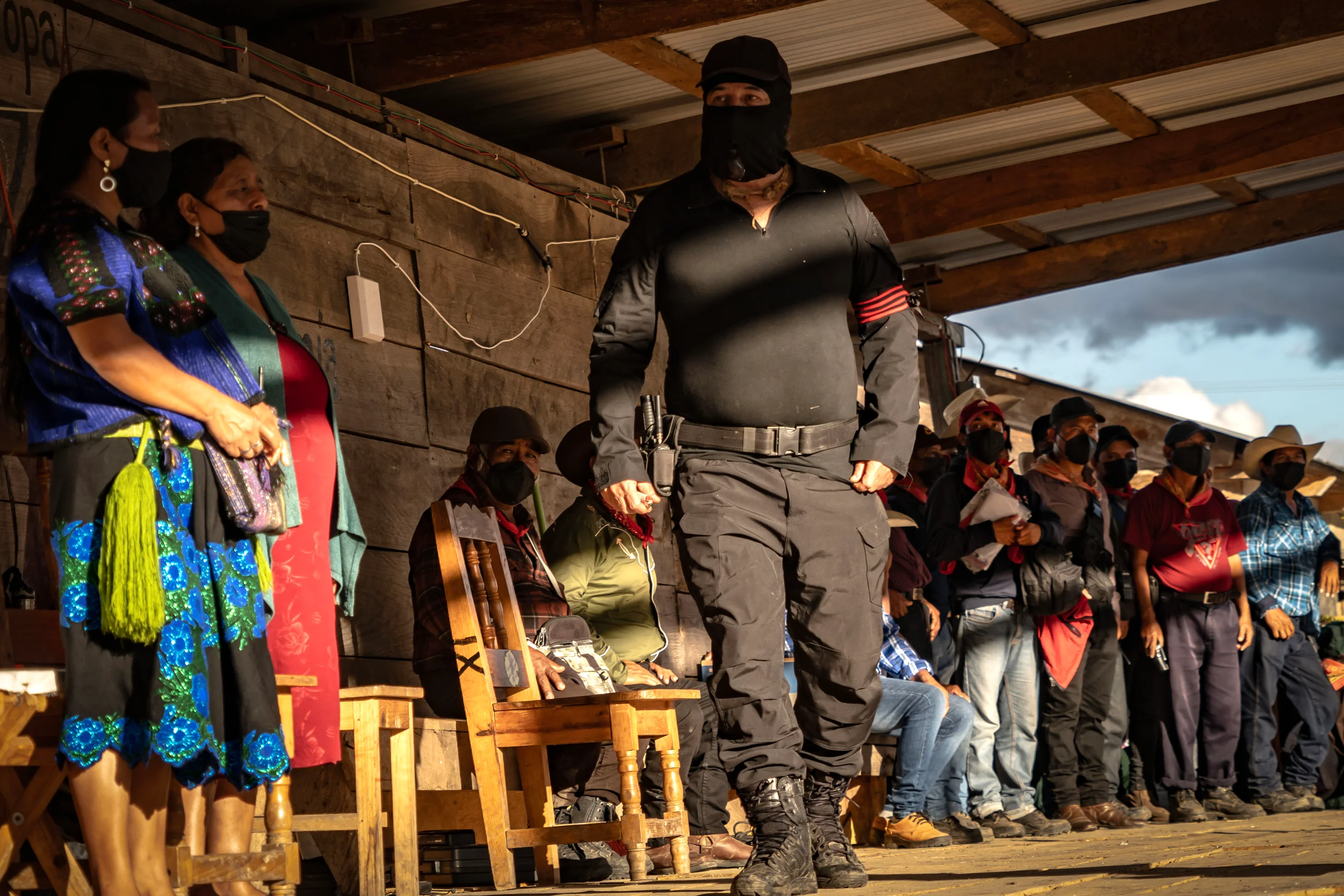
Subcomandante Marcos
 Mexico
Also known as: Rafael Sebastián Guillén Vicente, Subcomandante Galeano, Delegate Zero, Comandante Ramona
Birthday
June 19, 1957
Birth Sign
Gemini
Birthplace
Tampico, Tamaulipas, Mexico
Age
69 years old
About
Rafael Sebastián Guillén Vicente is a Mexican insurgent, philosopher, and author best known as Subcomandante Marcos, the primary spokesman for the Zapatista Army of National Liberation (EZLN). Born in Tampico in 1957, he transitioned from an academic career teaching philosophy to leading a revolutionary movement in Chiapas. He became a global icon for indigenous rights and anti-neoliberalism through his poetic communiqués and distinctive image of a ski mask and pipe.
Although he held the title of Subcommander, indicating he served under the collective leadership of indigenous commanders rather than acting as a sole dictator, his literary voice defined the movement's public face for two decades. In 2014, he announced a strategic disappearance to decentralize the EZLN, declaring himself a "hologram" created by the people he represented. As of 2026, he remains a background figure within the autonomous municipalities of Chiapas, occasionally issuing statements but largely absent from the central spotlight.
Early Life & Background
Rafael Sebastián Guillén Vicente was born on June 19, 1957, in the port city of Tampico, Tamaulipas. Unlike many revolutionaries who rose from rural poverty, Guillén came from a middle-class background and pursued a traditional path into academia. He earned a degree in philosophy from the prestigious National Autonomous University of Mexico (UNAM) in Mexico City. By the early 1980s, he had secured a position teaching at the Autonomous Metropolitan University (UAM), where he engaged with students and intellectuals about political theory and social justice.
His time as a professor marked the beginning of his radicalization. Influenced by Marxist-Leninist ideology and the geopolitical tensions of the Cold War, he joined the National Liberation Forces (FLN), a guerrilla group seeking to overthrow the Mexican government. The FLN operated underground, planning insurrection against the ruling Institutional Revolutionary Party (PRI). In 1984, Guillén left the relative safety of the university and relocated to Chiapas, the southernmost state of Mexico. This region was characterized by extreme poverty, severe land disputes, and the systemic marginalization of its Mayan population.
Upon arriving in the Lacandon Jungle, Guillén worked directly with indigenous communities, listening to their grievances and helping to organize them. He played a key role in transforming the local FLN cell into the Zapatista Army of National Liberation (EZLN). His academic training in philosophy allowed him to articulate the struggles of the peasants in complex, literary terms that resonated far beyond the jungle. Before the world knew him as the masked rebel, he was simply a teacher and organizer dedicated to the cause of land reform and indigenous autonomy.
Career Growth
The EZLN launched a surprise armed uprising on January 1, 1994, coinciding exactly with the implementation of the North American Free Trade Agreement (NAFTA). Guillén Vicente emerged publicly as Subcomandante Marcos, adopting a black ski mask, a colorful poncho, and a pipe to symbolize the anonymity of the oppressed. He immediately became the movement's chief spokesperson, issuing daily communiqués that blended political theory, fairy tales, and sharp satire. These writings were distributed globally through the nascent internet, making the struggle in Chiapas a focal point for international activists.
Throughout the late 1990s and early 2000s, Marcos traveled extensively, meeting with world leaders and celebrities while maintaining his masked persona. He published Our Word Is Our Weapon in 1996, a collection of his speeches and letters that became a bestseller and a staple in political science courses worldwide. In 2006, he launched "The Other Campaign" (La Otra Campaña), a counter-campaign traveling across Mexico in a pink truck to build a coalition against the established political parties. During this tour, he adopted the alias "Delegate Zero" and released the novel The Uncomfortable Dead.
In June 2014, Marcos announced his retirement from the public eye during a gathering in Oventic. He declared that he was ceasing to exist as a public figure, stating that the EZLN must now speak without a single face. This move effectively decentralized the movement's leadership structure. While he has made rare appearances since, such as a silent presence at the 30th anniversary of the uprising in 2024, he has maintained his self-imposed exile from the central stage. In 2026, he continues to operate under the moniker "Capitán Insurgente Marcos," serving in an advisory capacity within the EZLN's ideological framework.
Career Timeline
Public Image & Style
Marcos cultivated the image of the "masked intellectual," a philosopher-revolutionary who rejected the cult of personality common in Latin American politics. His aesthetic, ski mask, pipe, and poncho, was designed to represent the collective rather than the individual. Media outlets portrayed him as a charismatic writer and thinker rather than a typical warlord. His communication style was distinctively literary, using metaphors and parables to explain complex geopolitical issues to a global audience. He avoided traditional celebrity status, refusing interviews that focused on his appearance or personal details, ensuring the focus remained on the EZLN's political demands.
Fame & Fandom (iFAMOUS Rankings)
The iFANN Global Fame Engine has evaluated this person, but they do not currently hold a placement in the published rankings (Global Top 1,000 or a Top-100 scope list). He is not featured on the August 2026 iFAMOUS Rankings flagship list. His legacy is measured not by pop culture metrics but by political impact and enduring influence on global leftist movements. Supporters do not use a formal fandom name like "Marcosians." Instead, his base consists of EZLN members, indigenous communities, and international solidarity networks who identify as *compañeros* (comrades). Their engagement is characterized by political action, the distribution of his writings, and annual commemorations of the January 1st uprising. While he once captivated the world with communiqués bypassing traditional censorship, his relationship with supporters remains strictly ideological, grounded in the struggle for indigenous rights and autonomy.
Interesting Facts and Legends
The pipe Marcos smokes is not merely a prop but a deliberate reference to the tradition of indigenous elders who gather to listen to stories and make decisions. It signifies that he is a listener first and a speaker second. He has written under several pseudonyms throughout his career, including "Comandante Ramona" as a tribute to a fallen female Zapatista commander and "Delegate Zero" during his 2006 campaign. A famous rhetorical device used by Marcos involves claiming to be gay in San Francisco; he uses this absurdity to mock the media's obsession with labeling identities and to challenge rigid notions of masculinity and sexuality. His literary style is unique because it treats political reality as a form of fiction, often blurring the lines between fact and allegory in his communiqués.
Notable Quotes
“We are sorry for the inconvenience, but this is a revolution.”
“Yes, Marcos is gay. Marcos is gay in San Francisco...”
“I am a hologram... I am nothing more than the reflection of the indigenous peoples.”
“We fight for a world where many worlds fit.”
“The future belongs to those who believe in the beauty of their dreams.”
Family & Personal Life
Rafael Sebastián Guillén Vicente has fiercely guarded his private life, keeping his family out of the public record entirely. There are no verified reports of parents, siblings, or extended family members being named in connection with his public persona. He has never publicly acknowledged a spouse, children, or romantic partners. His entire existence has been framed as a dedication to the Zapatista cause, and he famously stated that he represents the "faceless" indigenous population rather than an individual with a personal life. Reports suggest he lives in seclusion within the Zapatista autonomous municipalities in Chiapas, surrounded only by fellow comrades and community members.
Notable Connections
EZLN General Command, Comandanta Ramona, International Solidarity Networks, FLN (National Liberation Forces)
Relationships & Dating History
Subcomandante Marcos has maintained a strict separation between his public persona and private life. He has never publicly acknowledged a romantic partner, spouse, or children. His entire existence has been dedicated to the Zapatista cause, and he famously stated that he represents the "faceless" indigenous population. Consequently, there is no documented dating history, marriage, divorce, or offspring associated with Rafael Sebastián Guillén Vicente. He remains officially single and unattached in the public record, having effectively "married" the revolution. As of 2026, he is reported to be living in seclusion within the Zapatista autonomous municipalities in Chiapas, with no confirmed current partner.
Salary, Net Worth In 2026
$0
iFANN Editorial Team estimate
As a revolutionary leader operating outside the capitalist market system, Subcomandante Marcos has no publicly disclosed net worth. He does not earn salaries, endorsement deals, or royalties in the traditional sense. His "wealth" is non-monetary, consisting of the support of his community and the ideological capital of the EZLN. Estimates of financial assets are speculative and generally considered negligible or non-existent in terms of personal liquid wealth. Any income generated from book sales goes to the EZLN or charitable causes, not to him personally. The iFANN Editorial Team estimates his personal fortune at approximately $0 based on the lack of commercial accumulation.
Awards & Accolades
View 3 records, honours and achievementsKnown For
The Zapatista Uprising
1994 · Spokesperson
Our Word Is Our Weapon
1996 · Author
The Uncomfortable Dead
2007 · Author
Keywords
Sources
Quick Facts
- Profession
- politician, partisan, philosopher
- Born
- June 19, 1957
- Birthplace
- Tampico, Tamaulipas, Mexico
- Gender
- Male
- Birth Sign
- Gemini
Personal Details
- Full Name
- Rafael Sebastián Guillén Vicente
- Children
- Education
- National Autonomous University of Mexico (UNAM); Autonomous Metropolitan University (UAM)
Frequently Asked Questions
What is Subcomandante Marcos's real name?
Is Subcomandante Marcos still alive in 2026?
Does Subcomandante Marcos have any children or a wife?
Why did Subcomandante Marcos disappear?
What is Subcomandante Marcos's net worth?
Similar People
Join the community
fans discussing