
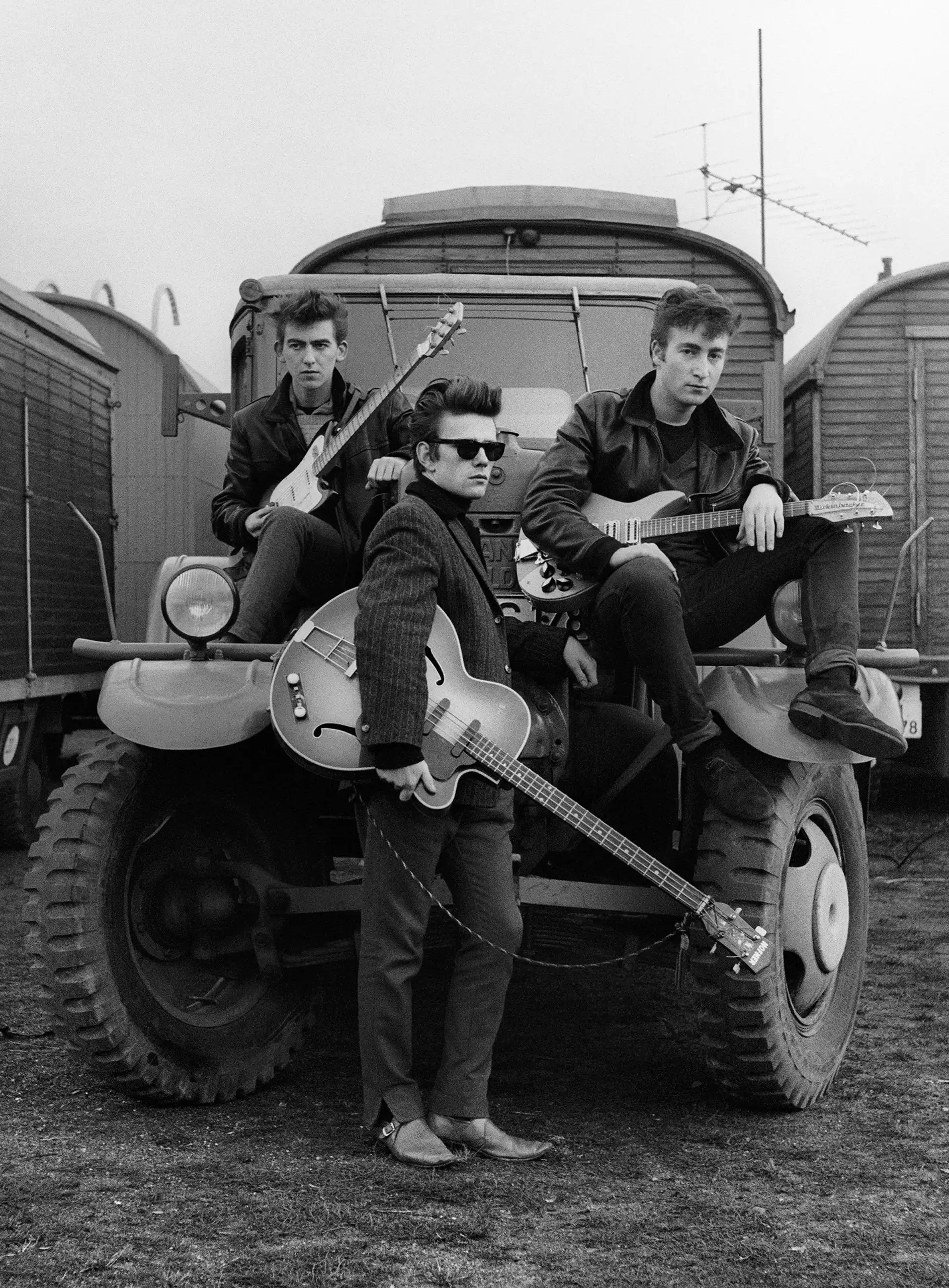
Stuart Sutcliffe
 United Kingdom
Member of The Beatles
Birthday
June 23, 1940
Birth Sign
Cancer
Birthplace
Edinburgh, Scotland
Age
Died at 21
About
Stuart Sutcliffe was a British painter and musician best known as the original bass guitarist for The Beatles. His artistic endeavors, particularly in avant-garde painting, are recognized for their quality and distinctive style. Sutcliffe's early career with The Beatles was brief, preceding their immense global fame. He is remembered today as a foundational member of the iconic band and a promising artist whose life was tragically cut short. Fans and critics alike acknowledge his unique contribution to both music and art, with his work continuing to be exhibited and studied.
Early Life & Background
Stuart Fergusson Victor Sutcliffe was born on June 23, 1940, in Edinburgh, Scotland, to Charles Stuart Sutcliffe, a merchant seaman, and Millie Sutcliffe. While born in Scotland, he was raised in Liverpool, England, where his family relocated shortly after his birth. His father's frequent and prolonged absences at sea placed considerable financial and emotional strain on the family, which in turn fostered a strong bond between Stuart and his mother and sisters, as well as pushing him towards a close circle of friends and a developing interest in artistic expression. From an early age, Sutcliffe showed considerable artistic promise, which led him to attend Prescot Grammar School, followed by the prestigious Liverpool College of Art. Here, he quickly distinguished himself as an exceptionally gifted draftsman and painter, earning recognition and winning school art prizes for his talent. His work during this period showed strong influences from Abstract Expressionism and European modernism, and he began exhibiting paintings in local student exhibitions, steadily building a serious reputation as an emerging fine artist.
It was at the Liverpool College of Art that Sutcliffe forged a close friendship with fellow student John Lennon, becoming an integral part of a bohemian circle of art students and musicians. This connection proved pivotal in his life. In 1960, Sutcliffe experienced a significant breakthrough in his artistic career when he sold one of his paintings for a considerable sum, estimated to be around £65-75. This financial success became a turning point, as Lennon and their mutual friends strongly encouraged him to use the proceeds to purchase a bass guitar. Despite possessing little prior musical experience, Sutcliffe followed their advice, acquiring a Höfner President bass. He subsequently joined Lennon's musical group, then known as Johnny and the Moondogs, which would soon evolve into The Beatles . His decision to join the band marked a new, unexpected chapter in his life, momentarily shifting his primary focus from painting to music, and setting the stage for his involvement in the group's formative years in Liverpool and Hamburg.
Career Growth
Although his musical career was brief and pre-dated The Beatles' commercial breakthrough, Sutcliffe's impact is notable in two fields. As the original bassist, he was part of The Beatles' formative Hamburg and Liverpool period, when they refined their sound by playing marathon sets. His decision to leave the band led to Paul McCartney permanently switching to bass, a change that helped solidify The Beatles' classic sound.
In art, his paintings have been exhibited posthumously in books and gallery shows, presented as the work of a serious, evolving modern artist rather than merely a Beatle associate. He is often referred to as the fifth Beatle in Beatles histories, but art historians increasingly emphasize his independent contribution to post-war British art.
Career Timeline
Public Image & Style
Stuart Sutcliffe is remembered as the enigmatic "fifth Beatle" — a brooding, artistically intense figure whose brief tenure with the band was overshadowed by his genuine talent as a painter. With his sharp cheekbones, slicked-back dark hair, and later the moptop cut he pioneered, Sutcliffe cultivated a moody, bohemian aesthetic that contrasted with the group's early rocker image. His style, influenced by Astrid Kirchherr, included black leather jackets and Beatnik flair. Media and fans often portray him as a tragic, sensitive soul — the artist who chose canvas over fame. Among Beatles enthusiasts, he is revered as a key architect of the band's visual identity. Art historians, however, focus on his abstract expressionist works, which have been exhibited in galleries and described as "raw, emotional, and ahead of their time." There is no official fandom name, but a dedicated community of "Sutcliffe scholars" and Beatles fans keeps his legacy alive. His social media presence is posthumous, maintained by estates and fan accounts that highlight his art and mythology.
Fame & Fandom
Stuart Sutcliffe remains a figure of haunting absence rather than active adoration. His legacy is defined by the tragic arc of a life extinguished at twenty-one, just as his band was on the cusp of global domination. Unlike the frenzied worship directed at his surviving bandmates, Sutcliffe never cultivated a formal fanbase with its own rituals or self-identifying name. His admirers are subsumed within the vast, decentralized community of Beatles fans, drawn to him not by hit singles or stadium tours, but by the mythos of the "fifth Beatle" who chose art over fame. The story of his departure from the group to pursue painting in Hamburg and his subsequent death from a cerebral hemorrhage serves as the primary narrative anchor for this retrospective reverence. Fans today engage with his memory through organic tributes, such as annual social media remembrances and visits to exhibitions featuring his lost paintings, treating these moments as pilgrimages to a site of unfulfilled potential. There were no meet-and-greets during his lifetime, no organized campaigns, and no specific fandom faction; his influence is purely cultural and historical. While he shaped the visual identity of the early Beatles and suggested their iconic name, his personal impact is felt most deeply in the quiet spaces between the known history of the group's rise. He exists now as a foundational ghost, a necessary element of the band's origin story that was removed before the world could fully know him. Stuart Sutcliffe is currently evaluated by iFANN but holds no placement in the Global Top 1,000 rankings. The iFANN Global Fame Engine has determined that he does not currently occupy a position in any published scope list.
Interesting Facts and Legends
Stuart Sutcliffe was the first member of the group to adopt the moptop haircut, a style pioneered by photographer Astrid Kirchherr that the others later emulated. He frequently performed with his back to the audience, a habit born of both shyness and the fact that he had learned the bass lines relatively late in his tenure. Most contemporaries viewed him as an artist who happened to play bass, rather than a musician dabbling in paint. A persistent legend suggests he may have suffered a head injury in a fight months before his death, a detail some accounts claim contributed to the fatal brain hemorrhage that took his life. The most enduring story surrounding him is the emotional bond he shared with John Lennon, whom he described as his alter ego. This connection began at the Liverpool College of Art in 1957 and fueled the bohemian aesthetic that defined the band's early image. Another pivotal moment in his lore is his decision to leave the group in 1961 to stay with Kirchherr in Germany, a choice that fundamentally altered the band's trajectory by forcing Paul McCartney to switch permanently to bass. His death in Hamburg in April 1962 is often framed as the moment the "real" Beatles lost their soulmate, leaving the remaining trio to navigate stardom without their original creative anchor.
Family & Personal Life
Notable Connections
Relationships & Dating History
Stuart Sutcliffe's only documented serious relationship was with Astrid Kirchherr, a German photographer he met in 1960 during The Beatles' first Hamburg residency. They quickly became a couple; she became his muse and stylist, and they got engaged. Sutcliffe remained with Kirchherr in Hamburg after leaving the band, focusing on his art, until his sudden death in 1962. As of 2026, he is deceased; at the time of his death, he was engaged to Kirchherr.
- EngagedAstrid Kirchherr1960 - 1962Met during The Beatles' first Hamburg residency; she became his fiancée and creative influence; relationship ended with his death.
Death & Aftermath
Died
April 10, 1962 (aged 21)
Death Place
Hamburg, West Germany
Cause of Death
Cerebral hemorrhage from ruptured aneurysm
Stuart Sutcliffe lay in a quiet room at the Klinikum Eppendorf in Hamburg, West Germany, where he had been rushed after collapsing from severe headaches that had plagued him for weeks. On April 10, 1962, he passed away in his sleep at the age of 21 without regaining consciousness. An autopsy conducted shortly after his death established the official cause as a cerebral hemorrhage resulting from the rupture of a congenital intracranial aneurysm, ruling out speculation regarding drug use or prior trauma that had circulated in later accounts. The German authorities handled the medical certification administratively.
The news devastated his inner circle, particularly John Lennon, who viewed Sutcliffe as his alter ego and reportedly refused to play the piano for a long time afterward. Paul McCartney also expressed deep grief over the loss of the band's original creative spark, though global reaction remained limited due to the group's status before their international breakthrough. A private funeral took place on April 13, 1962, at Ohlsdorf Cemetery in Hamburg, attended by close friends like Astrid Kirchherr and Klaus Voormann alongside members of the local art scene. His grave remains a site of quiet pilgrimage marked by a simple headstone.
Posthumously, his legacy has been preserved through the management of his artwork by the Official Stuart Sutcliffe Estate, which has overseen exhibitions of previously unseen pieces and publications such as Stuart Sutcliffe: Four Myths About the 5th Beatle . While he never received induction into a musician Hall of Fame, art historians increasingly emphasize his independent contribution to post-war British art rather than viewing him solely as a Beatles associate.
Net Worth (Estate Value)
$0
iFANN Editorial Team estimate
Because Sutcliffe died very young and before The Beatles' commercial breakthrough, detailed financial records are sparse. At the time of his death, he lived as a student artist and musician with modest means, earning from club performances and occasional art sales. There is no credible, sourced estimate for his exact estate value at death, but context suggests it was relatively small. Posthumous revenues connected to his name come primarily from licensing and reproduction of his artwork in books and exhibitions, as well as rights in photographs and related merchandise where his image appears as an early Beatle. However, detailed audited figures for how much the estate has earned since his passing are not publicly available in reputable sources. No reliable public estimate exists for the current value of the Stuart Sutcliffe estate as of 2026. Per iFANN's editorial analysis, the total net worth is $0.
Awards & Accolades
Known For
The Beatles
1960 · Bass guitarist
Keywords
Sources
Quick Facts
- Birthdate
- June 23, 1940
- Death date
- April 10, 1962
- Age at death
- 21
- Birthplace
- Edinburgh, Scotland
- Occupation
- Painter, musician
- Instrument
- Bass guitar
- Group
- The Beatles
- Fiancée
- Astrid Kirchherr
Personal Details
- Full Name
- Stuart Fergusson Victor Sutcliffe
- Education
- Liverpool College of Art, Hamburg College of Art
Frequently Asked Questions
What is Stuart Sutcliffe's net worth in 2026?
Why did Stuart Sutcliffe leave The Beatles?
How did Stuart Sutcliffe die?
Was Stuart Sutcliffe a good bass player?
Who was Stuart Sutcliffe engaged to?
Similar People
Join the community
fans discussing