 Japan
Japan“Sion Sono's 'Strange Circus' is a masterpiece of psychological horror that refuses to let the audience look away from the darkness of the human soul.”
Rue Morgue Staff
Rue Morgue
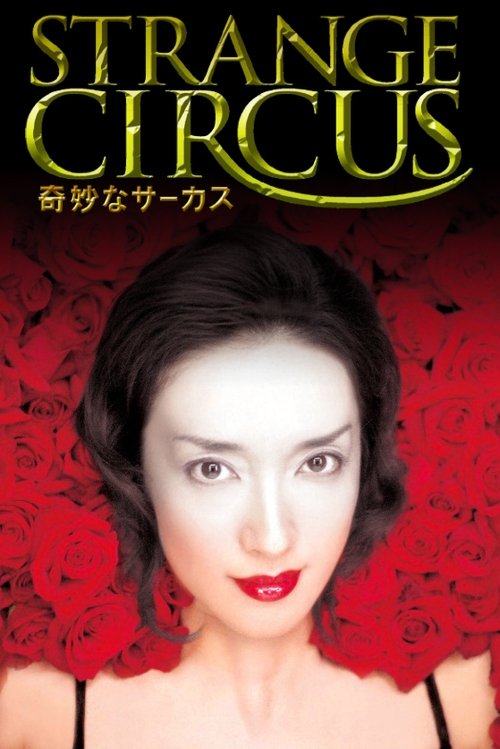
Japanese filmmaker Sion Sono crafted a nightmare that refuses to follow a straight line in this 2005 psychological horror. The story centers on Taeko, an erotic novelist whose latest manuscript mirrors her own traumatic history so closely that her assistant Yuji becomes obsessed with uncovering the truth. As he digs into her past, the boundary between fiction and reality dissolves, trapping him in a cycle of violence and abuse that defies logic.
Sono uses distinct visual styles to separate three timelines: the present day where Taeko writes, and flashbacks to the childhood of Mitsuko and her mother Sayuri. Vibrant colors saturate the memories of trauma while stark black and white frames depict the present. This approach forces viewers to piece together a puzzle where the identities of the women shift and merge, revealing a single psyche fractured by unspeakable events.
Stream
Availability and pricing can change. Confirm on the provider's site before purchasing.
The film opens in a quiet apartment where Taeko sits alone, surrounded by papers for a new book. She writes with a frantic energy, describing scenes of incest and family destruction that feel uncomfortably real. Her assistant Yuji enters the room, holding a copy of her previous work. He notices details in the text that match his own life too perfectly, sparking a curiosity that quickly turns into dread. He begins to research Taeko's background, only to find gaps in her history that suggest she has been hiding something massive.
We then cut to a sun-drenched summer day decades earlier. Young Mitsuko lives with her father Gozo, a respected school principal, and her mother Sayuri. The family appears normal until Mitsuko stumbles upon a violent act between her parents. The scene shatters her world, introducing a layer of horror that will haunt every subsequent moment. Gozo's behavior shifts from authoritative to predatory, and the household becomes a place of fear rather than safety.
The narrative jumps forward as Mitsuko grows into a teenager under her father's suffocating control. She tries to escape but finds herself trapped in a web of lies and manipulation. Meanwhile, the timeline shifts again to show Sayuri, who seems aware of the danger but powerless to stop it. She attempts to protect her daughter through silence, a strategy that ultimately fails as the abuse escalates.
Yuji continues his investigation in the present, finding letters and photographs that link Taeko directly to the Ozawa family. He discovers a shared physical trait among the characters that hints at their true connection. The story introduces Madamu Rejînu, a mysterious figure known as the Black Shadow, who watches the chaos unfold from the sidelines. Her presence adds another layer of surrealism to the already disjointed narrative.
As the timelines begin to overlap more frequently, the audience sees flashes of violence that blur the lines between past and present. Taeko's writing becomes more graphic, mirroring the events happening in Mitsuko's life. Yuji realizes that the story is not just fiction but a confession of crimes committed against those close to him. The tension builds as the characters confront the possibility that their identities are not what they seem.
The film explores the devastating impact of child abuse and the lengths the human mind will go to survive it. Through its non-linear structure, Strange Circus forces viewers to question the reliability of every character and event. The disjointed editing and shifting color palettes create a sense of unease that permeates every scene. The story moves toward a climax where the secrets of the Ozawa family are finally brought to light, threatening to destroy the fragile existence of everyone involved.
Yuji's obsession leads him deeper into the rabbit hole, where he finds himself unable to distinguish between the author's mind and his own perception. The narrative reveals that the trauma experienced by Mitsuko was so severe that her mind split into multiple personalities to cope. Each personality represents a different facet of her experience, from the innocent child to the adult victim.
The film's pacing accelerates as the timelines converge. Scenes from the past bleed into the present, creating a chaotic tapestry of memory and reality. The audience is left to grapple with the implications of the twisted family dynamics and the cyclical nature of abuse. The setup establishes a world where the past is a living entity that constantly threatens to consume the present.
As the final moments approach, the distinction between the characters becomes increasingly blurred. Taeko, Mitsuko, and Sayuri are revealed to be facets of the same person, trapped in an endless loop of their own making. The film ends without offering a clear resolution, leaving viewers to interpret the meaning of the fragmented self and the unhealed wounds of the past.
Strange Circus (2005) ORIGINAL TRAILER [SUB]
Critical Consensus
While divisive, Strange Circus is praised for its bold exploration of trauma and its visually striking, non-linear narrative. Critics acknowledge Sion Sono's willingness to push boundaries with graphic content, noting that the film's emotional core outweighs its shock value for those willing to engage with its difficult subject matter.
“Sion Sono's 'Strange Circus' is a masterpiece of psychological horror that refuses to let the audience look away from the darkness of the human soul.”
Rue Morgue Staff
Rue Morgue
“A harrowing journey into the mind of a broken woman, 'Strange Circus' is a film that demands attention and rewards patience with its intricate storytelling.”
In Review Online
In Review Online
“Sono delivers a visceral experience that challenges viewers to confront the most taboo aspects of human behavior, making it a standout in the horror genre.”
Variety Staff
Variety
Masumi Miyazaki
Taeko / Mitsuko / Sayuri
Rie Kuwana
Young Mitsuko
Seiko Iwaido
Teenage Mitsuko
Issei Ishida
Yuji
Hiroshi Ohguchi
Gozo Ozawa
Fujiko
Gozo's Mistress
Madamu Rejînu
Black Shadow
Tomorowo Taguchi
Editor-in-Chief
Director
Sion Sono
Writer
Sion Sono
Composer
Sion Sono
Cinematographer
Yuichiro Otsuka
Producers
Toshihiro Satô, Toshiaki Nakazawa, Toshiie Tomida, Koji Hoshino
Fantasia International Film Festival (2006)
Best Feature Film: Nominated
Sitges Film Festival (2006)
Fantastic Section: Nominated
Brussels International Festival of Fantasy Film (2006)
Best Director: Won
Join the community
fans discussing