“Demme has captured the essence of the Talking Heads' live show, turning a simple concert into a work of art that is both visually stunning and musically profound.”
A.O. Scott
The New York Times
 United States
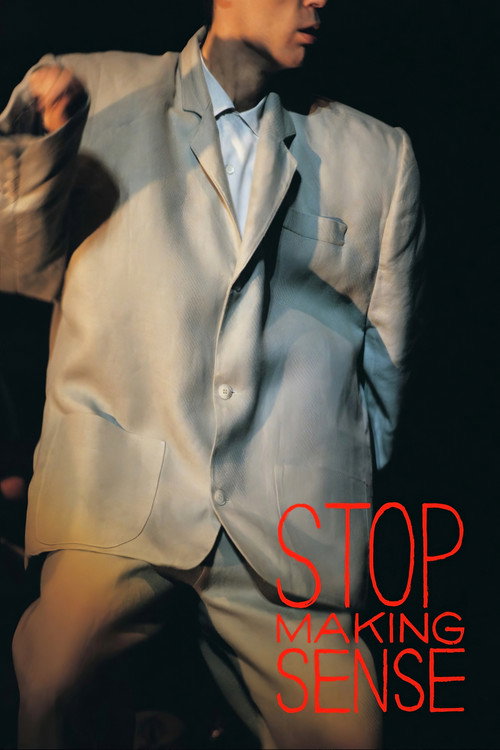
"See the music. Feel the madness. Watch the suit."
User Score
37,900 votes
Stop Making Sense isn't just a concert film; it's a masterclass in how to capture live music on camera. Directed by Jonathan Demme, this 1984 documentary follows Talking Heads through a series of performances from their Speaking in Tongues tour. The film opens with David Byrne walking onto a bare stage with just a boombox and a guitar, and builds from there, adding band members and guest musicians one by one until the stage is a vibrant, energetic ensemble. Byrne, Chris Frantz, Jerry Harrison, and Tina Weymouth are joined by backing vocalists Ednah Holt and Lynn Mabry, along with keyboardist Bernie Worrell, creating a rich, layered sound that spans the band's career.
Shot over three nights at Hollywood's Pantages Theater, the film benefits from Jordan Cronenweth's cinematography, known for his work on Blade Runner. Despite a modest budget of $1.2 million, Stop Making Sense grossed over $12 million at the box office. It's a film that captures the post-punk and new wave energy of the era, and it remains a high-water mark for music documentaries.
Availability and pricing can change. Confirm on the provider's site before purchasing.
The film opens on a stark, white, empty stage at the Pantages Theater in Hollywood. David Byrne walks out alone, wearing a massive oversized beige suit, carrying only a boombox and an acoustic guitar. He performs the opening track, Psycho Killer, accompanied solely by his voice and the recorded backing track from the boombox. As the concert progresses, the film introduces the other members of the band one by one, building the sound and the visual composition layer by layer. Bassist Tina Weymouth enters to join Byrne, adding a rhythmic foundation. She is followed by drummer Chris Frantz, whose steady beat transforms the sparse beginning into a driving groove. Keyboardist and guitarist Jerry Harrison joins next, filling out the sonic texture with synthesizers and guitar lines.
The ensemble grows further with the arrival of two female backing vocalists, Ednah Holt and Lynn Mabry, who provide harmonies and choreographed movement. Legendary funk keyboardist Bernie Worrell takes the stage, adding deep, funky organ and synth textures that elevate the energy to new heights. The central transformation of the film is the stage itself: the bare white void slowly fills with color, light, and human movement. Byrne's eccentric dancing and increasingly frantic movements contrast with the cool, precise synchronization of the backing vocalists and the tight, rhythmic precision of the rhythm section.
The film captures the band performing a setlist drawn from their albums Talking Heads: 77, More Songs About Buildings and Food, Fear of Music, and Remain in Light. Key songs include Burning Down the House, Once in a Lifetime, and Life During Wartime. Throughout the performance, Byrne delivers his signature spoken-word monologues and surreal lyrics, exploring themes of modern alienation, technology, consumerism, and the absurdity of daily life. The camera work, handled by Jordan Cronenweth, remains dynamic yet unobtrusive, utilizing wide shots to capture the full scope of the stage evolution and close-ups to highlight individual expressions and instrumentals. The lighting design shifts dramatically, moving from stark white spotlights to vibrant washes of red, blue, and green, mirroring the emotional intensity of the music.
The film culminates in a frenetic, high-energy finale where all nine performers are on stage, creating a wall of sound and motion that feels both chaotic and perfectly orchestrated. The audience, though largely unseen, is felt through the sheer energy radiating from the stage, making the viewer feel as though they are part of the live experience. The film ends abruptly after the final song, leaving the audience with a sense of exhilaration and awe at the sheer power of the performance.
Official Trailer
Official Trailer
Critical Consensus
Widely regarded as the greatest concert film ever made, Stop Making Sense captures the Talking Heads at their creative peak. Jonathan Demme's direction and the band's electrifying performance create a cinematic experience that transcends the genre, blending music, dance, and surrealism into an unforgettable celebration of live rock and roll.
“Demme has captured the essence of the Talking Heads' live show, turning a simple concert into a work of art that is both visually stunning and musically profound.”
A.O. Scott
The New York Times
“This is the best concert film I've ever seen. It's a triumph of direction, editing, and pure energy that makes you want to get up and dance.”
Peter Travers
Rolling Stone
“Stop Making Sense is a miracle of filmmaking. It takes a rock concert and turns it into something that feels like a movie about a movie, a dream of a dream.”
Roger Ebert
Chicago Sun-Times
“Jonathan Demme's direction is flawless, creating a visual language that matches the band's innovative sound. A landmark achievement in music cinema.”
Variety Staff
Variety
David Byrne
Self - Vocals, Guitar
Chris Frantz
Self - Drums, Vocals
Jerry Harrison
Self - Guitar, Keyboards, Vocals
Tina Weymouth
Self - Bass, Percussion, Vocals
Ednah Holt
Self - Backing Vocals
Lynn Mabry
Self - Backing Vocals
Steven Scales
Self - Percussion
Alex Weir
Self - Guitar, Vocals
Bernie Worrell
Self - Keyboards
Director
Jonathan Demme
Writer
Jonathan Demme
Composers
Jerry Harrison, Tina Weymouth, David Byrne, Chris Frantz, Bernie Worrell
Cinematographer
Jordan Cronenweth
Producer
Gary Goetzman
National Film Registry (2004)
Culturally, Historically, or Aesthetically Significant: Selected
Grammy Awards (1985)
Best Long Form Music Video: Nominated
National Society of Film Critics Awards (1985)
Best Cinematography: Won
Directors Guild of America Awards (1985)
Outstanding Directing – Documentary: Nominated
Join the community
fans discussing