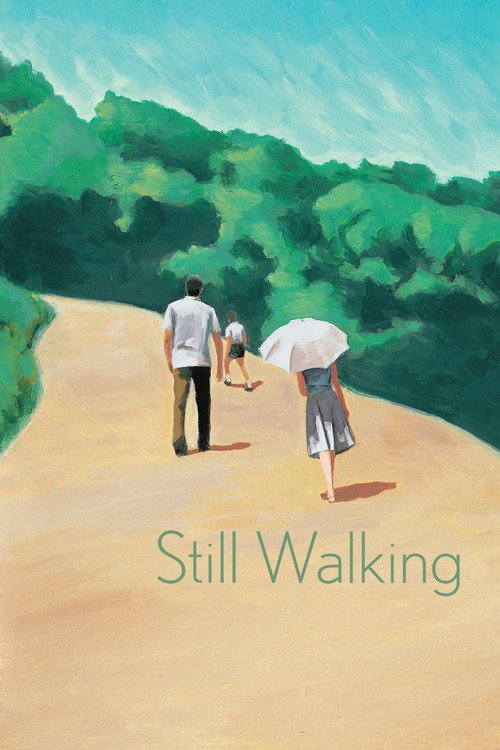
 Japan
Japan“A deeply affecting, deceptively simple film about the weight of family history.”
Manohla Dargis
The New York Times
Hirokazu Kore-eda, a master of quiet family dramas, presents Still Walking, a film that unfolds over a single day as the Yokoyama family gathers to honor their eldest son, who died 15 years earlier. The ritual is a memorial for the deceased, but the true focus is the living: the aging parents, their surviving son Ryota (Hiroshi Abe), his new wife Yukari (Yui Natsukawa), and his sister Chinami (YOU). As the day progresses, buried resentments, unspoken grief, and generational tensions rise to the surface. Shot on a modest budget (the film grossed $3.5 million worldwide), the movie relies on naturalistic performances and Yutaka Yamazaki's intimate cinematography. Critics praised its gentle yet piercing observation of family dynamics, earning it a 7.8 rating on IMDb. This is not a plot-driven story but a character study that finds drama in small gestures and awkward silences.
Stream
Max
Rent
Prime Video
Apple TV
Availability and pricing can change. Confirm on the provider's site before purchasing.
The Yokoyama family home sits nestled in a quiet coastal town, its rooms filled with the weight of fifteen years of unspoken grief. Every summer, the family gathers to mark the anniversary of Junpei's death, the eldest son who drowned while trying to save a stranger. This year, Ryota arrives with Yukari, his second wife, and her young son Atsushi. Ryota's father Kyohei, a retired doctor, keeps mostly to himself, tending to the garden and his dog. His mother Toshiko busies herself in the kitchen, preparing the elaborate meal that accompanies the memorial. The house hums with the rhythms of domestic ritual: chopping vegetables, setting out dishes, cleaning the altar.
Ryota's sister Chinami arrives with her husband Nobuo and their two children, Satsuki and Mutsu. The adults settle into familiar patterns of conversation, each exchange layered with subtext. Toshiko makes pointed remarks about Yukari's status as a widow and single mother, her words wrapped in a veneer of politeness. Kyohei barely acknowledges Ryota's presence, his disappointment palpable. Ryota, in turn, bristles at his father's expectations that he take over the family medical practice. The children play noisily, oblivious to the undercurrents swirling around them. A visit to Junpei's grave becomes a stage for competing grief: Toshiko weeps openly, while Ryota stands apart, his own sorrow buried beneath resentment.
As afternoon fades into evening, the family shares a meal of tempura and sushi, the conversation drifting from Junpei's childhood to the neighbor's new car. But the peace is fragile. When Toshiko brings out a box of Junpei's old belongings, the past intrudes with force. Ryota discovers a letter that reveals a side of Junpei he never knew. The family's carefully maintained facade begins to crack. Old accusations surface, and Ryota's anger at being forever compared to his perfect brother boils over. The day ends not with resolution but with a tentative step toward honesty, as each family member confronts the stories they have told themselves for years.
STILL WALKING Trailer (2008) - The Criterion Collection
STILL WALKING OFFICIAL TRAILER
Critical Consensus
Hirokazu Kore-eda's Still Walking is a masterful, understated drama that finds profound emotional depth in the everyday struggles and quiet moments of family life. Through naturalistic performances and gentle direction, the film explores themes of grief, memory, and reconciliation with remarkable sensitivity and insight.
“A deeply affecting, deceptively simple film about the weight of family history.”
Manohla Dargis
The New York Times
“Kore-eda captures the subtle, often awkward rhythms of family life with a painterly eye and a profound understanding of human nature.”
Todd McCarthy
Variety
“It's a film that sneaks up on you, its power accumulating through quiet observation and devastating emotional honesty.”
David Jenkins
Time Out
“A subtle, poignant, and ultimately devastating portrait of a family bound by unspoken resentments and enduring love.”
Stephen Holden
The New York Times
Hiroshi Abe
Ryota Yokoyama
Yui Natsukawa
Yukari Yokoyama
YOU
Chinami Yokoyama
Kazuya Takahashi
Nobuo Kataoka
Shohei Tanaka
Atsushi Yokoyama
Hotaru Nomoto
Satsuki Kataoka
Ryôga Hayashi
Mutsu Kataoka
Susumu Terajima
Sushi Deliverer
Kirin Kiki
Toshiko Yokoyama
Yoshio Harada
Kyohei Yokoyama
Director
Hirokazu Kore-eda
Writer
Hirokazu Kore-eda
Composer
Gontiti
Cinematographer
Yutaka Yamazaki
Producers
Satoshi Kono, Yoshihiro Kato, Hijiri Taguchi, Masahiro Yasuda, Lee Bong-ou
Asia Pacific Screen Awards (2008)
Best Screenplay: Won
Blue Ribbon Awards (2009)
Best Actress: Won
Blue Ribbon Awards (2009)
Best Supporting Actor: Won
Hochi Film Awards (2008)
Best Actress: Won
Kinema Junpo Awards (2009)
Best Actor: Won
Kinema Junpo Awards (2009)
Best Supporting Actress: Won
Mainichi Film Concours (2009)
Best Actor: Won
Mainichi Film Concours (2009)
Best Actress: Won
Mainichi Film Concours (2009)
Best Supporting Actor: Won
Palm Springs International Film Festival (2009)
FIPRESCI Prize for Best Actor: Won
Join the community
fans discussing