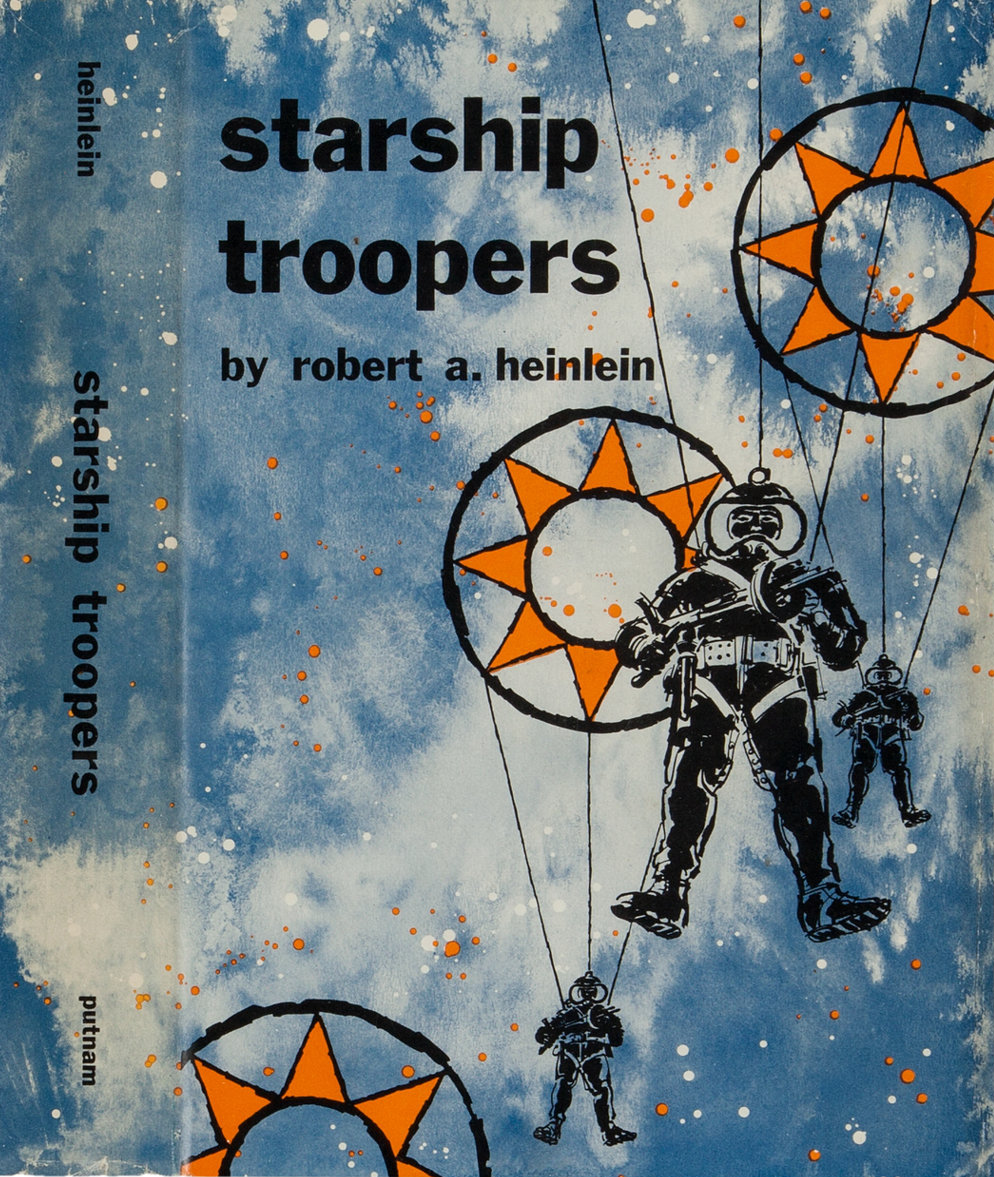
Starship Troopers
Robert A. Heinlein
Overview
Starship Troopers is a military science fiction novel by American writer Robert A. Heinlein. Written in a few weeks in reaction to the US suspending nuclear tests, the story was first published as a two-part serial in The Magazine of Fantasy & Science Fiction as Starship Soldier, and published as a book by G. P. Putnam's Sons on November 5, 1959.
The story is set in a future society ruled by a human interstellar government called the Terran Federation, dominated by a military elite. Under the Terran Federation, only veterans of a primarily military Federal Service enjoy full citizenship, including the right to vote. The first-person narrative follows Juan "Johnny" Rico, a young man of Filipino descent, through his military service in the Mobile Infantry. He progresses from recruit to officer against the backdrop of an interstellar war between humans and an alien species known as "Arachnids" or "Bugs". Interspersed with the primary plot are classroom scenes in which Rico and others discuss philosophical and moral issues, including aspects of suffrage, civic virtue, juvenile delinquency, and war; these discussions have been described as expounding Heinlein's own political views. Identified with a tradition of militarism in US science fiction, the novel draws parallels between the conflict between humans and the Bugs, and the Cold War. It is also a coming-of-age novel, which criticizes the US society of the 1950s, arguing that a lack of discipline had led to a moral decline, and advocating corporal and capital punishment.
Starship Troopers brought to an end Heinlein's series of juvenile novels. It won the Hugo Award for Best Novel in 1960, and was praised by reviewers for its scenes of training and combat and its visualization of a future military. It also became enormously controversial because of the political views it seemed to support. Reviewers were strongly critical of the book's intentional glorification of the military, an aspect described as propaganda and likened to recruitment. The novel's militarism, and the fact that government service – most often military service – was a prerequisite to the right to vote in the novel, led to it being frequently described as fascist. Others disagree, arguing that Heinlein was only exploring the idea of limiting the right to vote to a certain group of people. Heinlein's depiction of gender has also been questioned, while reviewers have said that the terms used to describe the aliens were akin to racial epithets.
Starship Troopers had wide influence both within and outside science fiction. Ken MacLeod stated that "the political strand in [science fiction] can be described as a dialogue with Heinlein". Science fiction critic Darko Suvin wrote that it is the "ancestral text of US science fiction militarism" and that it shaped the debate about the role of the military in society for many years. The novel is credited with popularizing the idea of powered armor, which became a recurring feature in science fiction books and films, as well as an object of scientific research. Heinlein's depiction of a futuristic military was also influential. Later science fiction books, such as Joe Haldeman's 1974 anti-war novel The Forever War, have been described as reactions to Starship Troopers. The story was adapted several times, including in a 1997 film version directed by Paul Verhoeven that satirized what the director saw as the fascist aspects of the novel.
Awards
Hugo Award for Best Novel: Best Novel: (1960)
Keywords
Book Info
- Author
- Robert A. Heinlein
- Publisher
- G. P. Putnam's Sons
- Published
- 1959-11-05
- Pages
- 263
- Language
- English
Join the community
fans discussing