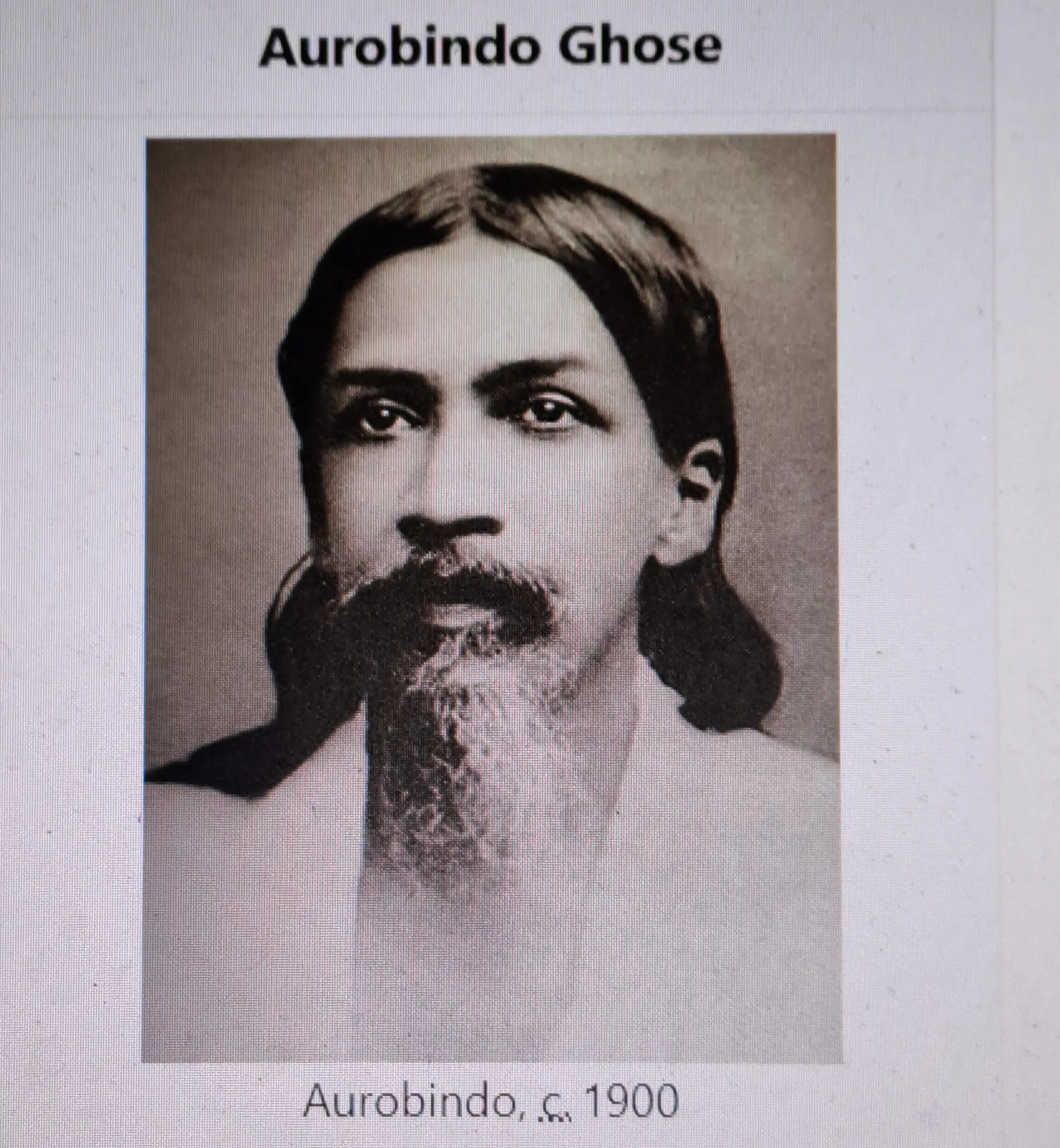
Sri Aurobindo
 India
Indiaphilosopher•yogi•poet•nationalist
Also known as: Aurobindo Ghosh, Shri Aurobindo, Maharshi Aravind Babu, Aravinda Ackroyd Ghose
Birthday
August 15, 1872
Birth Sign
Leo
Birthplace
Calcutta (now Kolkata), India
Age
Died at 78
About
Aurobindo Ghosh, known universally as Sri Aurobindo, was an Indian philosopher, yogi, guru, poet, and nationalist who fundamentally reshaped the trajectory of India's independence movement and global spiritual thought. Born in Calcutta in 1872, he educated himself in England before returning to India to serve in the princely state of Baroda. His early career was defined by fiery political activism, where he became the first prominent leader to demand complete independence (*Purna Swaraj*) through his newspaper Bande Mataram. Following his arrest and acquittal in the 1908 Alipore Bomb Case, he retreated to Pondicherry in 1910, marking a decisive shift from political activism to spiritual sadhana.
In his later life, he developed Integral Yoga, a philosophy seeking the divine transformation of human life, and established the Sri Aurobindo Ashram. He passed away on December 5, 1950, leaving behind a vast literary corpus including the epic poem Savitri and philosophical treatises like The Life Divine. His work continues to influence thinkers and practitioners worldwide, bridging ancient wisdom with modern consciousness.
Early Life & Background
Aurobindo Ghosh was born into a Bengali Brahmin family at the 'Sri Aurobindo Bhawan' in Calcutta. His father, Dr. Krishna Dhun Ghosh, was a physician influenced by the Arya Samaj movement, while his mother, Swarnalata Devi, was deeply religious and devoted to her children. In 1879, when Aurobindo was just seven years old, he was sent to England for education, a common practice for elite Indian families of the time. He attended St. Paul's School in London and later King's College, Cambridge, where he studied English literature and prepared for the Indian Civil Service examinations. Despite his academic brilliance, passing the entrance exam for the ICS in 1890, he famously refused to take the final examination, reportedly because he felt it would require him to swear allegiance to the British Crown in a manner that conflicted with his growing sense of national identity. During his time in England, he immersed himself in Western classical literature, music, and philosophy, which profoundly influenced his later poetic and philosophical works. Upon returning to India in 1893, he initially worked as a teacher and eventually entered the service of the Maharaja of Baroda, where he served as Vice-Principal of the Baroda State College and later as a private secretary to the Maharaja.
Career Growth
Sri Aurobindo's early career was defined by his transition from an educator to a revolutionary nationalist. In 1905, during the height of the Swadeshi Movement against the partition of Bengal, he emerged as a key leader. He joined the Indian National Congress and became a vocal advocate for boycotts of British goods and institutions. In 1906, he founded the newspaper Bande Mataram, using it as a platform to articulate a radical vision of Indian freedom. His writings were fiery and uncompromising, calling for mass mobilization and self-reliance (*Swadeshi*). This period marked his breakthrough in public consciousness, though it also made him a target of British intelligence. In 1908, he was arrested and charged with conspiracy in connection with the Alipore Bomb Case. He spent nearly a year in solitary confinement in Alipore Jail, where he experienced profound spiritual transformations. After being acquitted in May 1909, he left the active political sphere. In 1910, he moved to Pondicherry to live in seclusion and dedicate his life to spiritual practice and writing. From 1910 until his death, he developed Integral Yoga and produced major literary contributions including The Life Divine, The Synthesis of Yoga, and the epic poem Savitri.
Career Timeline
Public Image & Style
Sri Aurobindo projects an image of dignified authority and serene contemplation. Known for his piercing eyes and beard that grew longer with age, he carried a presence that commanded respect without needing to speak. His public persona evolved from a fiery revolutionary orator to a silent sage, reflecting his journey from political activism to spiritual mastery. Media and biographers often describe him as a man of immense intellect and unwavering conviction, whose words were carefully chosen to convey deep truths. His style was simple yet profound, avoiding the flamboyance of modern celebrity culture in favor of a timeless, scholarly demeanor. He is remembered not for fashion or trends, but for the gravity of his ideas and the peace he exuded.
Fame & Fandom (iFAMOUS Rankings)
Sri Aurobindo commands a global attention defined by enduring spiritual influence rather than the fleeting metrics of modern celebrity culture. While his legacy permeates Indian intellectual history and yoga communities worldwide, iFANN's Global Fame Engine has evaluated this person, but they do not currently hold a placement in the published rankings (Global Top 1,000 or a Top-100 scope list). The evaluation confirms that while his works remain essential reading for philosophers and practitioners, he does not register within the current top-tier fame scopes. Consequently, there is no formal fandom name documented for his followers; instead, his audience identifies through specific religious institutions like the Sri Aurobindo Ashram or as practitioners of Integral Yoga. These communities engage in devotional service and educational observances rather than commercial fan campaigns. Unlike pop icons who rely on viral moments, Sri Aurobindo's impact is measured by the continued reverence of political leaders and the sustained growth of spiritual townships like Auroville. His presence in the cultural consciousness remains steady, anchored in the historical significance of his revolutionary writings and his role as a father of the nation alongside figures like Gandhi. The absence of a ranked position reflects the unique nature of his fame: it is a quiet, deep-rooted devotion that transcends the noisy algorithms of contemporary popularity charts.
Interesting Facts and Legends
Known primarily as a linguist, poet, and translator, Sri Aurobindo left behind a massive corpus of work including the epic poem Savitri. Beyond his literary achievements, his life is surrounded by significant historical events and spiritual legends that form the core of his cultural mythology. One widely retold story concerns his time in solitary confinement during the Alipore Bomb Case, where legend holds he attained deep states of consciousness and began his major philosophical writings. Another central piece of lore involves his meeting with Mirra Alfassa, known as 'The Mother,' in 1914; followers believe she was the embodiment of the Divine Mother described in his yogic visions, symbolizing the union of masculine and feminine divine principles. Historically, he was the first Indian leader to openly demand complete independence (*Purna Swaraj*) through his newspaper, Bande Mataram, shifting the freedom struggle from moderate reformism to radical nationalism. After retiring from politics in 1910, he moved to Pondicherry to focus entirely on spiritual work, establishing the Ashram that continues to operate today. His death in 1950 marked the end of an era, yet his teachings continue to guide millions through his vast written works and the oral traditions of the Ashram community.
Notable Quotes
“True knowledge is not attained by thinking. It is what you are; it is what you become.”
“There is nothing mind can do that cannot be done by the spirit.”
“Life is a preparation for a greater life.”
“The future of humanity lies in the realization of the divine in man.”
“All life is yoga.”
Family & Personal Life
Sri Aurobindo was married to Mrinalini Devi (born Sarala Mitra) in 1892 when he was 20 and she was 16. They met in Calcutta; the marriage was arranged by their families. The couple had one daughter, Manashi, born in 1893. However, the marriage was short-lived and unhappy. Mrinalini Devi suffered from mental health issues and was unable to adjust to the demands of Sri Aurobindo's intense intellectual and spiritual life. She separated from him around 1900 or shortly thereafter, and the divorce was finalized in 1901. Sri Aurobindo did not remarry. Following his separation from his wife, he lived largely in celibacy, dedicating his life to his spiritual pursuits and the care of his daughter, who remained in the custody of her mother but maintained contact with her father.
Notable Connections
Mirra Alfassa (The Mother), Mrinalini Devi, Manashi Ghosh, Bal Gangadhar Tilak, Rabindranath Tagore, Mahatma Gandhi.
Relationships & Dating History
Sri Aurobindo was married to Mrinalini Devi (born Sarala Mitra) in 1892 when he was 20 and she was 16. They met in Calcutta; the marriage was arranged by their families. The couple had one daughter, Manashi, born in 1893. However, the marriage was short-lived and unhappy. Mrinalini Devi suffered from mental health issues and was unable to adjust to the demands of Sri Aurobindo's intense intellectual and spiritual life. She separated from him around 1900 or shortly thereafter, and the divorce was finalized in 1901. Sri Aurobindo did not remarry. Following his separation from his wife, he lived largely in celibacy, dedicating his life to his spiritual pursuits and the care of his daughter, who remained in the custody of her mother but maintained contact with her father. Regarding romantic relationships, there is no record of any other formal marriages or long-term romantic partnerships after his divorce. His relationship with Mirra Alfassa ('The Mother'), whom he met in 1914, was unique and central to his later life. While some biographers and followers describe it as a spiritual union of divine principles, others have speculated about its nature. Historically, they are documented as spiritual collaborators. They formed a partnership where Sri Aurobindo provided the philosophical and yogic foundation, and The Mother managed the practical organization of the Ashram and the founding of Auroville. They were never legally married, though they lived together in the Ashram. Their relationship is often described as a 'spiritual marriage' or a union of souls, transcending conventional romantic definitions. There were no children from this relationship. As of his death in 1950, Sri Aurobindo was widowed (in the sense of his previous marriage ending in separation/divorce and his partner being alive but not in a legal marital bond) and effectively single in the conventional sense, having dedicated his life to spiritual solitude and leadership.
- DivorcedMrinalini Devi1892 - 1901Arranged marriage; one daughter, Manashi; ended due to incompatibility and her mental health issues.
Death & Aftermath
Died
December 5, 1950 (aged 78)
Death Place
Pondicherry, India
Cause of Death
Natural causes due to advanced age and declining health
Sri Aurobindo passed away on December 5, 1950, at his residence within the Sri Aurobindo Ashram in Pondicherry. His final days were marked by a quiet physical decline consistent with his age of seventy-eight; he had withdrawn from public appearances decades earlier, spending his last years in deep spiritual seclusion. The immediate reaction among his followers was one of profound reverence, with tributes pouring in from political leaders, cultural figures, and spiritual communities across India and abroad who remembered his dual legacy as a revolutionary nationalist and a sage.
His body was cremated on December 6, 1950, during a private ceremony attended by close disciples and Ashram members. Following the rites, his ashes were interred in the Room of Silence, a small structure within the Ashram that has since become a major pilgrimage site for seekers worldwide. In the wake of his death, Mirra Alfassa, known as The Mother, assumed full leadership of the Ashram and continued to expand his teachings globally. The Government of India honored him with a commemorative stamp in 1960, and his literary estate, including the epic poem Savitri and the philosophical treatise The Life Divine, remains in continuous print under the management of the Sri Aurobindo Ashram Trust. Today, the Sri Aurobindo Society operates internationally, maintaining centers in Europe, the Americas, and Asia, while Auroville continues to serve as a living experiment in human unity based on his vision.
Net Worth (Estate Value)
$0
iFANN Editorial Team estimate
As a historical figure who died in 1950, Sri Aurobindo does not have a current net worth in the traditional sense. His estate is managed by the Sri Aurobindo Ashram Trust, which oversees the publication of his works and the operation of the Ashram and Auroville. The financial value of his 'estate' is derived from the ongoing royalties of his books, donations to the Ashram, and the economic activities of the Auroville community. Specific dollar figures for his personal wealth at death or the current value of the trust are not publicly disclosed in a format comparable to modern celebrity net worths. The Sri Aurobindo Ashram operates as a non-profit institution, and its assets are used for spiritual and educational purposes rather than personal accumulation.
Awards & Accolades
View 2 records, honours and achievementsKnown For
The Life Divine
1914 · Author
Savitri: A Legend and a Symbol
1950 · Author
Bande Mataram
1906 · Founder & Editor
Keywords
Sources
Quick Facts
- Profession
- linguist, poet, translator
- Born
- August 15, 1872
- Birthplace
- Sri Aurobindo Bhawan, Calcutta
- Died
- December 5, 1950
- Death Place
- Pondicherry
- Gender
- Male
- Spouse
- Mrinalini Devi
- Birth Sign
- Leo
Personal Details
- Full Name
- Aurobindo Ghosh
- Spouse
- Mrinalini Devi
- Children
- Manashi Ghosh
- Education
- St. Paul's School, London; King's College, Cambridge
Frequently Asked Questions
What is Sri Aurobindo best known for?
Did Sri Aurobindo marry?
Where did Sri Aurobindo die?
Who is 'The Mother'?
What is the most famous book by Sri Aurobindo?
Similar People
Join the community
fans discussing