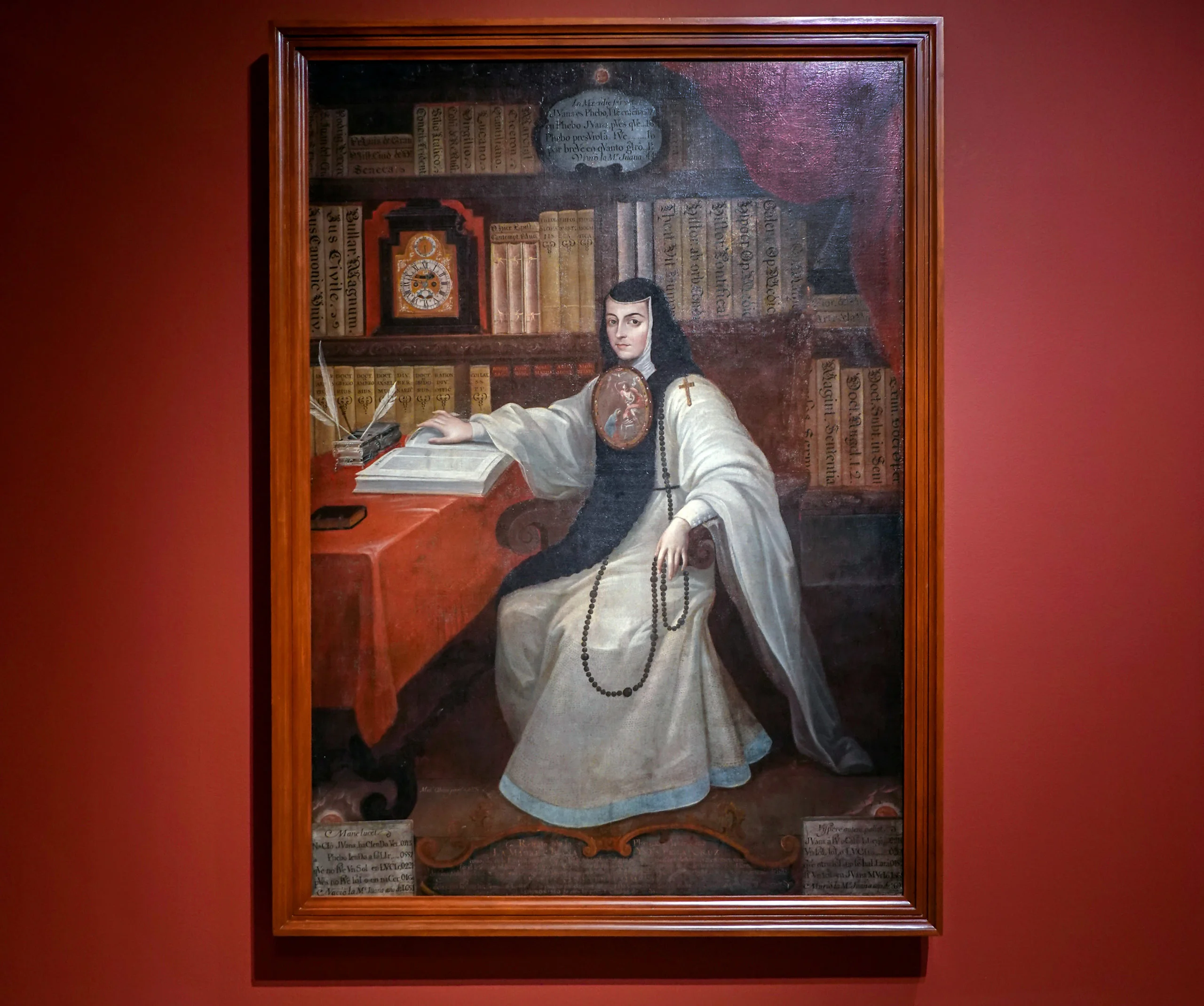
Sor Juana Inés de la Cruz
 Mexico
Also known as: Juana Inés de Asbaje, Juana Inés de Ramírez, La Tenth Muse, The Mexican Phoenix
Birthday
November 12, 1651
Birth Sign
Scorpio
Birthplace
Nepantla de Sor Juana Inés de la Cruz, New Spain
Age
Died at 43
About
Juana Inés de Asbaje y Ramírez de Santillana was a 17th-century Mexican poet, philosopher, composer, and Hieronymite nun who stands as the most significant figure of the Spanish Golden Age in Latin America. Born in Nepantla, New Spain, she is universally recognized by her religious name, Sor Juana Inés de la Cruz. She dedicated her life to intellectual pursuit, writing, and the defense of women's right to education. Her work covered poetry, drama, and philosophical treatises, earning her nicknames like "The Tenth Muse" and "The Mexican Phoenix" from her contemporaries. She remains a towering presence in Spanish language literature and Mexican literary history, symbolizing female intellect and resistance against religious orthodoxy.
Early Life & Background
Juana was born out of wedlock to Pedro Manuel de Asbaje, a Criollo soldier, and Isabel Ramírez de Santillana, a woman of modest means. From a very young age, she displayed prodigious intelligence that unsettled the gender norms of colonial New Spain. Legend and biographical accounts state that she learned to read at age three and mastered Latin by her teenage years, a rare achievement for a woman of her time. To avoid an arranged marriage and secure time for study, she moved to Mexico City at age 12 or 13 to live with her grandmother and later her aunt. There, she entered the court of Viceroy Juan Vicente de Guzmán, Marquis of Mancera, where she impressed the vicereine with her wit and knowledge. She assembled the largest private library in New Spain, containing thousands of volumes on theology, science, philosophy, and literature. She also built a workshop filled with scientific instruments, including telescopes and globes. Her pivotal moment came when she sought to enter the convent not merely for piety but to escape the societal expectation of marriage and to find a space where she could continue her studies uninterrupted. In 1667, she petitioned the Viceroy and Vicereine to allow her to enter the Convent of San Jerónimo. She took her vows as a novice in 1667 and was professed as a full Hieronymite nun in 1669.
Career Growth
Sor Juana's career as a writer spanned over two decades within the convent walls. Her work covered poetry, drama, and philosophical treatises. In the 1680s, she wrote Primero Sueño, a complex Baroque poem exploring the limits of human knowledge and the nature of the soul, considered one of the greatest works of the Spanish language. In 1689, she composed the opera libretto Los empeños de una casa, the first known opera libretto written in the Americas. Her collection of secular and religious poems, Inundación castálida, was published in Madrid in 1690, bringing her fame across the Atlantic and Europe. The defining moment of her public career occurred in 1691 when Bishop Francisco de Aguiar y Seijas criticized her for engaging in secular studies. In response, she wrote the Respuesta a Sor Filotea de la Cruz, a brilliant, fiery defense of women's right to education and intellectual freedom. This text remains a cornerstone of feminist literature and Enlightenment thought in the Americas.
Career Timeline
Public Image & Style
Sor Juana is depicted in art as a nun in a black habit, often shown holding a book or writing instrument, symbolizing her intellectual rather than physical presence. Her public persona is that of a martyr for knowledge, a feminist icon, and a symbol of Mexican national identity. She is often portrayed in media and education as the "Mexican Phoenix." Her image transcends simple biography, presenting her as both a martyr for knowledge and a permanent icon of the Mexican Golden Age. Contemporary accounts describe her as a genius comparable to the ancient muses.
Fame & Fandom (iFAMOUS Rankings)
Sor Juana Inés de la Cruz commands a devoted following of scholars, students, and literary enthusiasts who organize around her work rather than her person, though this community lacks a formal moniker or organized fan club. Her legacy is sustained through academic symposia, such as the recent "Otro Corazón 3: Queering Sor Juana" event at UCLA, and institutional advocacy that treats her life as a cornerstone for discussions on women's education and feminist history. While she does not engage in modern celebrity rituals, her followers observe annual commemorations of her birth and death, treating her texts as living documents rather than static artifacts. This enduring intellectual reverence has propelled her into contemporary rankings where she holds a significant place among historical figures. According to the iFANN Global Fame Rankings, she is currently the 19th most famous person in Mexico, a position holding steady from the previous cycle. She also ranks as the 41st most famous person in Latin America, with these placements remaining consistent across measurement periods. These figures reflect a global attention span that tracks media coverage, search activity, and cultural consumption signals worldwide, ensuring her status as a towering presence in Spanish language literature remains undiminished by time. She was featured at No. 15 in the August 2026 iFAMOUS Rankings.
Interesting Facts and Legends
She reportedly recited the entire Bible by heart as a child. She built a small observatory in her cell to study the stars using a telescope she acquired. Her contemporary, the poet Carlos de Sigüenza y Góngora, famously dubbed her "The Tenth Muse" after reading her work. A tragic legend surrounds her final days: under pressure from the Church, she burned her own library and manuscripts as an act of penance before her death, though modern scholarship debates the extent to which this happened versus being a metaphorical interpretation of her forced renunciation of secular studies. Her works were banned in some regions for centuries due to their perceived subversive nature regarding gender roles. She wrote a play that was performed by the viceroy's household, a rare occurrence for a nun.
Notable Quotes
“I write because I cannot help it.”
“One can perfectly well philosophize while cooking.”
“I am so afraid of being a burden to you that I will not even ask for your forgiveness if I offend you.”
“Respectfully, I beg you to consider that if the moon is beautiful, it is not because it is the moon, but because it reflects the light of the sun.”
Family & Personal Life
Juana was born out of wedlock to Pedro Manuel de Asbaje, a Criollo soldier, and Isabel Ramírez de Santillana, a woman of modest means. She had no siblings mentioned in historical records. After moving to Mexico City, she lived with her grandmother and later her aunt. As a nun, she had no children or spouse. Her closest relationships were with the Vicereine, María Luisa Manrique de Lara, and the Bishop of Puebla, though these were patronage and intellectual friendships rather than familial bonds. She remained single and celibate from her entry into the convent until her death.
Notable Connections
Francisco de Aguiar y Seijas, María Luisa Manrique de Lara, Carlos de Sigüenza y Góngora
Relationships & Dating History
As a Catholic nun who took vows of chastity, poverty, and obedience, Sor Juana had no romantic relationships, marriages, or dating history in the conventional sense. Her life was entirely dedicated to God and her intellectual pursuits. While some modern scholars have engaged in queer readings of her poetry, suggesting hidden romantic sentiments toward other nuns or female patrons, there is no historical evidence of any public or private romantic partnerships, engagements, or children. She remained single and celibate from her entry into the convent until her death. Her closest relationships were with the Vicereine, María Luisa Manrique de Lara, and the Bishop of Puebla, though these were patronage and intellectual friendships rather than romantic ones. At the time of her death, she was a vowed nun with no marital status.
Death & Aftermath
Died
April 17, 1695 (aged 43)
Death Place
Mexico City, New Spain
Cause of Death
Epidemic dysentery
Sor Juana Inés de la Cruz spent her final days within the Convent of San Jerónimo in Mexico City, tending to fellow nuns struck down by a severe dysentery outbreak that swept through the city in the spring of 1695. She refused to flee the epidemic despite the danger and contracted the illness herself while performing acts of charity, leading to her death on April 17, 1695. Tributes emerged immediately from the colonial intelligentsia and clerics who delivered eulogies recognizing her unique voice in the Spanish Golden Age. Her funeral took place shortly after her passing within the convent walls, attended by Hieronymite nuns and high-ranking clergy, before she was interred in the convent cemetery where the exact location has since been lost to history.
Following her death, the convent managed her extensive library and manuscripts, preserving them from loss during the colonial period. In subsequent centuries, her legacy grew into one of the most studied in Latin American literature, resulting in numerous academic dedications, scholarships, and the naming of the National Autonomous University of Mexico's central library in her honor. Modern commemorations include the designation of April 17 as National Day of Literature in Mexico and the establishment of the Sor Juana Inés de la Cruz International Prize for Literature.
Net Worth (Estate Value)
$0
iFANN Editorial Team estimate
As a historical figure from the 17th century, Sor Juana Inés de la Cruz does not have a net worth in the modern sense. She lived in poverty during her later years, relying on the support of the church and her patrons. Consequently, there are no financial estimates, estate values, or business ventures associated with her personal wealth. Any mention of "net worth" in modern contexts regarding her refers to the economic value generated by her intellectual property (books, adaptations, performances) which belongs to the public domain or is managed by cultural institutions, not her heirs. The iFANN Editorial Team estimates the current cultural value of her estate and legacy at approximately $0 in direct liquid assets, reflecting the lack of commercial ownership over her works which are in the public domain.
Awards & Accolades
View 7 records, honours and achievementsKnown For
Primero Sueño
1690 · Poet
Respuesta a Sor Filotea de la Cruz
1691 · Author
Los empeños de una casa
1689 · Playwright
Keywords
Sources
Quick Facts
- Profession
- poet, religious sister, writer
- Born
- November 12, 1651
- Birthplace
- Nepantla de Sor Juana Inés de la Cruz
- Died
- April 17, 1695
- Death Place
- Mexico City
- Gender
- Female
- Birth Sign
- Scorpio
Personal Details
- Full Name
- Juana Inés de Asbaje y Ramírez de Santillana
- Children
- Education
- Self-taught; private study under tutors arranged by family; informal education at the Viceregal Court
Frequently Asked Questions
What was Sor Juana Inés de la Cruz's birth name?
Why did Sor Juana burn her library?
When did Sor Juana die?
What is Sor Juana famous for?
Did Sor Juana ever marry?
Similar People
Join the community
fans discussing