 Japan
Japan“Mr. Kitano's style is so deadpan that it becomes a kind of poetry. The violence is sudden and shocking, but the quiet moments are even more powerful.”
Janet Maslin
The New York Times
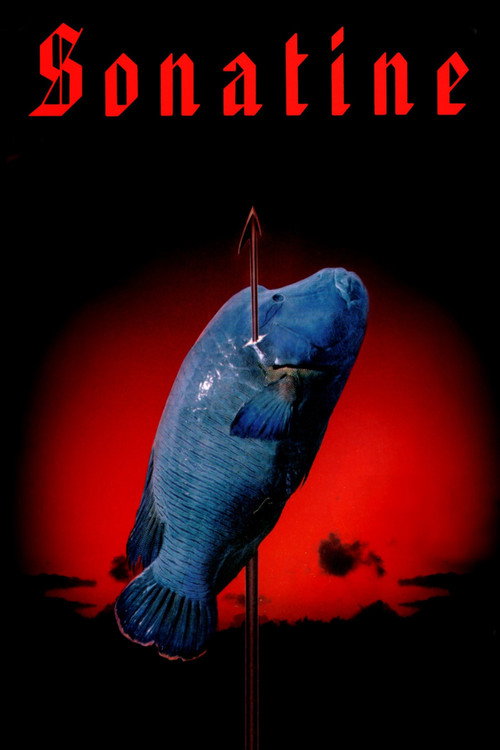
In 1993, Takeshi Kitano, already famous in Japan as a comedian and TV host, delivered a yakuza film that felt like nothing else. Sonatine opens with a hit man stabbing a victim in a parking garage, then cuts to a child's drawing. That tonal whiplash defines the movie. Kitano stars as Murakawa, a tired gangster sent to Okinawa on a mission that smells like a setup. He brings a small crew: the stoic Uechi, the volatile Ryoji, and quiet Ken. What starts as a routine mediation turns into an ambush, forcing the men to hide out on a remote beach. There, they dig holes, shoot fireworks, and play with a beach ball. The violence is sudden and shocking. The stillness is even more powerful.
Kitano directed, wrote, and edited the film himself, working from a script he banged out in two weeks. The budget was tiny, around ¥10 million, so he used natural light and shot many scenes in a single take. Joe Hisaishi, later famous for his Studio Ghibli scores, composed a minimalist piano soundtrack that mirrors the film's emotional restraint. The cast includes Aya Kokumai, a former model with no acting experience, as Miyuki, a woman who joins the gangsters on the beach. Regular Kitano collaborators Susumu Terajima and Ren Osugi fill out the underworld roles. Sonatine premiered at Cannes in 1994, where it won the International Critics' Prize and earned a Palme d'Or nomination. It grossed only $58,834 worldwide but found a devoted audience on home video.
The film's title refers to a short, light musical piece, a sonatina. That structure mirrors the story: a brief, beautiful pause before the inevitable violence. Kitano's trademark blue-gray palette, his deadpan humor, and his fascination with sudden death all take shape here. Sonatine is the artistic peak of his yakuza cycle, a work that influenced filmmakers like Quentin Tarantino and Park Chan-wook. The British Film Institute ranked it 15th on its list of the greatest Japanese films of all time.
Stream
Free with ads
Availability and pricing can change. Confirm on the provider's site before purchasing.
Aniki Murakawa has been a yakuza enforcer in Tokyo for so long that the violence feels routine. He wants out. But when his boss, the head of the Murakawa family, orders him to Okinawa to mediate a dispute between two local gangs, he cannot refuse. Murakawa picks four men for the trip: Ken, a quiet enforcer; Ryoji, a hot-headed young punk; Uechi, a loyal veteran; and the nervous Kitajima. They leave behind the neon-lit streets of Tokyo for the humid, unfamiliar island.
In Naha, Murakawa meets Katagiri, the local boss, and immediately senses something wrong. The dispute involves a powerful mainland syndicate, and the terms are vague. Murakawa's instincts tell him this is a trap. That night, an assassin attacks the hotel where the Tokyo men are staying. Ken is wounded. Murakawa kills the hit man. The group realizes their own family has set them up to die.
They flee to a secluded beach house, a small wooden structure with a tin roof, surrounded by sand and sea. Cut off from phones and orders, the men wait. Days pass. No word comes from Tokyo. The beach becomes a strange playground. Ryoji digs a giant hole in the sand, then fills it in. They stage sumo wrestling matches, shoot a gun at a can, and chase a beach ball. For the first time in their lives, these men act like children. A local woman, Miyuki, wanders onto the beach. She is bruised and silent. Murakawa offers her food and shelter. She stays. They barely speak, but a quiet bond forms between them.
The idyll is fragile. One by one, the men slip away to investigate the town. Kitajima disappears. Then Ryoji finds him dead, shot in an alley. The gangsters realize the mainland syndicate is hunting them. Paranoia sets in. Uechi suggests they fight back, but Murakawa hesitates. He seems more interested in watching the waves. The beach ball deflates. The hole in the sand fills with water. The men play Russian roulette with a revolver, laughing nervously. Murakawa sits with Miyuki, watching the sunset. He tells her he used to dream of a girl in a red dress playing on the beach. He does not know what the dream means.
Supplies run low. The men grow restless. Murakawa knows they cannot stay forever. The world outside the beach is closing in. He makes a decision: they will return to the city and confront their betrayers. Miyuki asks to come. He refuses. She watches from the beach as the men drive away. The car disappears into the hills.
Sonatine - Trailer
Critical Consensus
Sonatine is a masterful yakuza film that balances brutal violence with surreal, meditative beauty. Takeshi Kitano's direction is both minimalist and deeply expressive, while Joe Hisaishi's haunting score elevates the emotional weight. A unique blend of gangster thriller and existential drama, it remains one of Kitano's most celebrated works and a landmark of Japanese cinema.
“Mr. Kitano's style is so deadpan that it becomes a kind of poetry. The violence is sudden and shocking, but the quiet moments are even more powerful.”
Janet Maslin
The New York Times
“A stunningly assured piece of filmmaking that mixes black humor, shocking violence, and genuine tenderness in equal measure. Kitano is a major talent.”
Derek Elley
Variety
“Kitano creates a world where violence is as natural as breathing, and where the only escape is into madness or death. 'Sonatine' is a film of great beauty and sadness.”
Roger Ebert
Chicago Sun-Times
“A yakuza movie that becomes a meditation on the meaning of life and death. Kitano's deadpan humor and sudden bursts of action create a unique, hypnotic rhythm.”
Jonathan Rosenbaum
Chicago Reader
“Kitano's masterpiece. A film that moves from the grim realities of gangster life to the surreal calm of a beach hideout, creating a dreamlike atmosphere that lingers long after the credits roll.”
Peter Bradshaw
The Guardian
Takeshi Kitano
Aniki Murakawa
Aya Kokumai
Miyuki
Tetsu Watanabe
Uechi
Masanobu Katsumura
Ryoji
Susumu Terajima
Ken
Ren Osugi
Katagiri
Director
Takeshi Kitano
Writer
Takeshi Kitano
Composer
Joe Hisaishi
Cinematographer
Katsumi Yanagijima
Producers
Ritta Saito, Takio Yoshida, Hisao Nabeshima, Masayuki Mori
Cannes Film Festival (1994)
Palme d'Or: Nominated
Cannes Film Festival (1994)
International Critics' Prize: Won
Japanese Academy Awards (1994)
Best Film: Nominated
Blue Ribbon Awards (1994)
Best Film: Won
Join the community
fans discussing