 Ukraine
“A raw account of Ukrainian resistance in Donbas. The story of a hippy who turns warrior after his wife is killed could not be more urgent.”
Peter Bradshaw
The Guardian
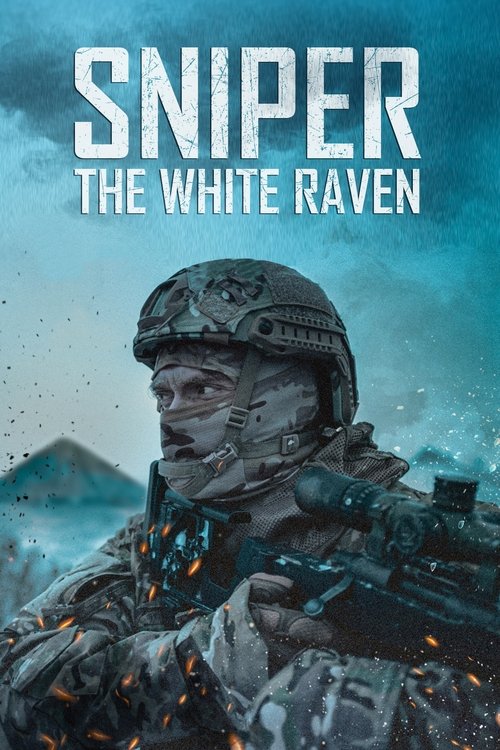
Marian Bushan's Sniper: The White Raven is a Ukrainian war drama that began shooting long before anyone outside the region was paying close attention to the Donbas. Pavlo Aldoshyn plays Mykola, a physics teacher and beekeeper whose quiet rural life with his pregnant wife Nastia (Maryna Koshkina) is torn apart when the 2014 conflict reaches their doorstep. The film follows what he becomes afterward: a sniper trained to kill with the patience he once reserved for tending hives and planting trees.
Bushan wrote the script with Mykola Voronin, and the pair keep the focus tight on Mykola's interior collapse rather than on battlefield spectacle. Andrii Mostrenko's Cap, the veteran who schools him in the craft, gives the middle stretch its spine, and the film's best scenes are physical and wordless: a man learning to wait, to breathe, to suppress every teacherly instinct he has. It was made for a reported $1 million through UM Group, shot on practical locations with a cast of Ukrainian actors.
The film opened in Ukraine in May 2022, three months into Russia's full-scale invasion, a timing that turned a small revenge drama into something closer to a dispatch from the front. Its theatrical footprint was tiny (the reported box office figure is $881), but Well Go USA picked it up for North America and released it on disc that September, and it found most of its audience on streaming. Critics were split in a consistent way: admiration for the grounded, regionally specific first half, frustration when the second settles into more familiar revenge-thriller beats.
Stream
Free with ads
Availability and pricing can change. Confirm on the provider's site before purchasing.
Mykola lives in a village in the Donbas with his wife Nastia, who is pregnant. He teaches physics at the local school, keeps bees, and plants trees on the land around their home. The film takes its time with this life. Mykola is gentle to the point of passivity, a man who quotes principles about not harming living things and means them. When talk of the gathering conflict drifts through the village, he waves it off. He has no appetite for politics or for the men on either side who are starting to carry weapons.
War arrives in 2014 anyway. Shelling reaches the area, and the film's central catastrophe is the destruction of Mykola's household. Nastia is killed. The circumstances are brutal and staged without melodrama, and the film is careful to show what the loss does to Mykola's body before it shows what it does to his mind. He stops planting. He stops tending the hives. The pacifism he was known for curdles into something colder.
Mykola enlists with the Ukrainian forces, not out of patriotic fervor but because he wants to kill the men responsible for his wife's death. The distinction matters to the film. His new unit is led in part by a hardened soldier everyone calls Cap, who becomes his mentor. Cap is not a speechmaker. He teaches by example and by drill, and the training sequences that follow are practical and repetitive: range time, camouflage, stalking, breath control, the long waits that define a sniper's day. Mykola turns out to be a natural, and the film suggests why. The patience he learned from beekeeping and from teaching children translates directly into the sniper's discipline. The same stillness that made him a good beekeeper makes him a good killer.
The unit includes a brigade commander played by Roman Semysal and fellow soldiers Ivan (Egor Kozlov) and Hyurza (Vadym Kurylko). Their scenes give the middle of the film its texture: boredom, banter, sudden violence, the ordinary friction of men living together in a war zone. Mykola is quiet among them, and the film keeps returning to his face during downtime, watching him calculate.
A rival emerges. An elite Russian sniper is operating in the sector, and the film builds toward a confrontation between the two. The middle act lays the groundwork through patrols, a few sharp firefights, and close calls that narrow Mykola's focus to a single target. Bushan stages the stalk-and-shoot material in ruined buildings and open ground, and the film's best sequences are almost silent, built on breath and angle and the sound of a round being chambered.
What the film does well is refuse to make the transformation clean. Mykola does not become a hero in the conventional sense. He becomes effective, and the effectiveness costs him something the film keeps visible in his face and in the way he moves through rooms. The revenge thread keeps the emotional stakes clear, but the real subject is the erosion of the man who planted trees. The film stops short of answering whether the killing restores anything. That question is saved for the climax.
Official Trailer [Subtitled]
Critical Consensus
Reviewers largely agreed that the film works best as a grounded character study of a pacifist broken by war, and falters when it slides into conventional revenge-thriller mechanics. Most praised Pavlo Aldoshyn's central performance and the raw regional authenticity, while some faulted the second half for losing the intimacy of its setup.
“A raw account of Ukrainian resistance in Donbas. The story of a hippy who turns warrior after his wife is killed could not be more urgent.”
Peter Bradshaw
The Guardian
“Rage and resilience. The film is at its strongest when it stays close to Mykola's interior life and the ordinary texture of the life he loses.”
Nicolas Rapold
The New York Times
“A Ukrainian character study that devolves into a generic revenge thriller, losing the specificity that made its opening so promising.”
Carlos Aguilar
The Wrap
“Riveting and relevant, a film about Ukrainian spirit in war that earns its emotional weight through detail rather than spectacle.”
James Verniere
Boston Herald
Pavlo Aldoshyn
Mykola
Maryna Koshkina
Nastia
Andrii Mostrenko
Cap
Roman Semysal
Brigade Commander
Egor Kozlov
Ivan
Vadym Kurylko
Hyurza
Director
Marian Bushan
Writers
Mykola Voronin, Marian Bushan
Composer
Nadiia Odesiuk
Join the community
fans discussing