 United Kingdom
“The series was repeatedly cited by critics as a defining youth drama of its era, praised for its unflinching portrayal of adolescence and refusal to moralize.”
Guardian TV Team
The Guardian
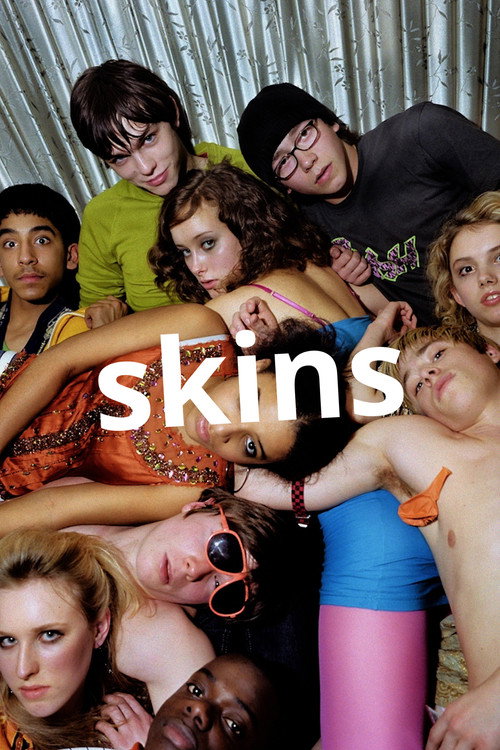
E4 launched a cultural shift in January 2007 with Skins, an irreverent drama that traded polished teen tropes for the messy reality of life in Bristol. Created by Bryan Elsley and Jamie Brittain, the series tracked a raucous group of friends through their final year at Hillingdon College before moving to university. The show featured a rotating cast of young actors who became household names overnight, including Nicholas Hoult as Tony Stonem, Kaya Scodelario as Effy Stonem, and Dev Patel as Anwar Kharral. Over seven series and 61 episodes running until August 2013, the program balanced dark comedy with intense emotional stakes, earning a solid 8.1 rating from its audience.
The series broke new ground by hiring largely untrained teenagers and structuring each two-year arc around a different generation of students. This "regeneration" model allowed the narrative to evolve naturally as the characters aged out of sixth form, replacing them with fresh faces while maintaining a consistent tone of raw authenticity. Critics noted the show's refusal to moralize, instead presenting teenage life as a chaotic mix of sex, drugs, mental illness, and family dysfunction without offering easy solutions.
Availability and pricing can change. Confirm on the provider's site before purchasing.
Skins operates on a unique premise: take a group of friends on the cusp of adulthood, assign each episode to a single character, and let the story unfold entirely through their subjective perspective. Set in and around Bristol, the central figures attend Hillingdon College, a fictional sixth-form institution, where they spend their days navigating exams and their nights in bedrooms, parks, clubs, and house parties. Each episode foregrounds one character's internal world, their home life, their secrets, their desires, or their specific brand of damage, while the rest of the group swirls around them as supporting players in someone else's story.
The first generation (Series 1–2) centers on Tony Stonem, a charismatic but manipulative golden boy who treats his friends like experiments. His circle includes his girlfriend Michelle, his awkward best friend Sid who is hopelessly in love with the troubled Cassie, the self-destructive Chris, the religiously conflicted Jal, the gay Maxxie, and the Muslim teenager Anwar. Series 1 establishes their chaotic social hierarchy, filled with parties, crushes, and family breakdowns. Series 2 darkens significantly with the arrival of the obsessive Sketch, pushing the group toward the pressures of leaving school and the consequences of Tony's behavior. The season ends as the group fractures under the weight of adulthood.
Generation 2 (Series 3–4) shifts focus to a new ensemble anchored by Effy Stonem, Tony's younger sister and a near-silent enigma from the first run. Her orbit includes Pandora, James Cook, Freddie, JJ, Naomi, and the twin sisters Emily and Katie Fitch. Series 3 explores intense, often destructive friendships and first loves, while Series 4 pushes these characters into a darker register dominated by mental illness, family crises, and exam pressure. The cast graduates again, leaving behind a legacy of unresolved trauma and fleeting connections.
Generation 3 (Series 5–6) introduces Franky Fitzgerald, an androgynous newcomer who becomes the group's emotional center. She joins metal-loving Rich, image-obsessed Mini, party-driven Liv, goofy Alo, and brothers Nick and Matty Levan. Series 5 focuses on finding a tribe and surviving social cruelty, while Series 6 adds the mysterious Alex and depicts the group's turbulent attempts to grow up without losing each other. The final run, Series 7, abandons the ensemble model entirely. It consists of six feature-length episodes grouped into three two-part stories that revisit former characters as young adults, offering a deliberate epilogue structure that checks in on where they have ended up rather than providing a traditional finale.
Skins Series 1 Preview Trailer
Skins Official Trailer
Skins Generation 2 Trailer
Critical Consensus
Skins was widely praised for its raw authenticity and willingness to let teenagers be genuinely messy. Critics admired its innovative rotating-cast structure and emotional honesty. While some criticized its depiction of drug use and sex, the series remains a landmark of British teen television known for its unflinching portrayal of adolescence.
“The series was repeatedly cited by critics as a defining youth drama of its era, praised for its unflinching portrayal of adolescence and refusal to moralize.”
Guardian TV Team
The Guardian
“Variety noted the show's restless, documentary-like energy and its success in capturing how teenagers actually talk.”
Todd McCarthy
Variety
“The Hollywood Reporter highlighted the format's bold experiment in recasting its ensemble every two years.”
Leslie Felperin
The Hollywood Reporter
“The A.V. Club praised the series' startling emotional sincerity beneath the provocation.”
Kyle Ryan
The A.V. Club
“IndieWire cited Skins as a precursor to later frank teen dramas such as Euphoria.”
Eric Kohn
IndieWire
Nicholas Hoult
Tony Stonem
Kaya Scodelario
Effy Stonem
Dev Patel
Anwar Kharral
Hannah Murray
Cassie Ainsworth
Jack O'Connell
James Cook
Dakota Blue Richards
Franky Fitzgerald
April Pearson
Michelle Richardson
Mike Bailey
Sid Jenkins
Joe Dempsie
Chris Miles
Lily Loveless
Naomi Campbell
Directors
Tom Green, Andy Hay, Jonny Campbell, Diarmuid Lawrence, Jamie Brittain
Writers
Bryan Elsley, Jamie Brittain, Jack Thorne, Sian Welch, Gwyneth Hughes
Composers
Simon Boswell, Tobias Jesso Jr.
Cinematographers
Ben Smithard, Paula Macewen
Producers
John Yorke, Charles Pattinson, Bryan Elsley, George Faber
BAFTA Television Award (2008)
Best Drama Series: Nominated
BAFTA Television Award (2010)
Best Drama Series: Nominated
Rose d'Or (2009)
Entertainment: Won
Royal Television Society Programme Award (2008)
Drama Series: Won
Join the community
fans discussing