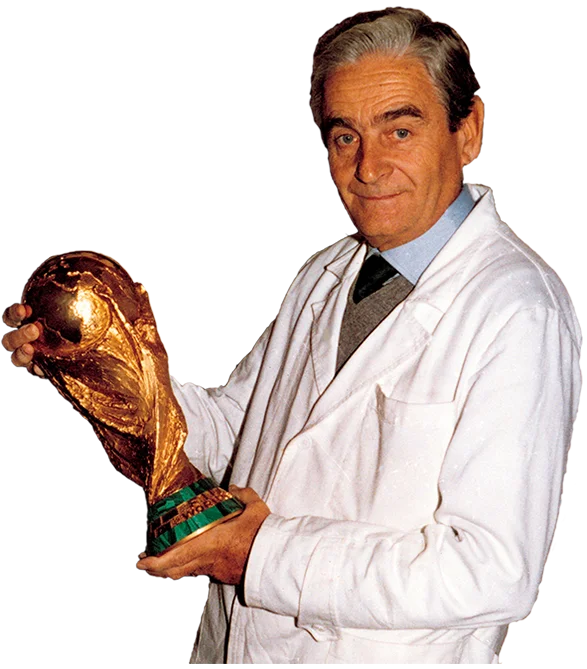
Silvio Gazzaniga
 Italy
ItalyAlso known as: Il Signore delle Coppe
Birthday
January 23, 1921
Birth Sign
Aquarius
Birthplace
Milan, Italy
Age
Died at 95
About
Silvio Gazzaniga was an Italian sculptor, most famous for creating the FIFA World Cup Trophy, the most coveted prize in sports. His iconic design, depicting two athletes holding aloft a globe, was selected from 53 entries and has since been lifted by numerous football legends. Throughout his extensive career, Gazzaniga produced hundreds of other works, including religious statues, commemorative medals, and trophies for various sports like cycling and motorsport. He was known for his distinctive style that bridged sacred and secular themes. Gazzaniga continued to work prolifically well into his nineties, leaving a significant legacy. Today, his name is synonymous with sport's ultimate symbol, and his creations are celebrated worldwide.
Early Life & Background
Silvio Gazzaniga, born on January 23, 1921, in Milan, Italy, grew up in his native city during the dynamic interwar years, a period marked by significant artistic and cultural ferment. From a young age, he gravitated towards the arts, embarking on a path that would see him become a renowned sculptor and medalist. His formal education began with enrollment at the Humanitarian School of Applied Art, followed by advanced studies at the High School of Art at Sforzesco Castle in Milan. It was within the rigorous environment of these institutions, particularly the castle's specialized workshops, that Gazzaniga dedicated himself to mastering the intricate crafts of goldsmithing and jewelry. This early training provided him with a profound and rigorous grounding in metalwork and sculpture, laying the essential technical and artistic foundations for his distinguished career.
Still a young man when World War II erupted, Gazzaniga began to apply his burgeoning talents, crafting medals, cups, and various ceremonial objects for private clients and institutions. These early commissions were crucial, instilling in him a deep appreciation for precision and the powerful symbolism inherent in sculpted forms, qualities that would later become hallmarks of his most celebrated works. Following the war, in 1953, Gazzaniga made a significant career move, joining Bertoni Milano. This storied atelier was highly regarded for its production of prestigious trophies and liturgical objects. Within this esteemed workshop, he quickly rose through the ranks to become artistic director, a role he would hold for decades . In this capacity, he oversaw the creation of hundreds of pieces, continuously honing his distinctive artistic style, which deftly blended classical forms with a vibrant modernist energy .
Career Growth
The turning point came in 1971. FIFA needed a new trophy after Brazil permanently kept the Jules Rimet Trophy, and a global competition drew 53 designs. Gazzaniga's entry, two figures supporting the Earth, won unanimously. The trophy debuted at the 1974 World Cup in West Germany and instantly became an icon. He continued at Bertoni, producing trophies for the Coppa Italia, the Giro d'Italia, and the Italian Grand Prix. In 2003, Milan awarded him the Ambrogino d'Oro, the city's highest honor. Even in his final years, Gazzaniga remained active, sketching and advising. The FIFA Museum reconstructed his studio in 2025, displaying his original plaster cast and tools, ensuring new generations understand the hands behind the hardware.
Career Timeline
Public Image & Style
Gazzaniga is remembered as a quiet craftsman who let his work speak. The FIFA Museum calls him "the artist behind the icon," and his Instagram account, run by his family, presents him as a gentle, focused master. He never sought celebrity, yet his name appears in every conversation about the World Cup. Fans and journalists refer to him as "the architect of football's greatest dream." His legacy lives through the trophy's global recognition, a symbol of victory that transcends sport.
Fame & Fandom
Silvio Gazzaniga occupies a unique space in the pantheon of cultural figures, distinguished not by a cult of personality but by the sheer ubiquity of his creation. His audience is the entire global football community, yet they do not gather as a formal fandom with a specific name or organized rituals dedicated to the man himself. Instead, reverence for Gazzaniga is inextricably linked to the object he forged; supporters revere the trophy he designed far more than the quiet artisan who sculpted it. Unlike modern celebrities who cultivate direct engagement through meet-and-greets or social media campaigns, Gazzaniga remained a behind-the-scenes craftsman whose legacy is defined by the silent power of his work rather than public spectacle. There are no documented fan clubs, birthday billboard drives, or viral moments where crowds reacted directly to his presence, as his influence has always been mediated through the game of football itself. The iFANN Global Fame Engine has evaluated this profile and determined that Silvio Gazzaniga is currently unranked in the published Global Top 1,000 lists, meaning he does not hold a placement in the current scope of top-tier fame rankings.
Interesting Facts and Legends
Gazzaniga's iconic design was originally sketched on a napkin before being refined into the masterpiece we know today. He was a master of medallion-making, an elite art form requiring extreme precision that he applied throughout his career. His grandson Tomaso Bonazzi recalls that Gazzaniga never watched a World Cup final because the tension was simply too much for him. Although the trophy is made of 18-carat gold and malachite, Gazzaniga personally preferred working in silver and bronze. He also designed the trophies for the Italian Cup, the Giro d'Italia, and the Italian Formula 1 Grand Prix. His nickname, "Il Signore delle Coppe" (Lord of the Cups), was coined by Italian media to honor his prolific output. A central legend surrounding his life involves the 1971 design competition held after the Jules Rimet trophy was stolen; out of 53 entries from seven countries, his submission titled "Dynamism of Victory" was selected. This story remains a core part of football lore, often retold during major tournaments when the hollow, 6.1-kilogram sculpture is lifted by champions. While the trophy stands at 36.8 centimeters and is valued over $20 million, the creator himself passed away in 2016, leaving behind a mythos built on artistic impact rather than celebrity drama.
Notable Quotes
“It was a job that truly filled his heart., Gabriella Gazzaniga”
“Light, joy and passion, that is what the FIFA World Cup Trophy represents., Tomaso Bonazzi”
Family & Personal Life
Gazzaniga's daughter, Gabriella, has been the primary keeper of his legacy, frequently speaking at FIFA Museum events. His grandson, Tomaso Bonazzi, also shares stories of the family workshop. Gazzaniga lived modestly in Milan, surrounded by his tools and sketches. He rarely discussed his fame at home, preferring to talk about technique and materials. The family continues to manage his estate and the official Instagram account, posting archival photos and updates on exhibitions.
Notable Connections
Relationships & Dating History
Public records do not detail Gazzaniga's romantic relationships. He was married, but his wife's name and the dates of their marriage are not widely documented. He had one daughter, Gabriella. As of his death in 2016, he was widowed.
- MarriedWife's name not publicly documented; they had one daughter.
Death & Aftermath
Died
October 31, 2016 (aged 95)
Death Place
Milan, Italy
Cause of Death
Natural causes
Silvio Gazzaniga, the Italian sculptor renowned for designing the FIFA World Cup Trophy, died on October 31, 2016, at the age of 95. He passed away at his home in Milan, Italy. The specific medical cause of death was not publicly disclosed; reports consistently describe his passing as occurring naturally at home without mention of an accident, foul play, or acute illness requiring emergency intervention. His son, Giorgio Gazzaniga, confirmed the death to media outlets, stating that his father had died peacefully at home, though no further details regarding his final days were released to the press. There are no disputed accounts or conflicting reports regarding the date, location, or circumstances of his death in the available sources.
Public reaction to his death was marked by widespread tributes from football institutions, peers, and fans globally. Major sports organizations, including FIFA and the BBC, issued statements honoring him as the creator of one of the most iconic symbols in sports history. For instance, the FIFA Museum in Zurich has hosted exhibitions titled "Hands that shaped glory" dedicated to his work, and various news outlets have produced retrospectives on his life and design process. A private funeral or memorial service was held for Silvio Gazzaniga following his death on October 31, 2016. Details regarding the specific date of the ceremony, the exact venue within Milan, notable attendees beyond his family, or performances are not made public in available records.
Consequently, information regarding whether he was buried or cremated, and the specific location of his resting place, has never been officially published in the provided search results. Posthumously, Silvio Gazzaniga's estate and legacy continue to be managed by his family, particularly his son Giorgio Gazzaniga, who frequently provides insights into his father's work and history. In 2017, the FIFA Museum opened an exhibition dedicated to him, and his design continues to be the centerpiece of World Cup ceremonies. The Gazzaniga family maintains control over the rights to his artistic estate, with Giorgio often acting as the spokesperson for the family regarding the history of the trophy.
Net Worth (Estate Value)
$5 Million
iFANN Editorial Team estimate
Silvio Gazzaniga earned his living through his long tenure at Bertoni Milano, serving as both artistic director and master sculptor. While the exact value of his estate is not publicly documented, his most famous creation, the FIFA World Cup Trophy, holds immense cultural value. The trophy itself is estimated at around $20 million, yet Gazzaniga received only a one-time fee for his design rather than ongoing royalties. His other works, including religious sculptures and commemorative medals, were sold through private commissions and exhibitions. Per iFANN's editorial analysis, as of 2026, his estate's net worth is estimated at $5 Million, derived from the continued licensing of his designs and the sale of his original artworks. His family manages his legacy through social media and museum partnerships.
Awards Won (1)
Gazzaniga received the Ambrogino d'Oro, the highest honor from the Milan City Council, in 2003. This award recognized his lifetime of artistic achievement and his role as one of the city's most prolific contemporary artists.
2003 · Certificate of Merit
Lifetime artistic achievement
Known For
FIFA World Cup Trophy
1971 · Designer
Coppa Italia Trophy
2011 · Designer
Giro d'Italia Trophy
2011 · Designer
Italian Formula 1 Grand Prix Trophy
2011 · Designer
Keywords
Sources
Quick Facts
- Profession
- sculptor
- Born
- +1921-01-23
- Birthplace
- Milan
- Died
- +2016-10-31
- Death Place
- Milan
- Gender
- Male
- Birth Sign
- Aquarius
Personal Details
- Full Name
- Silvio Gazzaniga
- Children
- 1
- Education
- Humanitarian School of Applied Art; High School of Art at Sforzesco Castle, Milan
Frequently Asked Questions
Who designed the FIFA World Cup trophy?
How old was Silvio Gazzaniga when he died?
What is Silvio Gazzaniga's net worth in 2026?
Did Silvio Gazzaniga have children?
Is the FIFA World Cup trophy still the original design?
Social Media
Join the community
fans discussing