 Italy
ItalyAbout
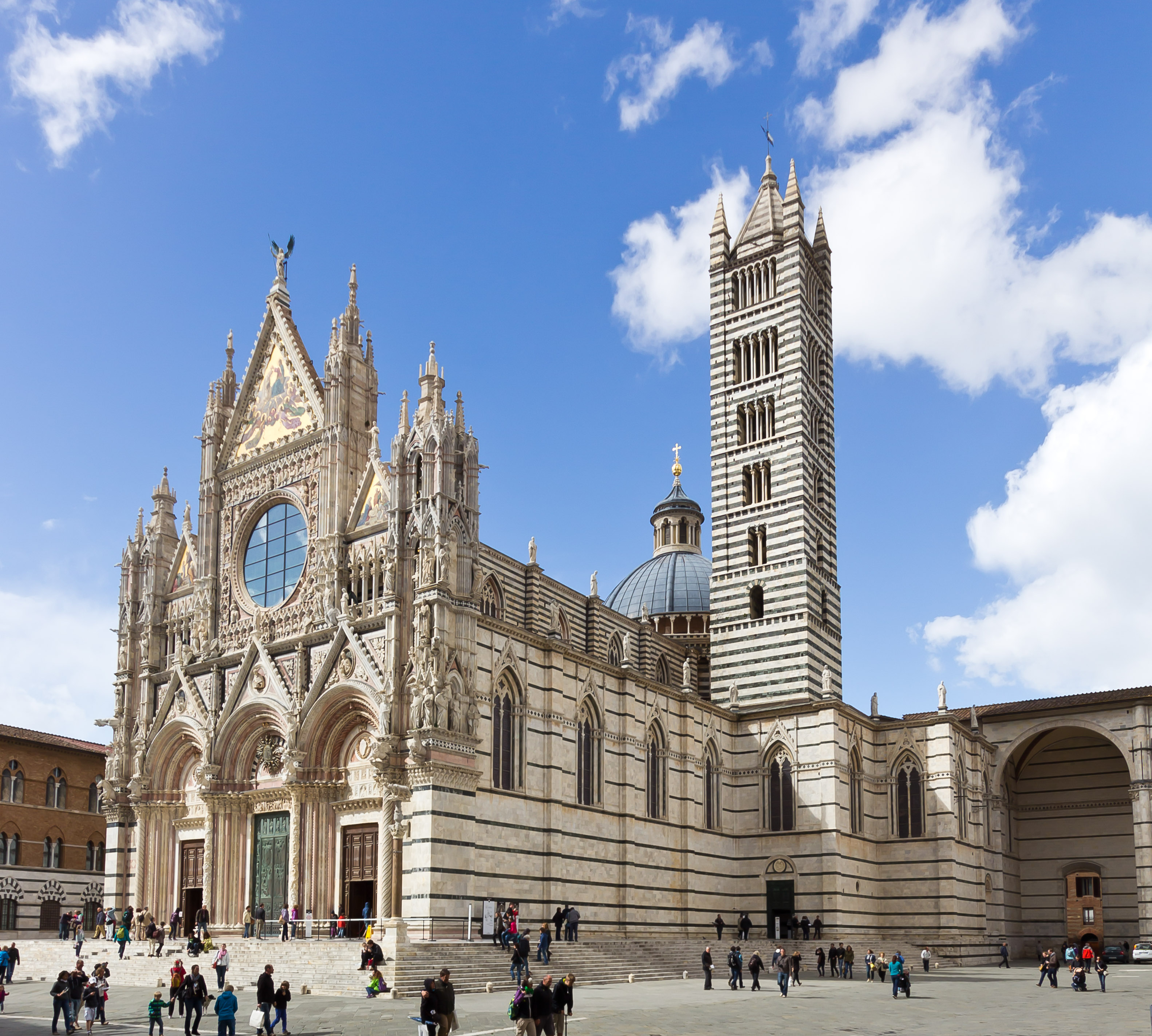
Siena Cathedral, known in Italian as the Duomo di Siena, is a medieval masterpiece that has anchored the identity of its Tuscan city for over eight centuries. Consecrated to the Assumption of Mary, this Roman Catholic church stands as a testament to Sienese pride, civic ambition, and artistic achievement. Construction began in the early 13th century, and the cathedral complex grew continuously until the Black Death of 1348 brought expansion to a halt. The result is a stunning blend of Romanesque and Gothic styles, with a striking black and white striped marble facade that dominates the city's skyline.
While the cathedral is primarily a place of worship, it is also a treasure trove of art and history. Its interior houses works by Donatello, Pinturicchio, and Michelangelo, among others, and its marble mosaic floor is considered one of the finest in Italy. The cathedral is a major tourist attraction, drawing visitors who marvel at its grandeur and the stories etched into its stone. Though no official budget figures exist for a building that took centuries to complete, its value is immeasurable in both cultural and historical terms. This is not just a church; it is a symbol of Siena itself, reflecting the city's wealth, faith, and enduring spirit.
Mission
The cathedral serves a dual mission: it is primarily a place of Catholic worship, dedicated from its earliest days as a Marian church, and it functions as a major cultural and artistic treasure house. The Opera Duomo's mission encompasses preserving the cathedral's artistic heritage, including its world-famous marble mosaic floor, sculptures by Donatello, Pinturicchio, Michelangelo, and other masters, and making these accessible to the public. The cathedral also hosts temporary exhibitions and cultural events, such as the 2026 photography exhibition "SIBYLS" by American artist Bill Armstrong in the Crypt.
History
The origins of Siena Cathedral reach back to the 12th century, with a consecration recorded in 1179, though the traditional founding date is set at 1196. The building rose over several decades, with the dome completed in 1263, reaching 48 meters. The cathedral was a civic project as much as a religious one, reflecting the wealth and ambition of medieval Siena.
The most dramatic chapter came in the early 14th century, when the city planned a massive expansion that would have transformed the cathedral into the largest church in Christendom. The project, known as the Duomo Nuovo, involved extending the nave and creating a new baptistery. But the Black Death of 1348 decimated Siena's population and halted construction permanently. The unfinished walls still stand today, visible from the city, a haunting reminder of what might have been.
Over the centuries, the cathedral accumulated its artistic treasures. The marble mosaic floor, begun in the 14th century, was worked on sporadically for over 600 years, with contributions from artists like Pinturicchio and Domenico Beccafumi. The Piccolomini Library was added in the early 1500s to honor Pope Pius II. The cathedral survived earthquakes, wars, and the passage of time, remaining the spiritual heart of Siena.
Subdivisions
Piccolomini Library
A library housing illuminated manuscripts and frescoes by Pinturicchio.
Siena Cathedral Pulpit
An octagonal pulpit carved by Nicola Pisano and his workshop, a masterpiece of medieval sculpture.
Campanile
The bell tower of the cathedral, offering views of the city.
Crypt
An underground space housing the cathedral's treasury and hosting temporary exhibitions.
Museo dell'Opera del Duomo
The museum complex housing original artworks and the panoramic Facciatone viewpoint.
Notable People
Nicola Pisano
Sculptor · 1265-1268
Carved the cathedral's pulpit, a landmark of medieval Italian sculpture.
Pinturicchio
Painter · 1502-1507
Frescoed the Piccolomini Library with scenes from the life of Pope Pius II.
Donatello
Sculptor · 1450s
Created the bronze statue of John the Baptist, now in the cathedral museum.
Michelangelo
Sculptor · 1501-1504
Sculpted the Piccolomini Altar figures, including a young Saint Peter.
Milestones
1179
Cathedral consecrated according to Visit Tuscany.
1196
Traditional founding date of the cathedral.
1263
Dome completed, standing 48 meters high.
1348
Black Death halts the major expansion project.
1502-1507
Pinturicchio frescoes the Piccolomini Library.
2026
Hosts the SIBYLS photography exhibition in the Crypt.
Sources
Organization Info
- Founded
- 1196
- Headquarters
- Piazza del Duomo, Siena, Tuscany, Italy
- Country
- Italy
- Parent
- Opera della Metropolitana di Siena
- Type
- Religious
- Dedication
- Assumption of Mary
- Architectural Style
- Romanesque-Gothic
- Dome Height
- 48 meters
Official Website
www.operaduomo.siena.it
Join the community
fans discussing