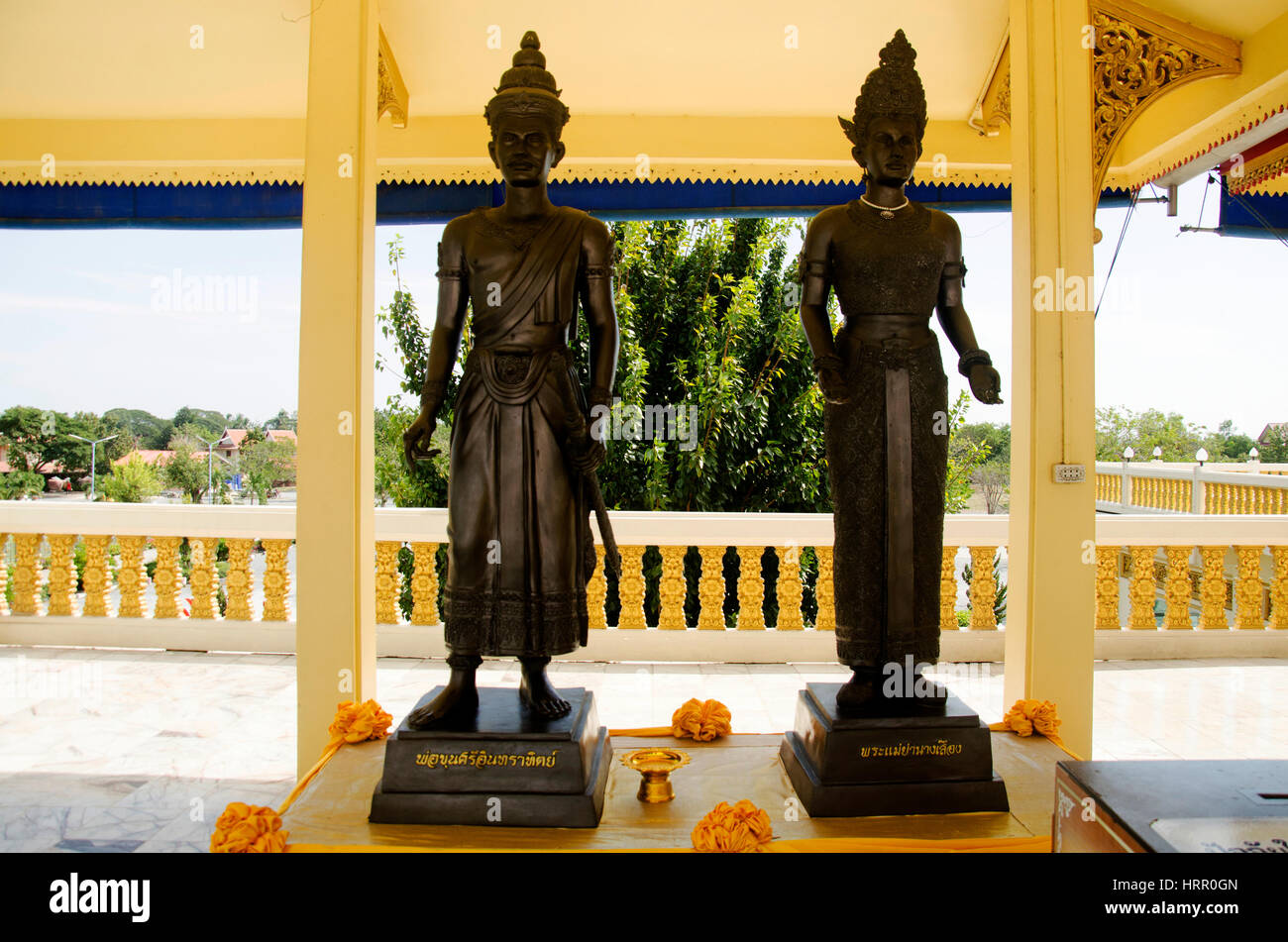
Si Inthrathit
 Thailand
monarch•politician•military officer
Also known as: Sri Indraditya, Pho Khun Bang Klang Hao, Phra Ruang
Birthday
1188
Birth Sign
Capricorn
Birthplace
Mueang Rat (present-day Nakhon Thai, Phitsanulok Province)
Age
Died at 82
About
Si Inthrathit, also known as Pho Khun Bang Klang Hao, was the founding monarch of the Sukhothai Kingdom, the first independent Thai polity. Born around 1188 in Mueang Rat, he rose from local chieftain to lead a successful revolt against the Khmer Empire in 1238, establishing the Phra Ruang dynasty, the first historical Siamese royal house. His reign from 1238 to 1270 consolidated Thai territories and promoted Buddhism, setting the stage for Sukhothai's golden age under his successors.
Today, Si Inthrathit is revered in Thailand as the founding father of the Thai nation. The Sukhothai Historical Park, the capital he founded, is a UNESCO World Heritage Site and a major cultural landmark. His legacy endures in the very name of the dynasty and the cultural identity of Thailand.
Early Life & Background
Si Inthrathit was born Bang Klang Hao around 1188 in Mueang Rat, a town in what is now central Thailand. His father was Chantha Racha and his mother Nang Nak, though some sources name her Sirisudhārājadevī. Little is recorded of his childhood, but folklore describes him as handsome and strong, with a legendary tale of a fairy who fell in love with a mortal and bore a son destined to become king.
Before his rise, he served as ruler of the town of Ban Kho. The region was under the influence of the Khmer Empire, and Sukhothai itself was governed by Pho Khun Si Nao Nam Thom. After Si Nao's death, a Khmer warrior named Sabat Khlon Lamphong seized the town. Bang Klang Hao, allied with Si Nao's son, recaptured Sukhothai and then led a broader revolt that liberated Thai principalities from Khmer control around 1238.
Career Growth
In 1238, Si Inthrathit founded the Sukhothai Kingdom and established the Phra Ruang dynasty. His reign focused on consolidating territory and defending against Khmer incursions. He promoted Buddhism, personally following Mahayana Buddhism, though his successors later adopted Theravada Buddhism as the state religion. He initiated the construction of major temples, laying the foundation for Sukhothai's cultural flourishing.
Si Inthrathit died in 1270, succeeded by his son Ban Mueang and later by his younger son Ramkhamhaeng, who expanded the kingdom and created the Thai alphabet. The kingdom he founded became a major center of Buddhism by the late 1300s. His descendant Lu Thai wrote the Traibhumikatha in 1345, and the kingdom was absorbed by Ayutthaya in 1438. In 1991, the Sukhothai Historical Park was declared a UNESCO World Heritage Site.
Career Timeline
Public Image & Style
Si Inthrathit is revered in Thailand as the founding father of the Thai nation, celebrated for liberating Thai principalities from Khmer domination and establishing a stable kingdom. His image is that of a unifier and a promoter of Buddhism. The Sukhothai period is still regarded as the birthplace of Thai culture, language, and art.
There is no modern fandom, but Thai historians and cultural enthusiasts actively engage with his legacy through the Sukhothai Historical Park and related institutions. A statue of him stands in Sawankhalok District, Sukhothai Province.
Fame & Fandom (iFAMOUS Rankings)
Si Inthrathit commands a presence defined by historical gravitas rather than the frenetic energy of modern celebrity culture. As the founding monarch of the Sukhothai Kingdom, his legacy is sustained not by fan clubs or social media campaigns, but by the enduring reverence of historians, cultural scholars, and tourists who visit the Sukhothai Historical Park. There is no formal name for any collective following; the concept of an organized fandom with rituals, hashtags, or subscription drives does not apply to a figure from the thirteenth century. His admirers are best described as students of history and devotees of Thai heritage who engage with his story through academic study and pilgrimage rather than the participatory fandoms seen in contemporary entertainment. The digital footprint he leaves is one of general public interest and academic inquiry, reflecting his status as a foundational national icon rather than a pop culture phenomenon. Regarding his standing in global fame metrics, iFANN has evaluated his profile against its comprehensive database of historical and contemporary figures. Si Inthrathit is currently unranked in the published Global Top 1,000 rankings or any specific scope list managed by iFANN. This absence of a placement reflects the specialized nature of his fame, which remains deeply rooted in regional history and cultural identity rather than broad-spectrum global celebrity.
Interesting Facts and Legends
Throughout his life and reign, Si Inthrathit was known by numerous names including Bang Klang Hao, Si Intratit, Arun Raj, Sairakaraj, Phra Ruang, and Roja Raj, while his full regnal title was Kamrateng An Sri Inthrabodinthrathit. The city he established, Sukhothai, translates to Dawn of Happiness in the Thai language. Folklore surrounding his origins describes a supernatural conception where a fairy fell in love with a mortal man in a forest, a tale that persists in local storytelling traditions. He founded the Phra Ruang dynasty, recognized as the first historical Siamese royal house, which laid the groundwork for subsequent Thai kingdoms. His son, Ramkhamhaeng, later expanded upon these foundations by creating the Thai alphabet, further cementing the cultural identity of the region. Historical records attribute the development of the distinct Sukhothai Art style to his reign, marking a departure from previous artistic conventions under Khmer rule. The declaration of the Sukhothai Historical Park as a World Heritage Site stands as a modern reflection of the architectural and cultural achievements realized during his era. A widely retold story of his reign involves the decisive break from Khmer Empire control, an act of independence that transformed him from a local chieftain into the first king of a sovereign Siamese state. Another persistent legend details his adoption of the name Si Inthrathit upon ascension, signifying his divine right to rule and the dawn of a new era for the people.
Family & Personal Life
Si Inthrathit was married to Sueang, who bore him at least five children. His eldest son, Ban Mueang, succeeded him as king, while his younger son Ramkhamhaeng became the most famous Sukhothai king. Details about his other three children are scarce in historical records. His father was Chantha Racha and his mother Nang Nak, also known as Sirisudhārājadevī.
His family lineage traces back to King Phatumsuriyawong, possibly identified with Khmer monarch Suryavarman II, though this connection is debated.
Notable Connections
Si Inthrathit was associated with his father Chantha Racha, mother Nang Nak, wife Sueang, and sons Ban Mueang and Ramkhamhaeng. He allied with Pho Khun Si Nao Nam Thom's son to recapture Sukhothai. His descendants, including Lu Thai, continued his legacy. The Khmer warrior Sabat Khlon Lamphong was his predecessor in ruling Sukhothai.
Relationships & Dating History
Si Inthrathit was married to Sueang, who is recognized as his queen consort. The exact date of their marriage is unknown, but it likely occurred before his rise to power. Together they had at least five children, including his successors Ban Mueang and Ramkhamhaeng. Historical records provide no details about any other romantic relationships. He remained married to Sueang until his death in 1270.
- MarriedSueang? - 1270His wife and queen consort, mother of his children.
Death & Aftermath
Died
1270 (aged 82)
Death Place
Sukhothai
Cause of Death
Natural causes
Si Inthrathit spent his final years consolidating the foundations of the Sukhothai Kingdom he established in 1238, ruling from the capital city until his passing around 1270. Historical records do not specify a precise day or month for this event, nor do they detail his immediate final days or any last public appearances before his death. The cessation of his reign is attributed to natural causes given his estimated age, though no medical examination or official ruling exists to confirm this diagnosis. Funeral rites followed the Buddhist customs standard for Thai royalty of that era, involving cremation, yet specific details regarding the location, timing, or attendees of these ceremonies remain undocumented in surviving texts.
Following his death, the throne passed directly to his eldest son Ban Mueang, who succeeded him as king without interruption. The kingdom continued to flourish under the Phra Ruang dynasty, eventually expanding significantly under the rule of Si Inthrathit's younger son Ramkhamhaeng. Centuries later, the monarch received posthumous recognition through the erection of bronze statues in Nakhon Thai and the designation of the Sukhothai Historical Park as a UNESCO World Heritage Site in 1991, cementing his status as the founding father of the Thai nation.
Net Worth (Estate Value)
As a 13th-century monarch, Si Inthrathit's personal wealth cannot be quantified in modern terms. The concept of net worth does not apply to medieval kings in the same way as contemporary figures. His historical estate, the Sukhothai Kingdom, was a significant economic power in its era, but its wealth has long since passed into history.
Today, the ruins of his capital generate substantial tourism revenue for Thailand as a UNESCO World Heritage Site, but this income accrues to the modern Thai state, not to any estate associated with Si Inthrathit.
Awards & Accolades
View 5 records, honours and achievementsKnown For
Founding the Sukhothai Kingdom
1238 · Founder and first king
Establishing the Phra Ruang dynasty
1238 · Founder
Keywords
Sources
Quick Facts
- Profession
- monarch, politician, military officer
- Born
- c. 1188
- Birthplace
- Mueang Rat
- Died
- 1270
- Death Place
- Sukhothai Kingdom
- Gender
- Male
- Spouse
- Sueang
Personal Details
- Full Name
- Bang Klang Hao
- Spouse
- Sueang
- Children
- Ban Mueang, Ramkhamhaeng, and three others
Frequently Asked Questions
Who was Si Inthrathit?
When was Si Inthrathit born and when did he die?
Who succeeded Si Inthrathit as king?
What is the significance of the Sukhothai Kingdom?
How is Si Inthrathit remembered in Thailand today?
Join the community
fans discussing